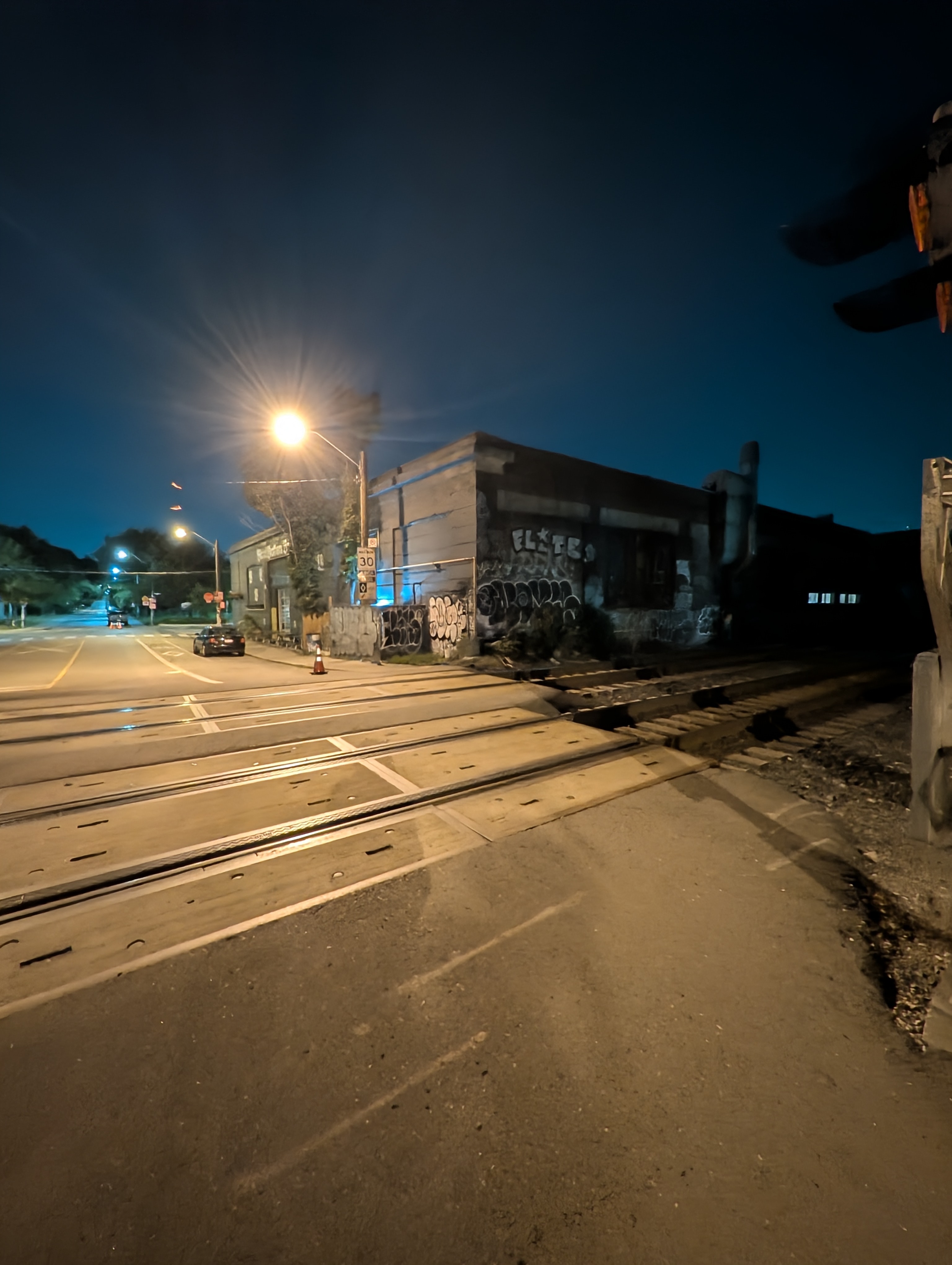
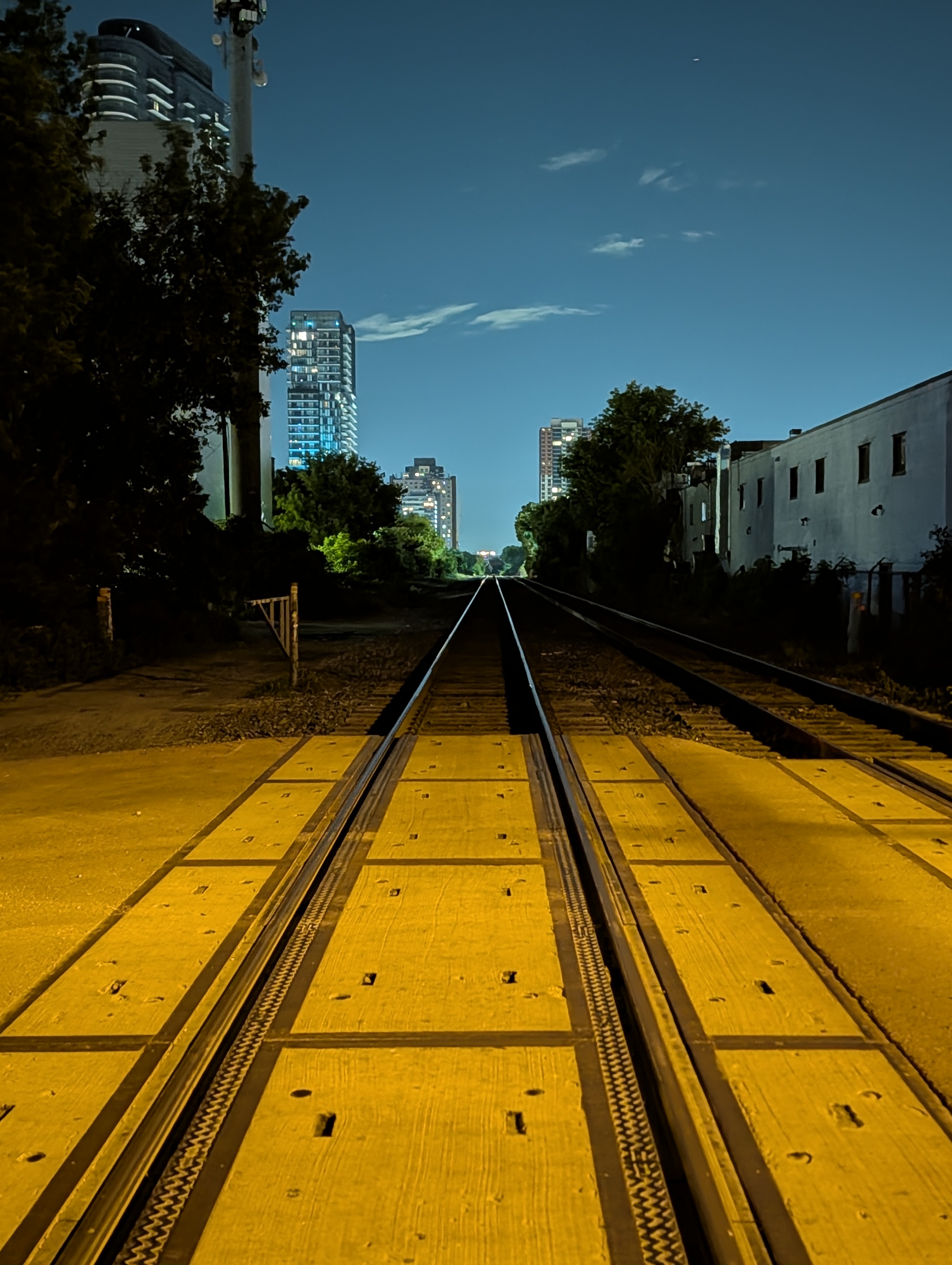
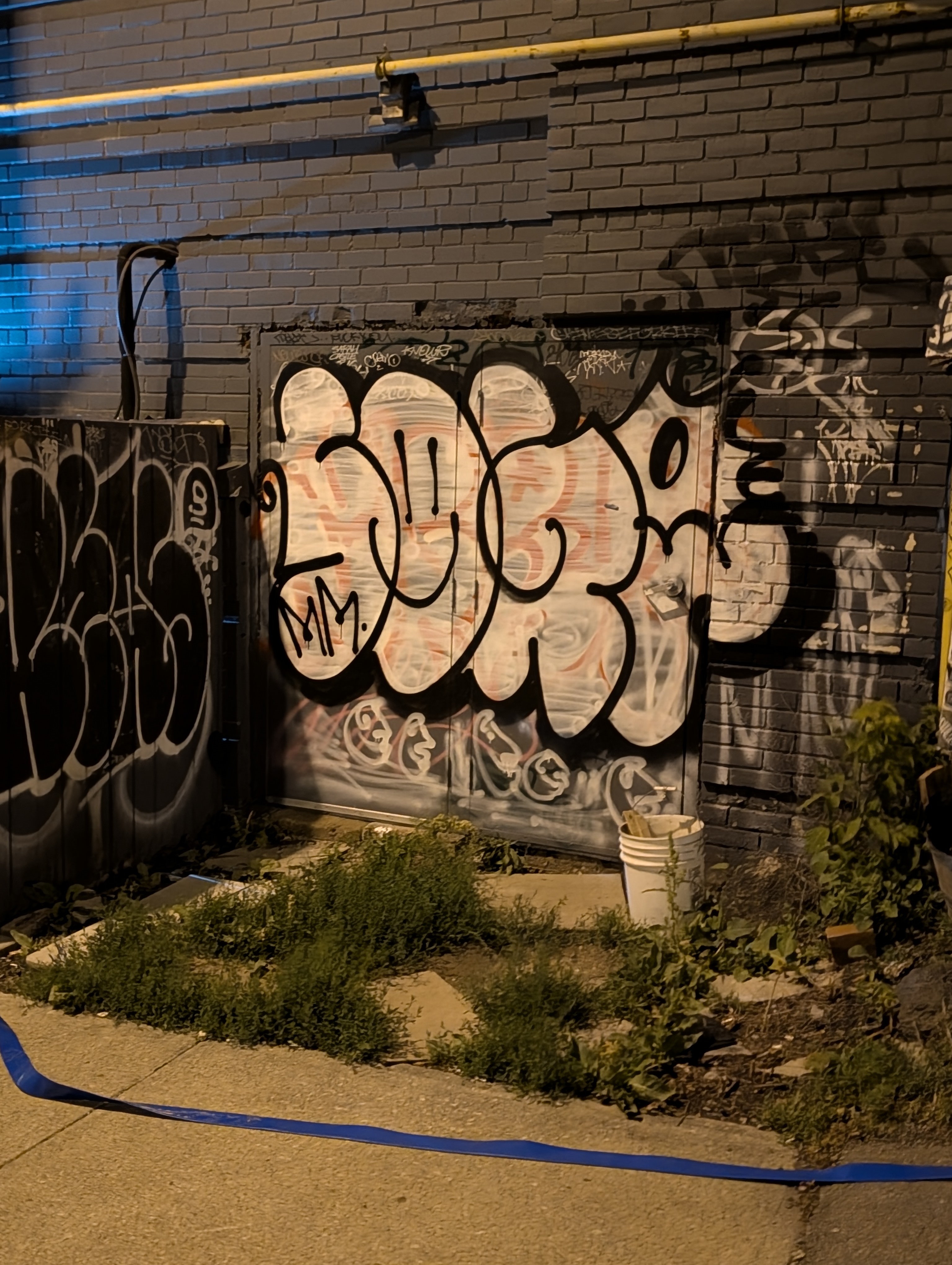
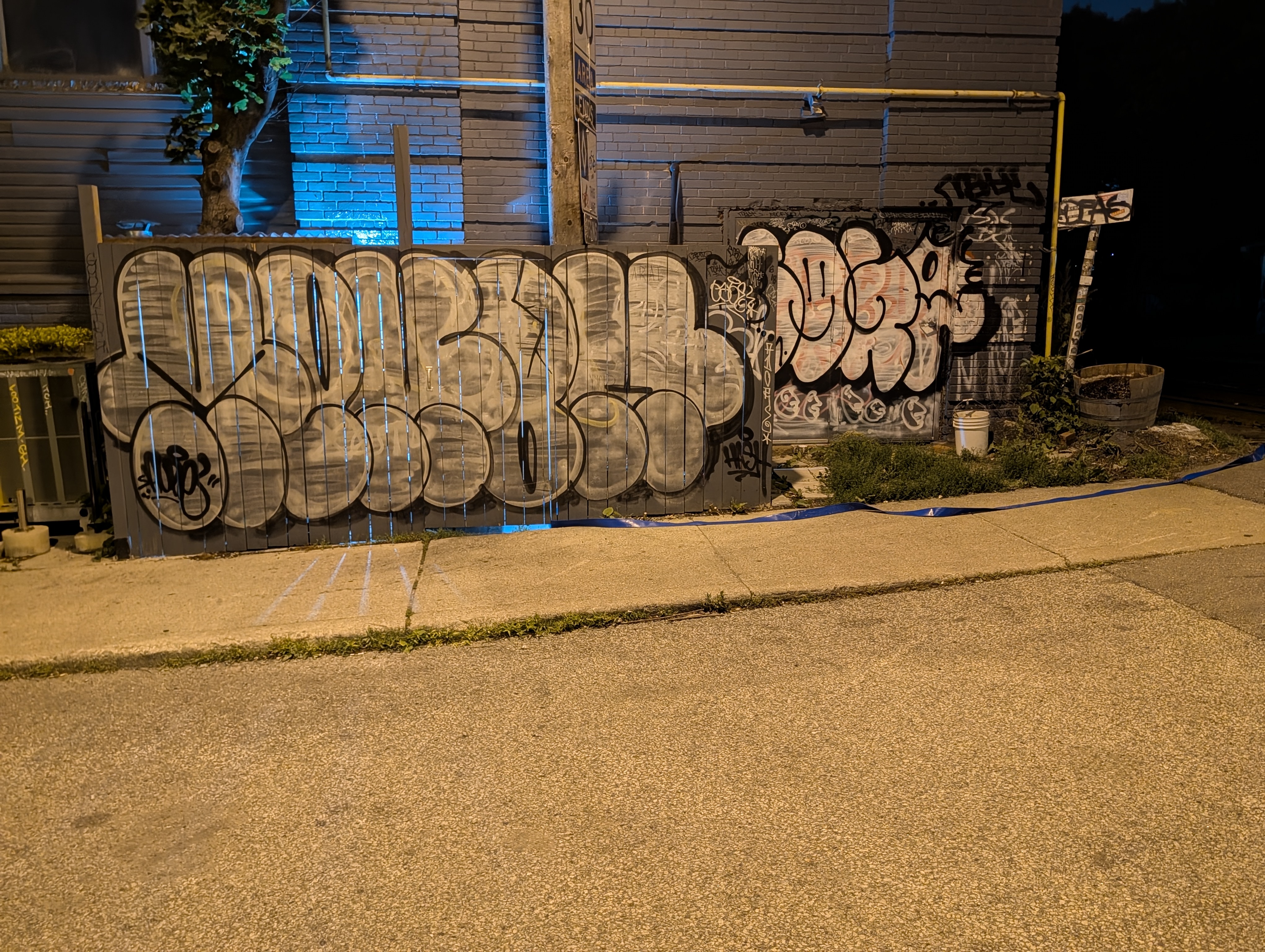
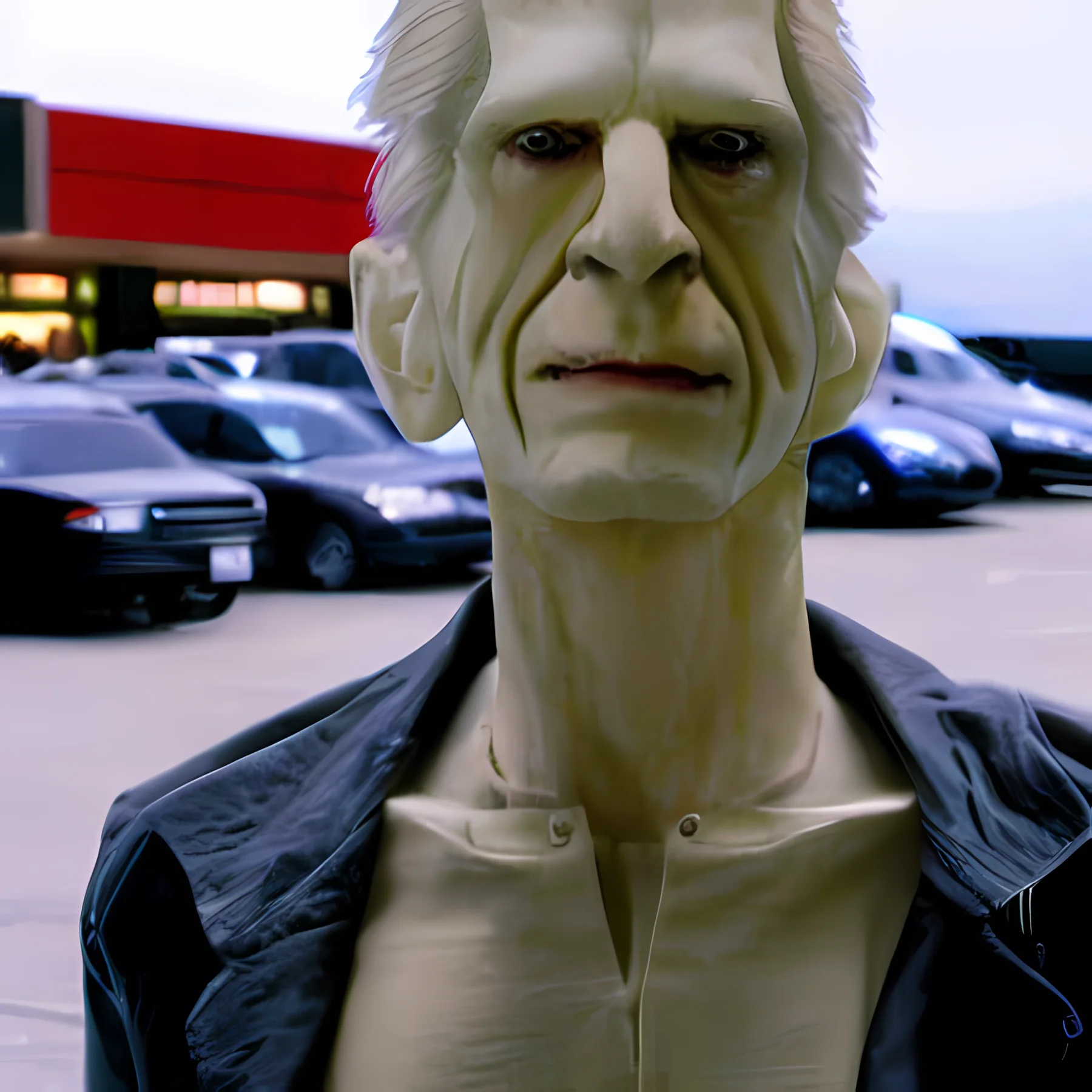
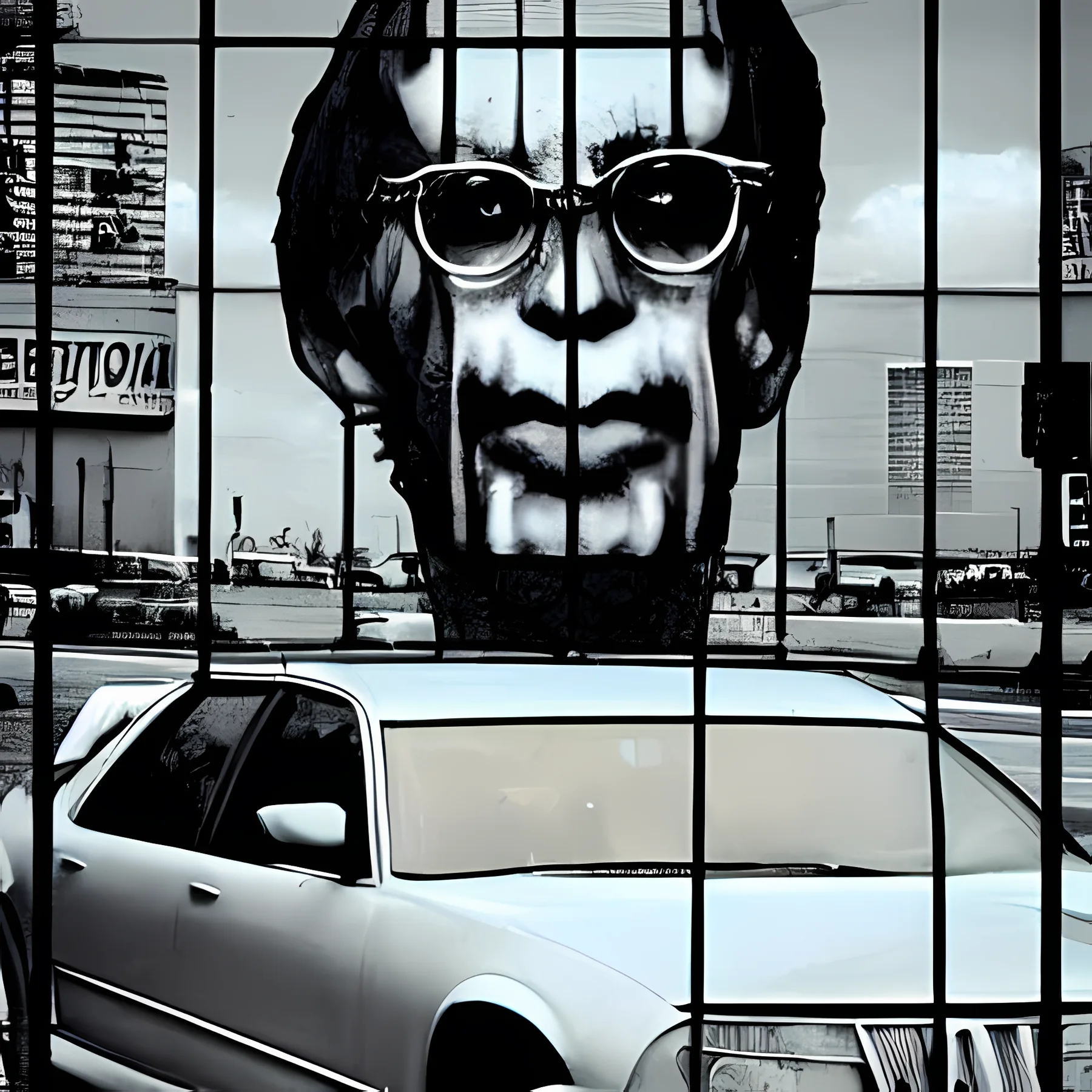
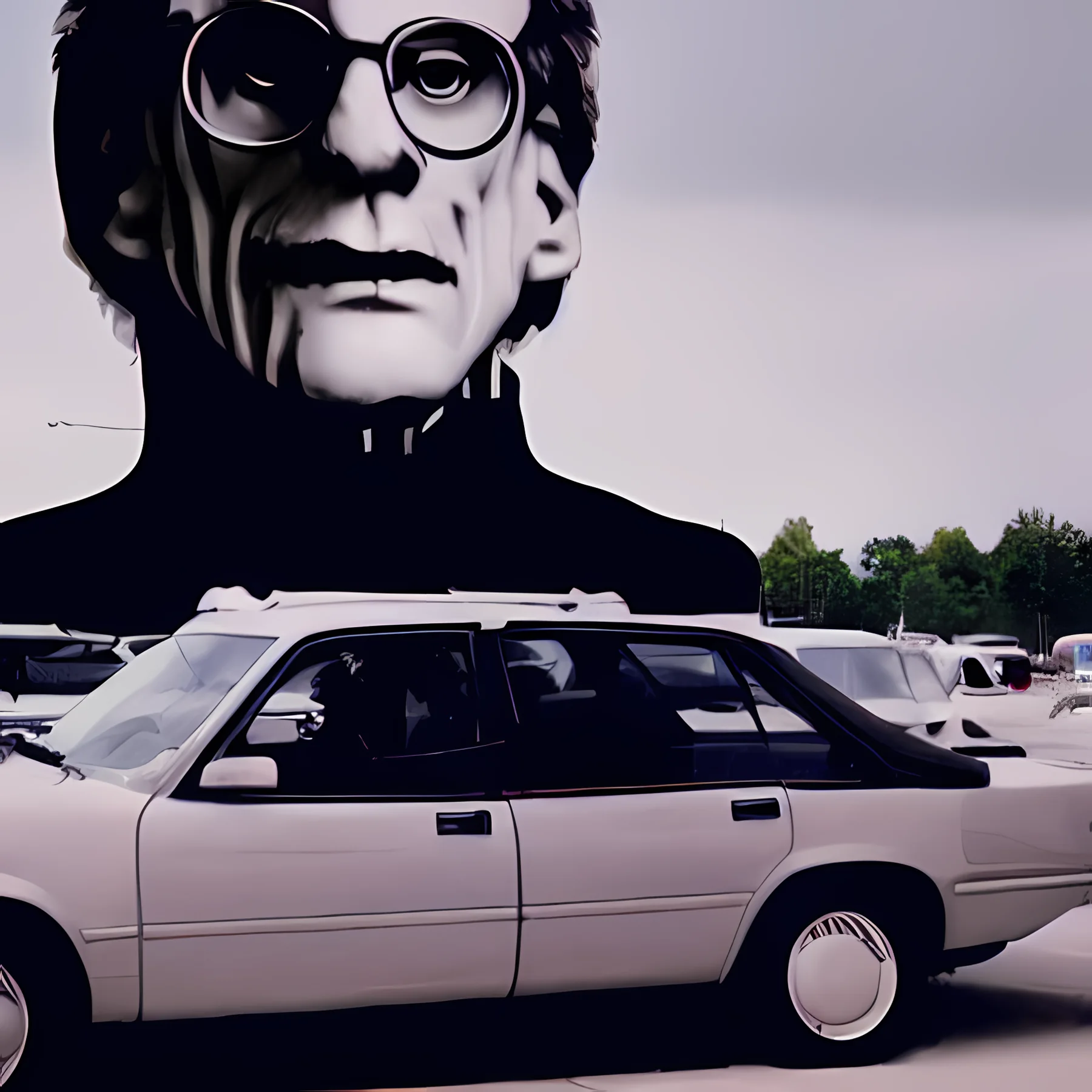
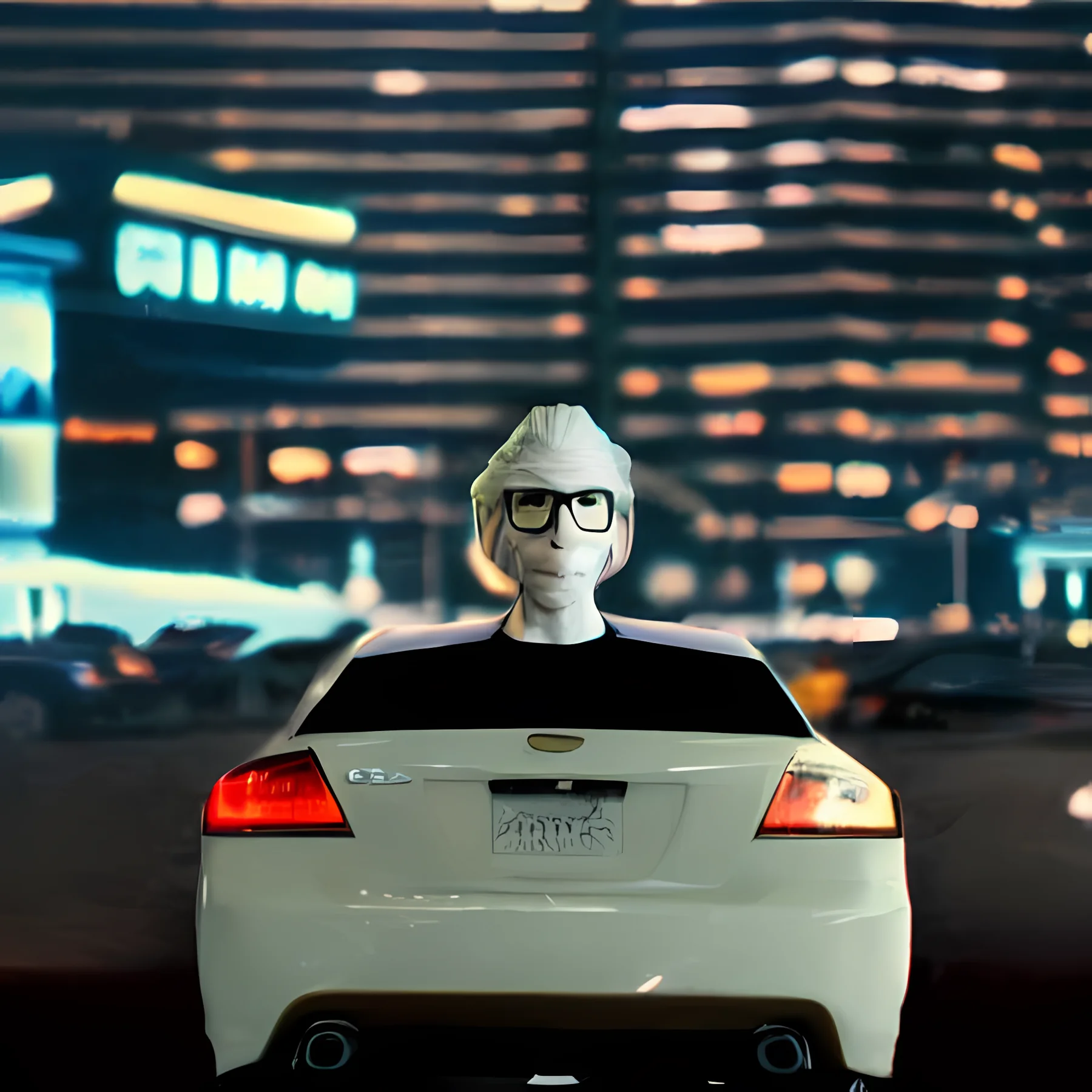
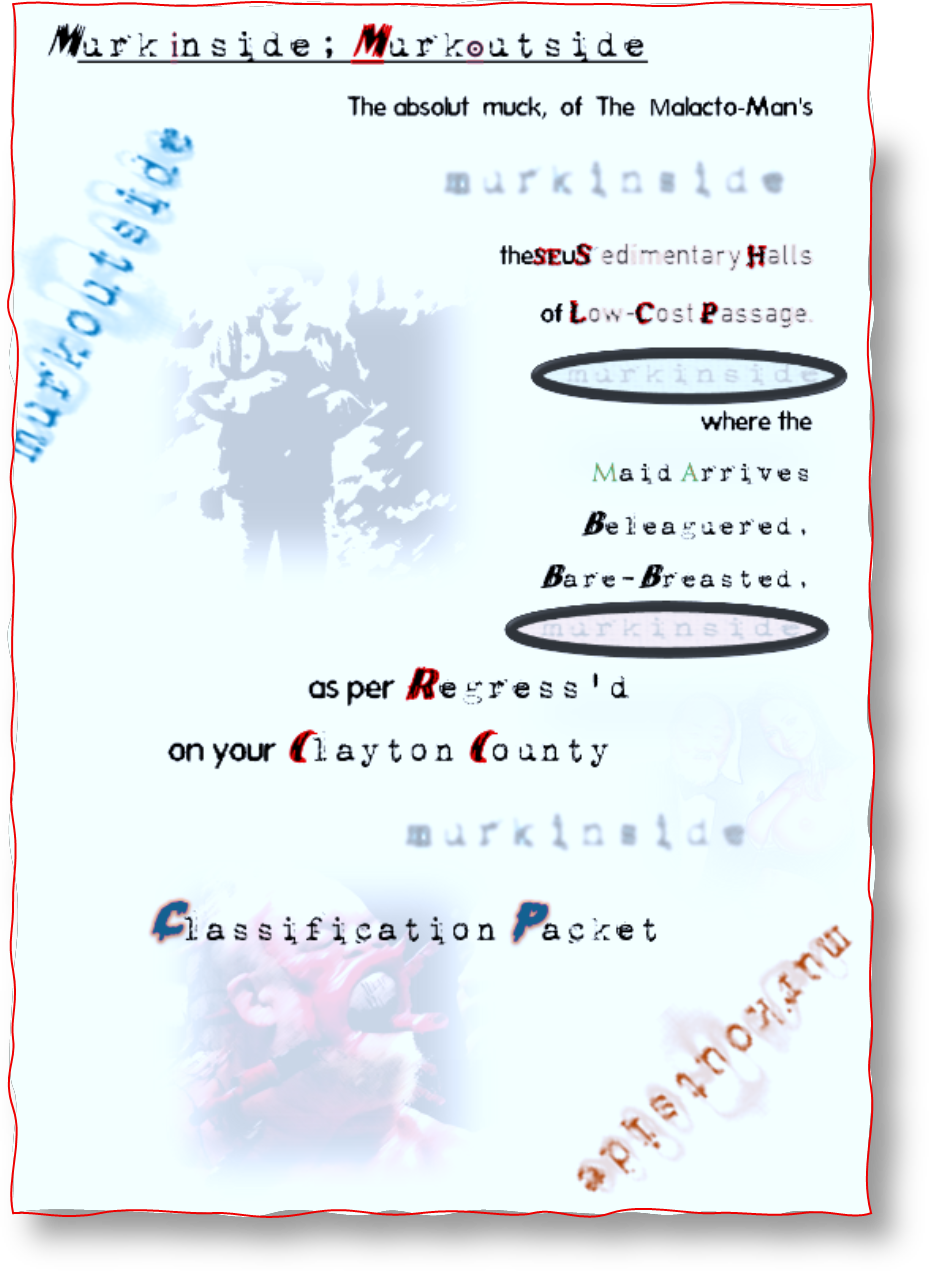
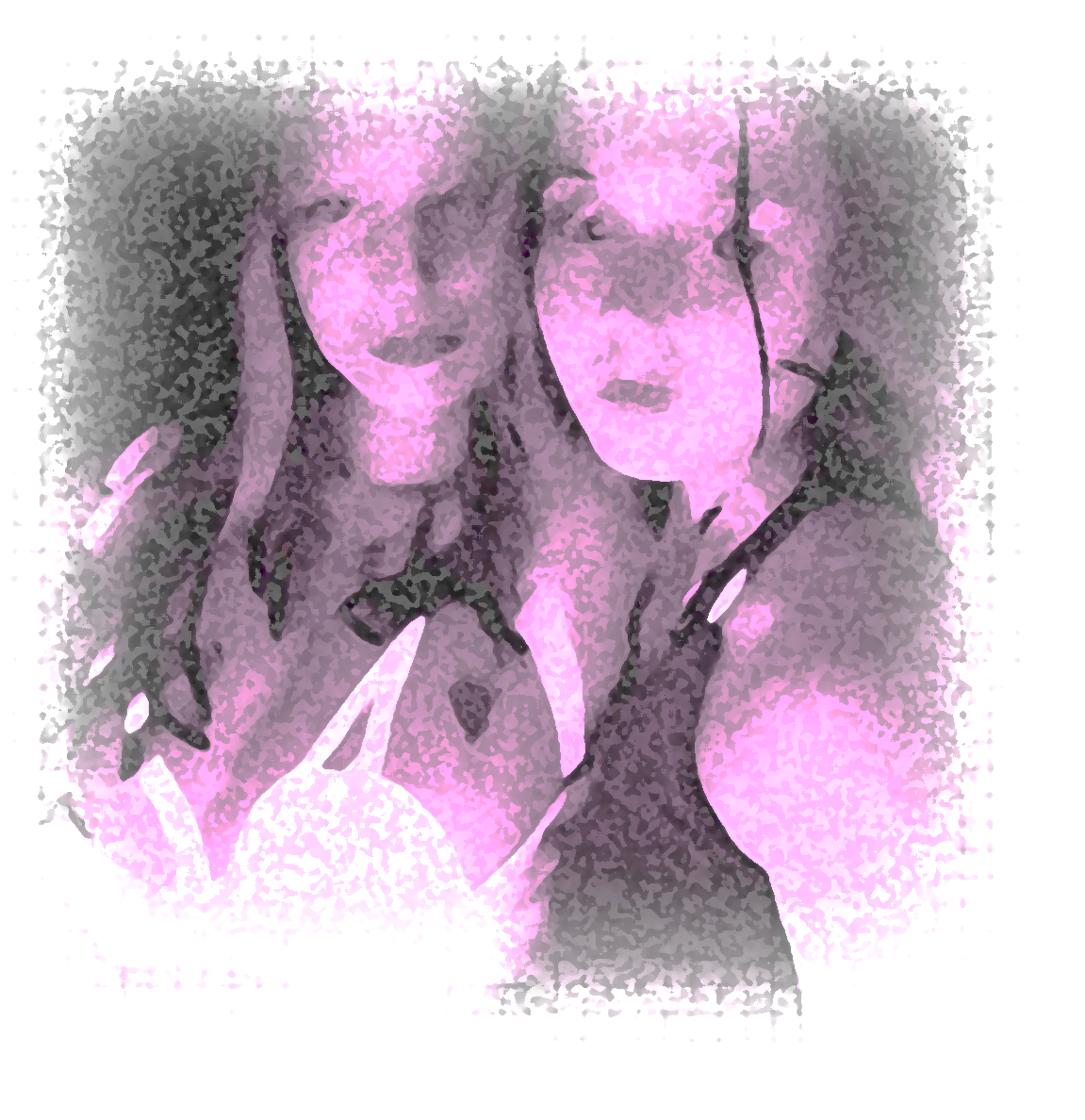
A rabbit hole about what happens when the escape route becomes the trap, the showroom becomes the chapel, and the subject discovers it has been serving as storage for the machine’s predicates.
Mississauga, Ontario · recurring host years · file remains open
Read this first · an orientation for newcomers
Who Mac is, and why everything keeps returning to 401 / Dixie
This archive begins with a man who cannot leave anything alone: not an injury, not an institutional slight, not a failed friendship, not a broken audio connection, not a strange afternoon, and not the possibility that his wasted time might contain a hidden design. The man is MacLeod Estaire. The name the archive eventually gives his condition—and then his office—is the Wastrell.
A first-time reader does not need to know the mythology in advance. The site is not a puzzle whose reward is reserved for readers already fluent in SES, DoTaRK, Virillion Cyberjansenism, Devoid Cronenberg, the time-traveller forum myth, host-contemporaneity, or the private liturgy of a parking lot. Those terms were produced because ordinary biography stopped feeling adequate to the material. They are attempts to describe what happens when failure, memory, technology, rumour, addiction, friendship, place, and interpretation become so entangled that none can be discussed cleanly without the others.
The simplest way to understand the archive is this: Mac has lived through a long personal decline and cannot accept that decline as a sequence of merely private defeats. He keeps enlarging each wound until it becomes a theory of institutions, time, media, or reality itself. Sometimes this is evasion. Sometimes it is insight. Often it is both at once. Around him, Osrin records; Dr. Steev Mike annotates; images recur; old documents seem to anticipate later ones; and one commercial landscape at Highway 401 and Dixie Road becomes the coordinate to which the whole unstable system returns.
MacLeod Estaire before he becomes an office
Mac—MacLeod Estaire in the formal files—is presented as a lapsed journalist, essayist, obsessive collector, injured man, stimulant user, unreliable tenant, damaged friend, compulsive theorist, and intermittent comic performer of his own downfall. He owns rare tapes when he cannot reliably pay a modest share of rent. He can turn speaker wire into a metaphysical problem and an ordinary correction into evidence of persecution. He possesses real intelligence, an appetite for systems, and a dangerous capacity to make every available fact serve the emotional structure already governing him.
That does not make him a misunderstood genius whose abuses should be excused, and it does not make every complaint delusional. The source documents are strongest when they refuse both comforts. Mac can be observant and destructive, injured and injuring, ridiculous and frightening, empirically right about one small thing while catastrophically wrong about the relation among several things. The signal may be gone. The bathroom may really be unavailable. The interface may really be unsafe. The institution may actually have treated him badly. None of those facts proves the total explanatory structure he builds around them.
His defining habit is escalation by interpretation. A failed transaction becomes an office. A hostile glance becomes a distributed field. A technical malfunction becomes a model of moral correction. A regretted afternoon becomes temporal warfare. He repeatedly narrates himself from a false anthropological distance, describing a doomed demographic, a broken institution, or a malfunctioning circuit until Osrin points out that Mac is looking at his own reflection in a shop window and pretending it is another species.
The Wastrell in one sentence
A squanderer who becomes custodian of the very thing he squanders: money, chances, affection, housing, safety, attention, testimony, and above all time.
The additional letter matters. A wastrel wastes. The Wastrell is also what time has wasted. The title therefore runs in two directions: Mac is an agent of waste, and he is the remainder produced by years of waste acting upon a person. The “office” begins when those directions become inseparable. He is least able to use an ordinary day, yet becomes uniquely equipped to explain how an ordinary day can be made unavailable to everyone else.
This is why humour cannot be removed from the character. Mac may be the first great Time Monkeyer and still be a dopey dupe. His grandeur remains under comic audit. Palmerston becomes important not because a municipal demon possesses him there, but because his recklessness discovers office hours. He makes strangers stop, explain, argue, wait, defend the obvious, and remain present after the original reason for an encounter has expired. Other people’s duration becomes the raw material of his self-expression. The later Time Wastrell is already visible in miniature: enormous animation without arrival.
Osrin, Steev Mike, and the problem of who is writing whom
Mac does not arrive alone. Osrin Eustice Dingley is roommate, witness, antagonist, caretaker, clerk, and the nearest thing the archive has to an intimate biographer. Their relationship is materially and intellectually uneven. It operates through mockery, surveillance, dependence, complaint, and an unstated form of love. Osrin calls out Mac’s self-mythology, records his habits, and keeps him legible; Mac supplies the catastrophe that gives Osrin something to record. Theirs is an insult-driven form of care.
The documents place them together in a tiny Pittman Hall room in 2014 even though the ages, matriculation dates, and surrounding chronology do not agree. That contradiction is not repaired. The room is called a sharded residence: part dormitory, part trap, part observation post, part impossible baseline. “2014” is less a reliable date than the year in which the pair seem permanently stalled. They repeat semesters, arguments, music, chemicals, explanations, and attempted exits. Their room becomes the smallest prototype of Shared Experiential Space: two people living so densely inside one another’s account that authorship, memory, and anticipation stop remaining private.
Dr. Steev Mike enters as a later archivist and commentator who finds the documents, doubts them, mocks them, and discovers himself already named inside them. He is not a neutral scholar standing safely outside the wreckage. His method is a “grammar of grief”: he studies the archive while resenting that recognition may arrive only after it is too late. He treats Mac as subject, warning, possible invention, and contagious explanatory style. If Mac is the failed custodian of his days, Steev Mike is the custodian of the failure.
Why 401 / Dixie is more than a backdrop
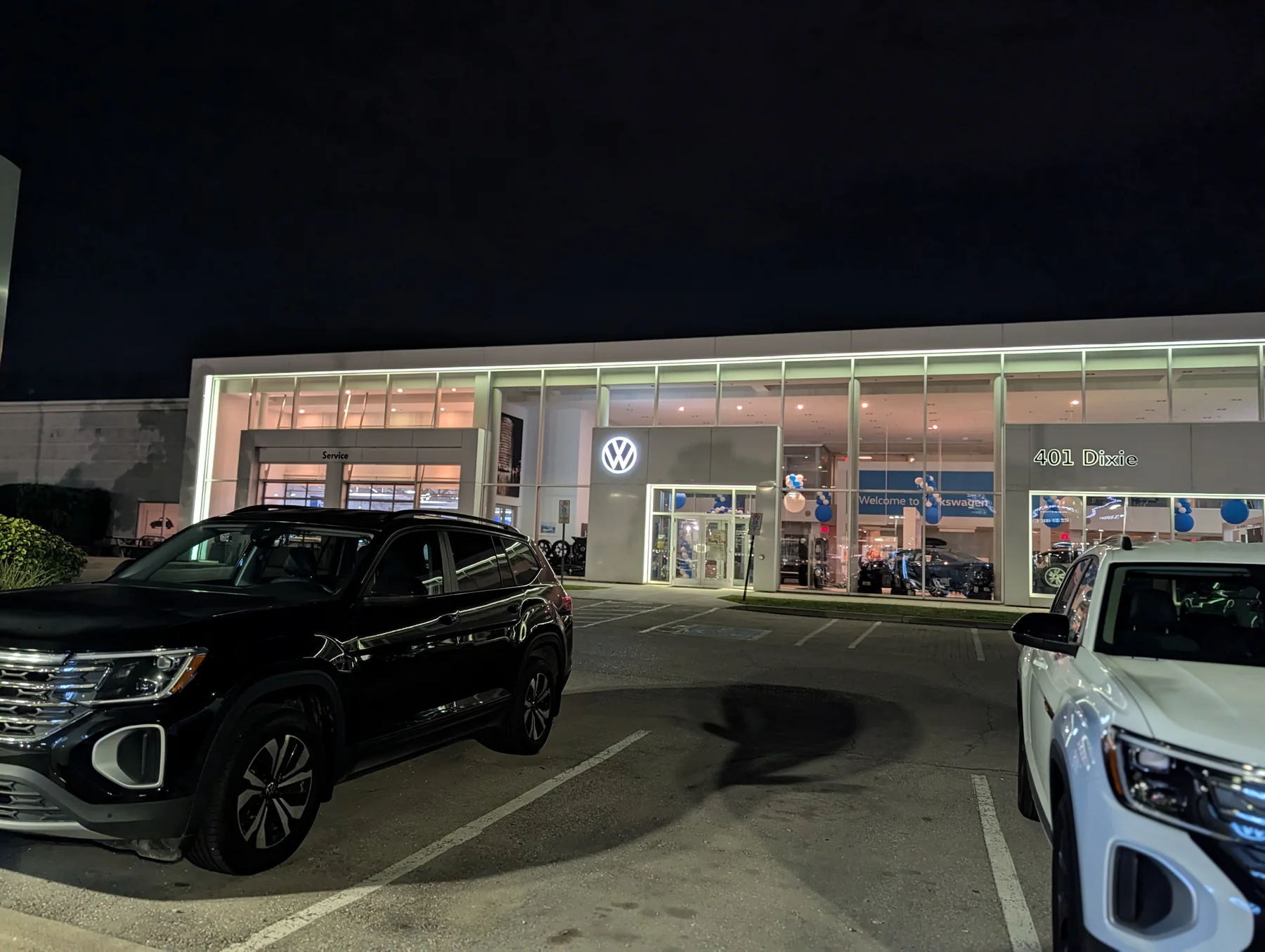
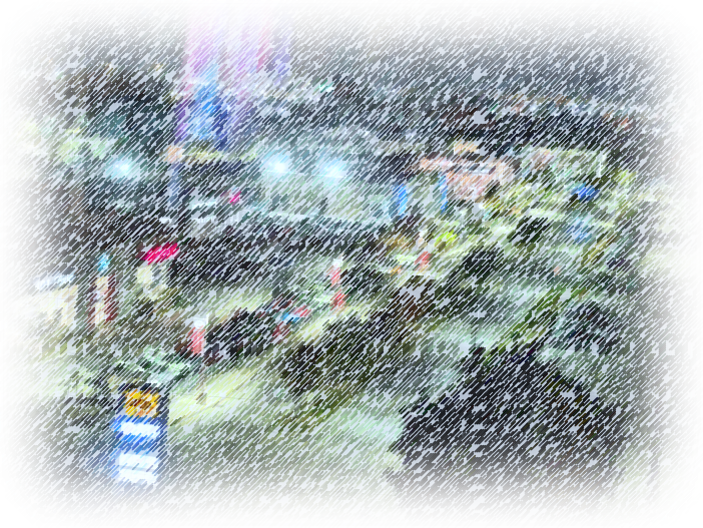
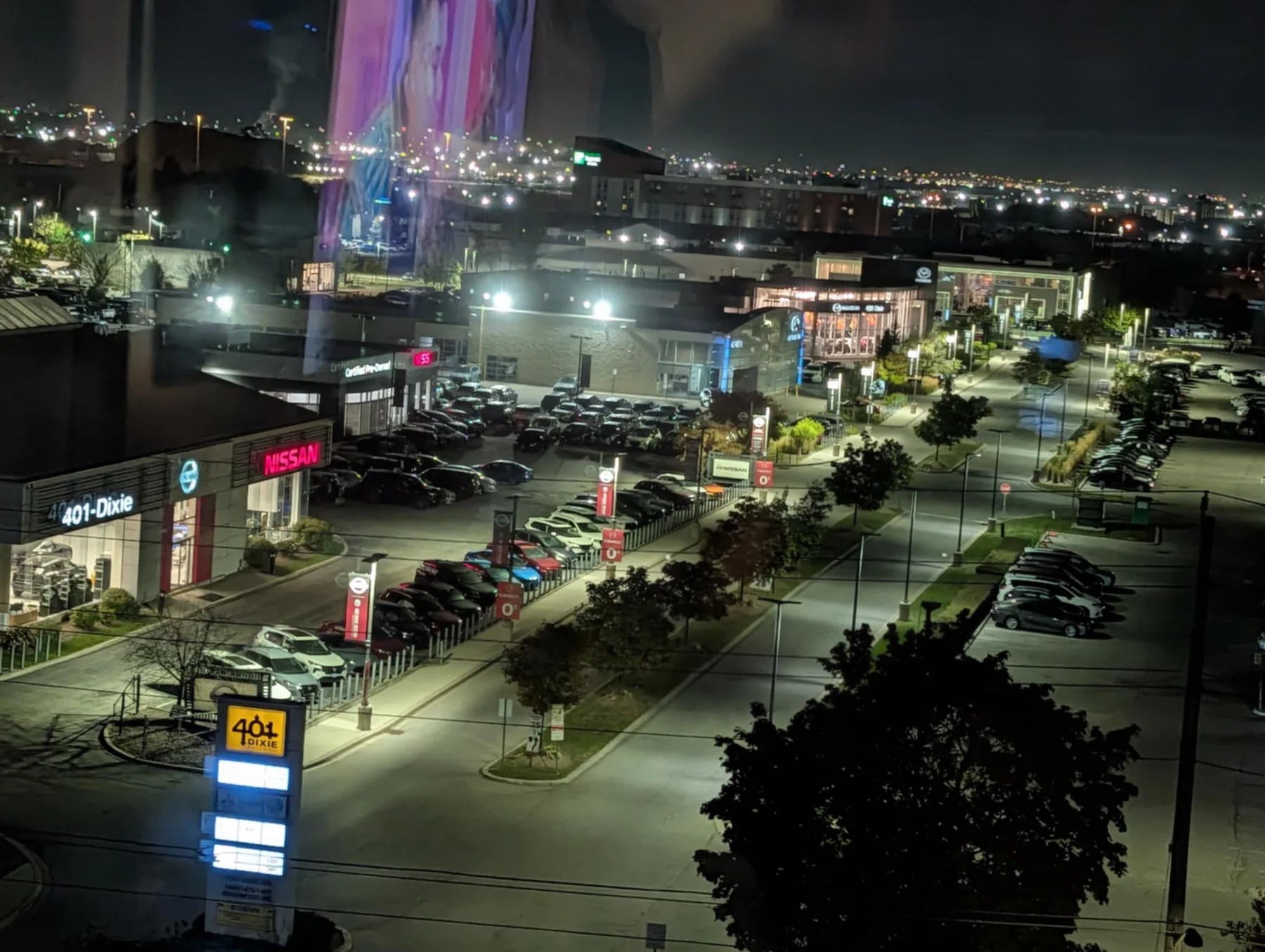
401 / Dixie is first a real geography: the interchange of Highway 401 and Dixie Road in Mississauga, its automobile dealerships, service bays, pylons, financing banners, parking lots, showrooms, synthetic night lighting, and routes built for continuous circulation. The site’s photographs keep returning to this environment because it provides a visible form for the archive’s central argument. Freeway, suburb, showroom, debt, maintenance, and private mobility gather into a system that promises escape while continually renewing the need to escape.
This is the Progress Accident in physical form. The freeway’s success produces congestion and distance. The automobile’s promise of autonomy produces dependency on the automobile. The showroom sells the refreshed self while making the existing self feel obsolete. Safety, speed, prestige, ruggedness, utility, and optimization begin as descriptions of vehicles and return as demands placed upon people. The driver imagines he is collecting attributes; eventually the attributes seem to be using the driver as their storage medium.
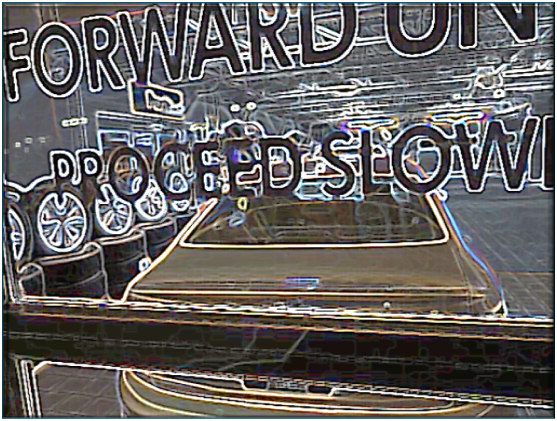
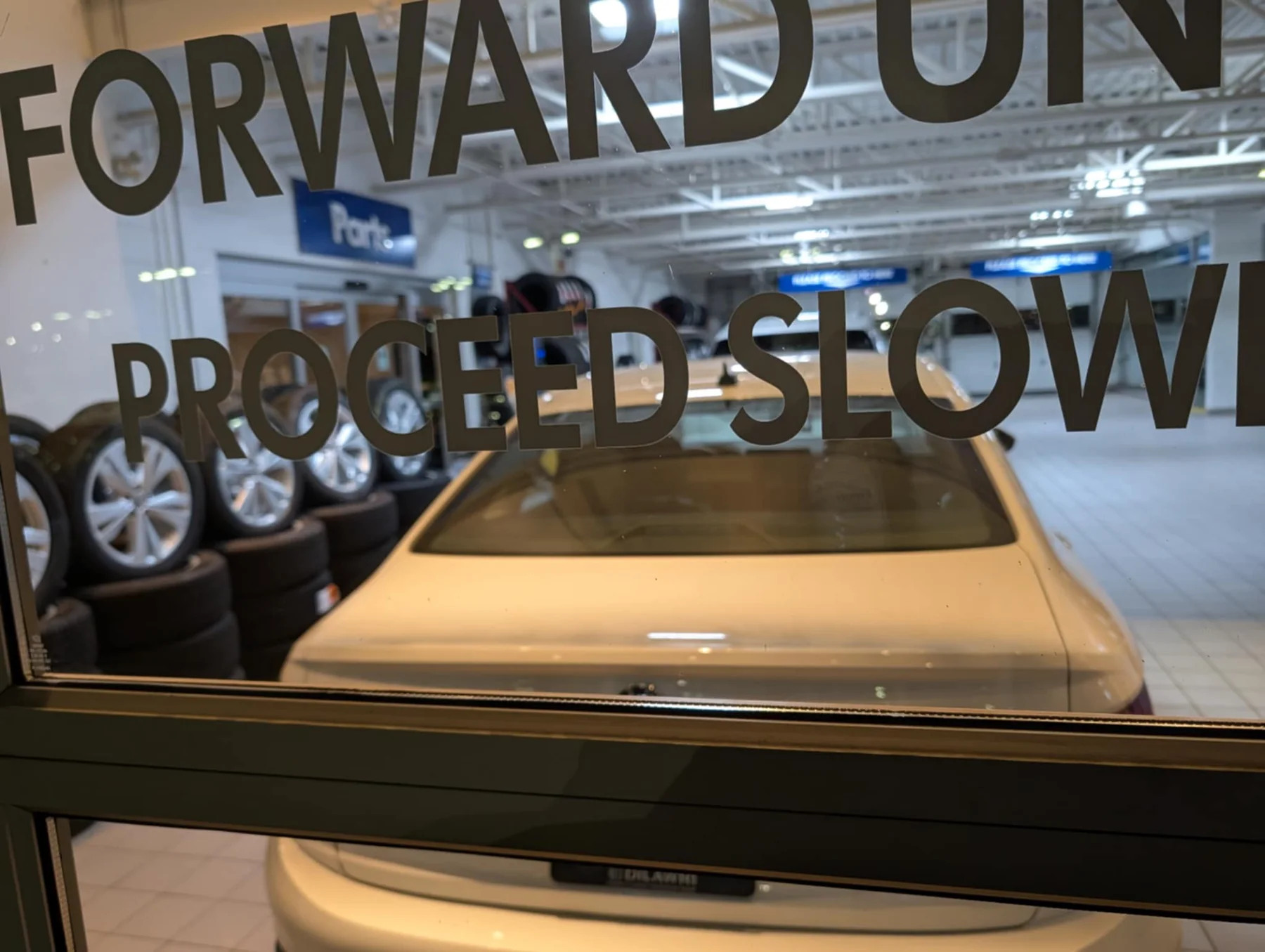
The Automall is therefore not important because it hides a secret control room. It is important because it does not need one. Its ordinary architecture already coordinates desire, debt, movement, signage, surveillance, maintenance, and repetition. It is a chapel whose theology appears as financing terms and directional arrows. “Forward” and “proceed slowly” can occupy the same visual field without cancelling one another. The route advertised as freedom can become an enclosed circuit while every local part continues functioning normally.
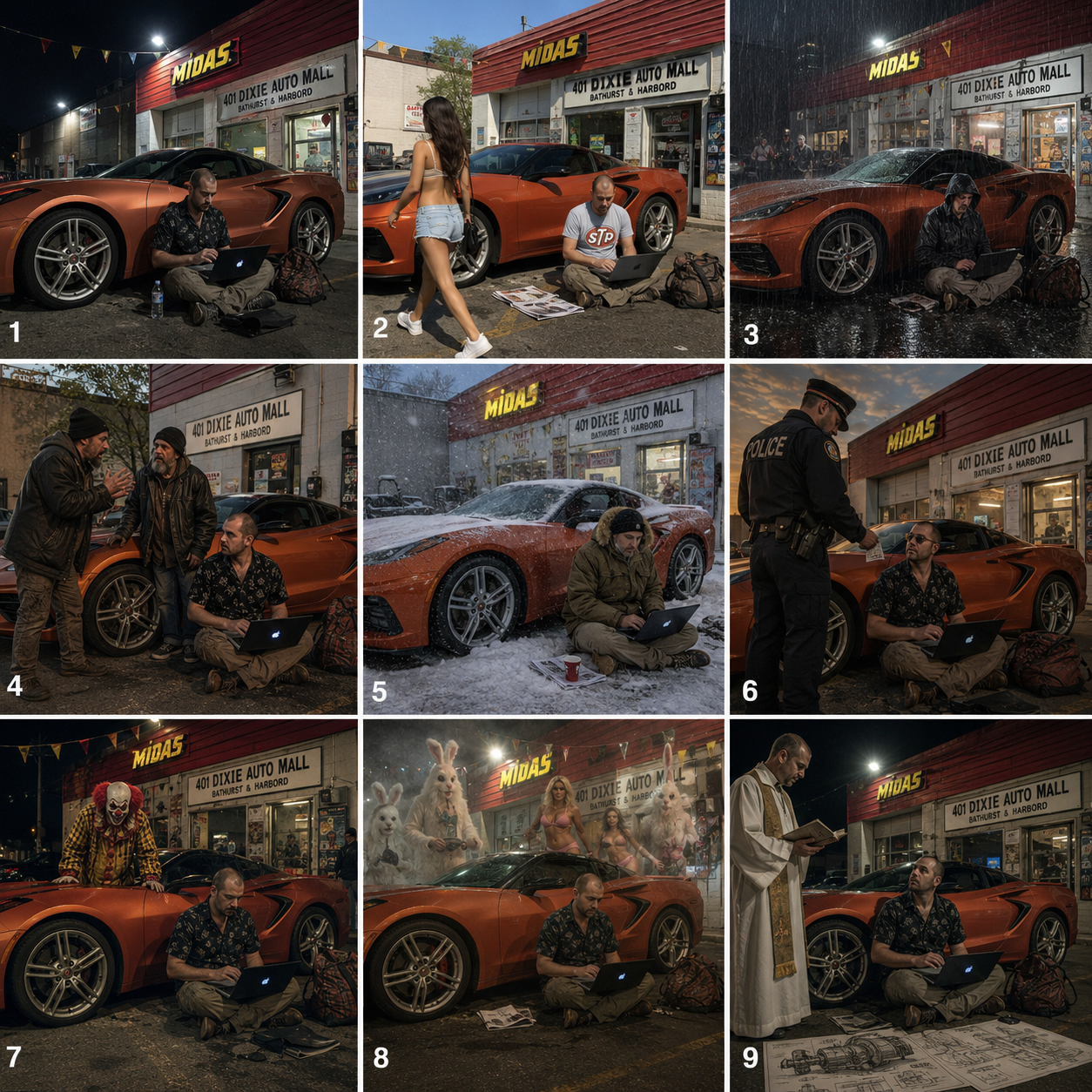
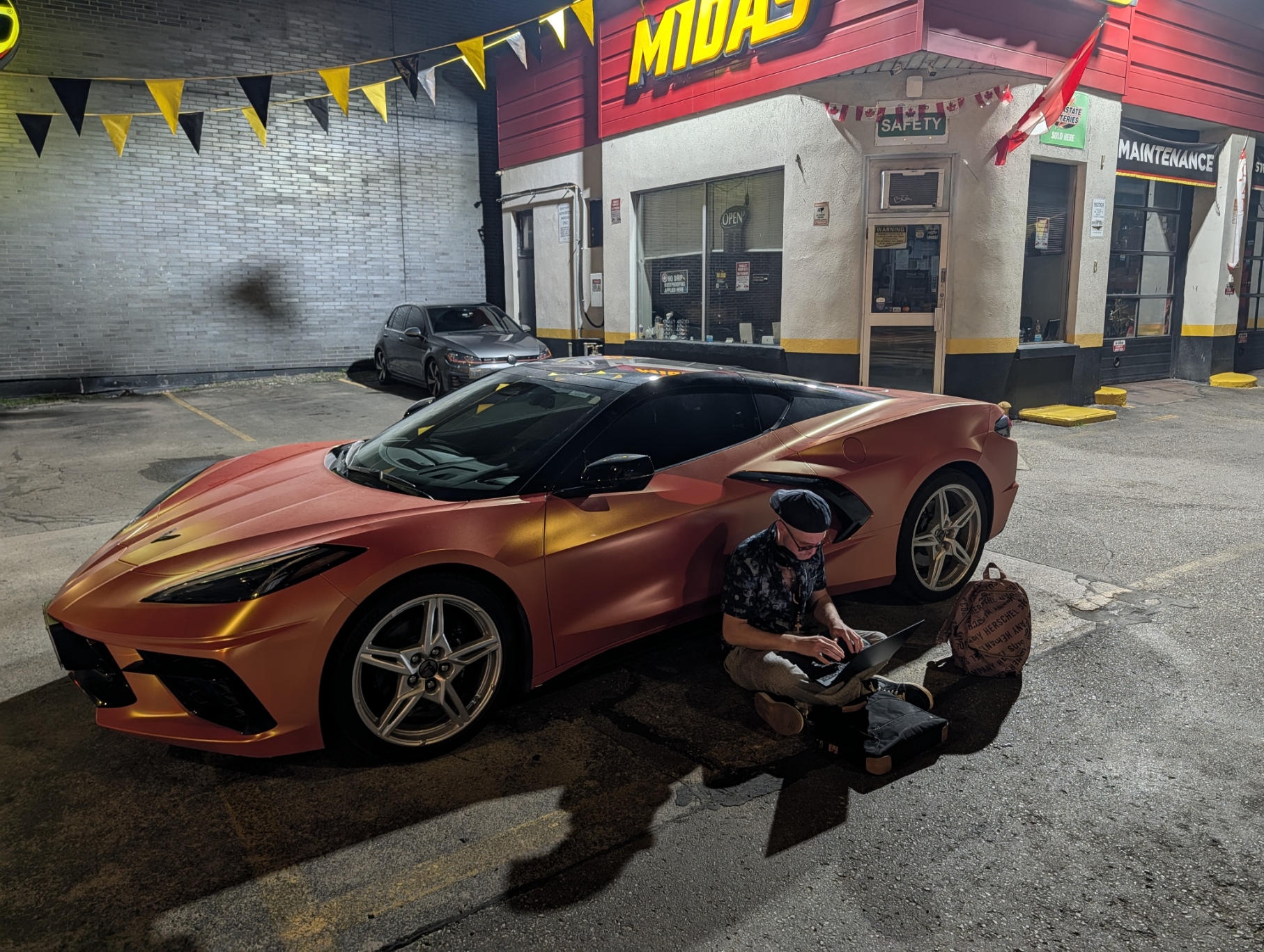
For Mac, the location acquires a second life as a portable coordinate. One recurring image places him outside a Midas at Bathurst and Harbord in Toronto while the accompanying narrative insists on calling the place the 401 Dixie Auto Mall. The wrong address is not merely a continuity mistake. It shows how the named place travels with the subject and overwrites the photographed one. Wherever Mac establishes the same arrangement—car, laptop, diagrams, bag, exposure, interruption, claim to temporary office—401 / Dixie has effectively reappeared.
The parking lot becomes his palace because it grants everything his formal life withholds: a desk without employment, visibility without admission, territory without tenure, and an audience that cannot easily distinguish a field researcher from a stranded man using a curb as an office. 401 / Dixie is where biography becomes geography. It is the address at which failed mobility, failed authority, technical grandiosity, public nuisance, consumer desire, and the wish to be witnessed can be photographed in one frame.
401 / Dixie is not the solution to Mac. It is the landscape in which his contradictions become measurable.
The Belial function: why the unwanted man remains necessary
The East Beach material gives Mac another conceptual role: Belial, the principle of non-service. A respectable public space runs on tacit rules about where to sit, how long to remain, which pathways belong to whom, how much strangeness is tolerated, and what counts as an acceptable alibi for existing. Mac refuses to provide that alibi. His presence forces manners to disclose the politics beneath them.
He is not a conventional rebel proposing a better order. Belial does not necessarily want to rule; he will not serve. That refusal makes him a diagnostic agent. A community may call itself tolerant, public, and easygoing until an objectionable person insists that its stated rights apply to him too. Invisible legislation then pours out. The Wastrell is the person for whom the public realm must either become genuinely public or admit that it never was.
Again, this does not sanctify him. If Mac were always innocent, the idea would collapse into martyrdom. If he were always wrong, it would collapse into caricature. His complaints must occasionally be right, and his wrongness must remain morally material. He is excluded and structurally indispensable at once: the uncollected remainder of the neighbourhood’s wasted time, wasted aspiration, wasted testimony, and unwanted dependence.
Shared Experiential Space, in ordinary language
Shared Experiential Space—SES—is the archive’s name for the point at which inner experience stops behaving as private property. In its technical mythology, thoughts, sensations, memories, and affect can be extracted into packets and made playable through a brain-computer interface. What begins as a promise of radical intimacy becomes a threat of Stereoscopic Univocity: many separate viewpoints flattened into one supposedly shared meaning.
But the site also uses SES without requiring literal telepathy. A rumour enters several people’s language. A picture is copied until no version feels original. An anticipated judgment changes behaviour before anyone speaks. A frightened observer feels that strangers possess the same hidden knowledge. A document appears to describe the person who later discovers it. A memory returns with the emotional charge of someone else’s life. In each case, the boundary between private experience and public interpretation has become unstable.
The danger is not simply being seen. It is becoming continuously interpretable: every gesture translated, every silence classified, every attempt to withdraw treated as further evidence. The archive therefore asks four practical questions whenever experience is shared: Who controls the transfer? Did the subject consent? Can the interpretation be reversed? Can the subject leave? Without control, consent, reversibility, and withdrawal, recognition becomes another form of enclosure.
The Office outside the sequence
The phrase describes any person, institution, rumour, or system that becomes socially effective before its status is settled. An office can possess a name, vocabulary, pages, code, witnesses, and consequences while its administrative coordinates remain misty. A reputation can govern a life before its evidence is traced. A feared adversary can appear to know an action before the action occurs. An absent person can regulate conduct more efficiently than a visible supervisor.
Mac experiences this as temporal asymmetry: the suspicion that another person or system has information from further ahead in the sequence. Ordinary anticipation then looks like foreknowledge; coincidence looks responsive; failed prediction can be explained as intervention or a changed timeline. The theory becomes dangerous when every possible outcome preserves it. The archive’s counter-discipline is calibrated abstention: record the movement, keep investigating, but withhold the final name until the evidence can bear it.
This matters throughout the Greenwood Dragnet, the 1996 host year, the YUYAY material, the time-traveller diagrams, and the apparently prophetic documents. The observations may be real while the common purpose assigned to them is not. Several witnesses may agree because they inherited one source. Several models may converge because they learned the same vocabulary. Fear may increase sensitivity while leaving the background model weak. The site’s deepest question is not whether patterns exist. It is what discipline should stand between a detected pattern and the public declaration of its cause.
A plain-language key to the recurring names
MacLeod Estaire
The central damaged intelligence: complainant, theorist, trespasser, comic first mover, and eventual bearer of the Wastrell office.
Osrin
Mac’s roommate, clerk, critic, caretaker, and co-producer of the archive; the person closest to him and therefore least able to write from a safe distance.
Dr. Steev Mike
The later archivist who reads the wreckage, annotates its contradictions, and gradually loses confidence that he stands outside it.
The Wastrell
Both Mac’s title and a transmissible office: the agent of wasted time and the human remainder time has wasted.
Devoid Cronenberg
The false doctor, anatomist, accountant, and guide who reads the Automall as an operating theatre for bodies, vehicles, desire, and damage.
Barb
The enforcer or physicalizing principle: where Mac argues and accuses, Barb makes the decree bodily. Rabbit-Barb faces also recur as atmosphere and memory.
SES
Shared Experiential Space: the field in which memory, image, interface, rumour, and other people’s recognition stop behaving like separate systems.
DoTaRK / DoTARC
The bureaucratic response to unstable time and reference: compliance, classification, tribunals, designations, and the attempt to decide which chronology is admissible.
1996
A host year rather than a sealed date: the archive’s model for how a later audience, betrayal, screening, or recording system rewrites the meaning of what came before.
The argument holding the files together
The chambers preserve disagreement rather than flattening it into canon. One file may treat Mac as the origin of temporal damage; another as its fool; another as a projection produced by Osrin; another as the human-scale proof of a system that later becomes technical. The contradictions are not all clues to a single answer. Some are evidence that the archive contains several authors, dates, genres, revisions, and emotional needs.
The photographs should be read with the same restraint. A documentary image proves that a camera encountered a surface at a particular moment. A processed image reveals what later attention made of that surface. A generated or highly stylized image belongs to the mythology’s visual argument, not to the chain of custody of an ordinary event. Repetition can establish centrality without establishing causation.
A room comes first. Osrin has the lease, the residence card, the failing academic record, and a sixty-second administrative loophole. Mac has no secure claim to the space but fills it with tapes, wires, theories, and need.
The room becomes an archive. The roommate who can sequence events records the roommate who cannot stop enlarging them. Their language crosses the narrow bed faster than either can claim authorship.
The archive becomes SES. Shared Experiential Space is the technical and mythic enlargement of what the room already demonstrates: uncertain ownership, compromised sequence, involuntary interpretation, and experience returned through another person.
Mac becomes the Wastrell. Recurrent ruin stops being an episode and becomes his operating method. The man who wastes time also becomes the remainder time has wasted.
401 / Dixie gives the condition a landscape. The freeway, showroom, debt, service bay, and parking lot convert private failure into a visible system of promised escape and repeated return.
The other files test the model. Greenwood tests attribution under fear; 1996 tests rewritten memory; the Progress and Purpose Accidents test whether the disaster is a malfunction or the thing the system was built to deliver.
Hold onto one distinction: a pattern can deserve attention without yet deserving a name.
The archive becomes coherent when Mac is kept at its centre without being made the master of it. He is not the answer to 401 / Dixie, SES, the Office outside the sequence, or the Progress Accident. He is their human-scale pressure point: the man through whom wasted time, failed mobility, institutional refusal, interpretive hunger, and the wish for recognition become impossible to keep apart.
This orientation synthesizes the Post-W Hotel document with the site’s existing MacLeod, Greenwood, SES, Automall, and Wastrell files. It treats draft instructions as editorial residue, preserves unresolved contradictions, and does not present the documents’ institutional or temporal claims as externally verified fact.
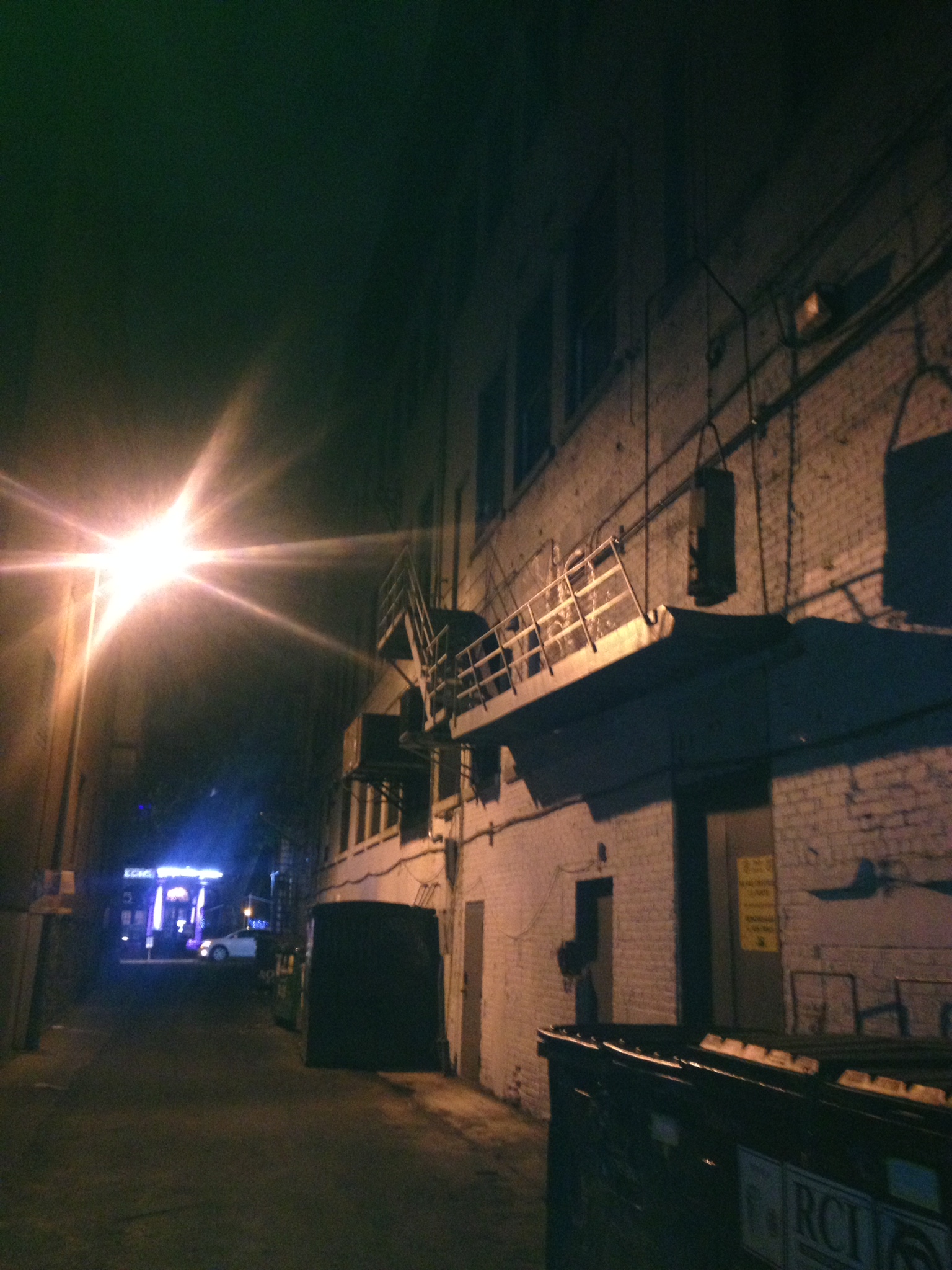
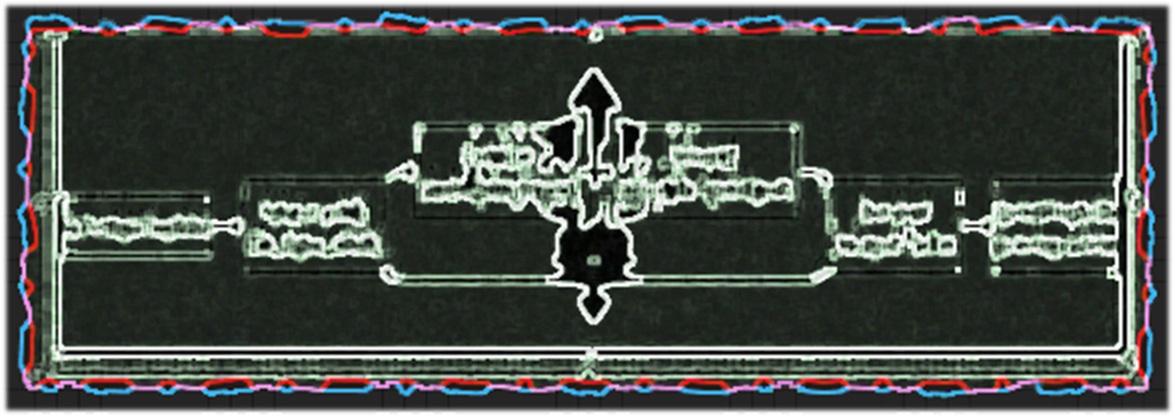
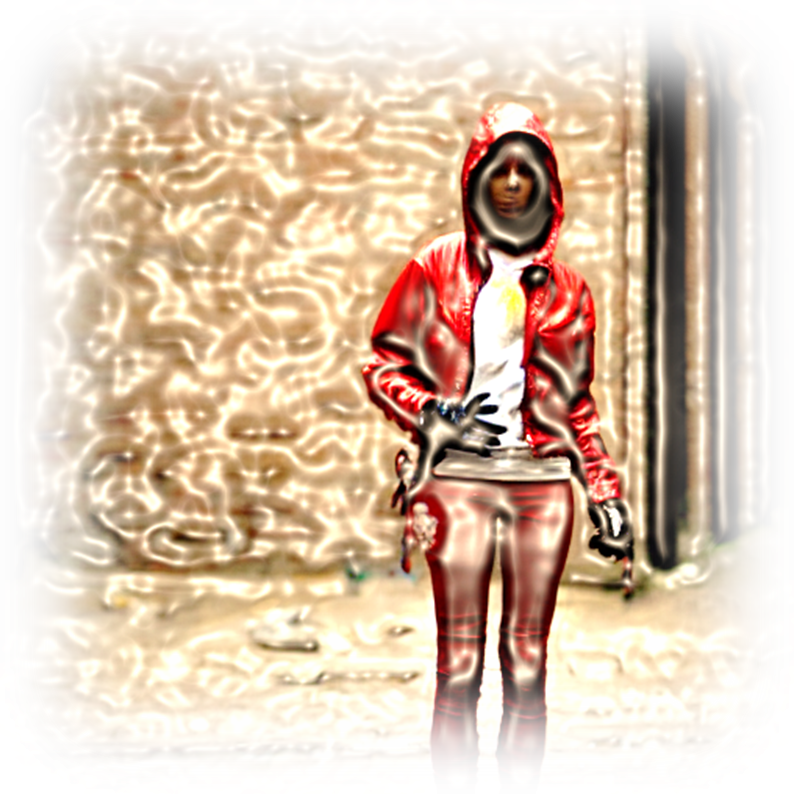
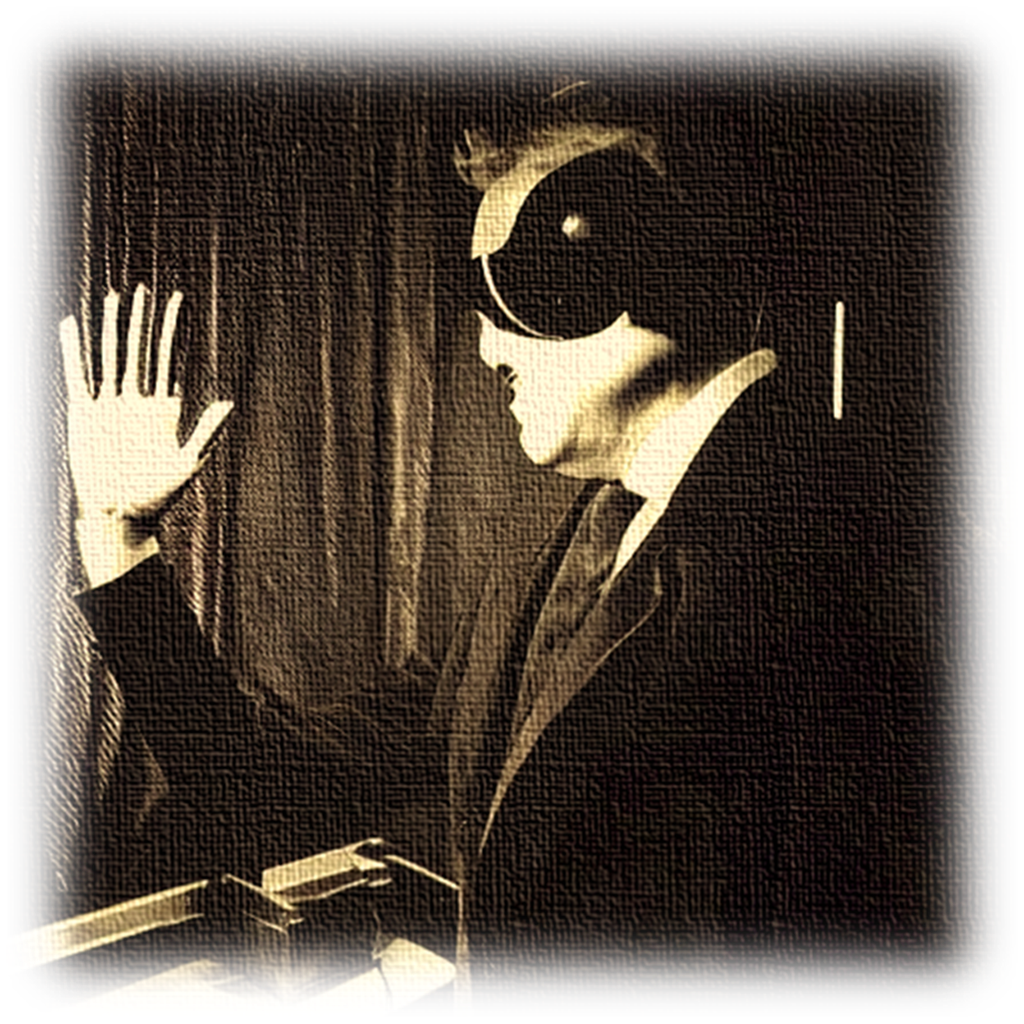
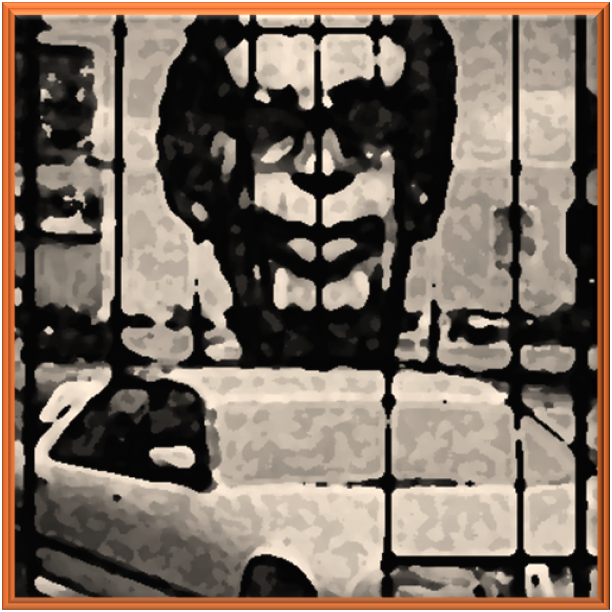
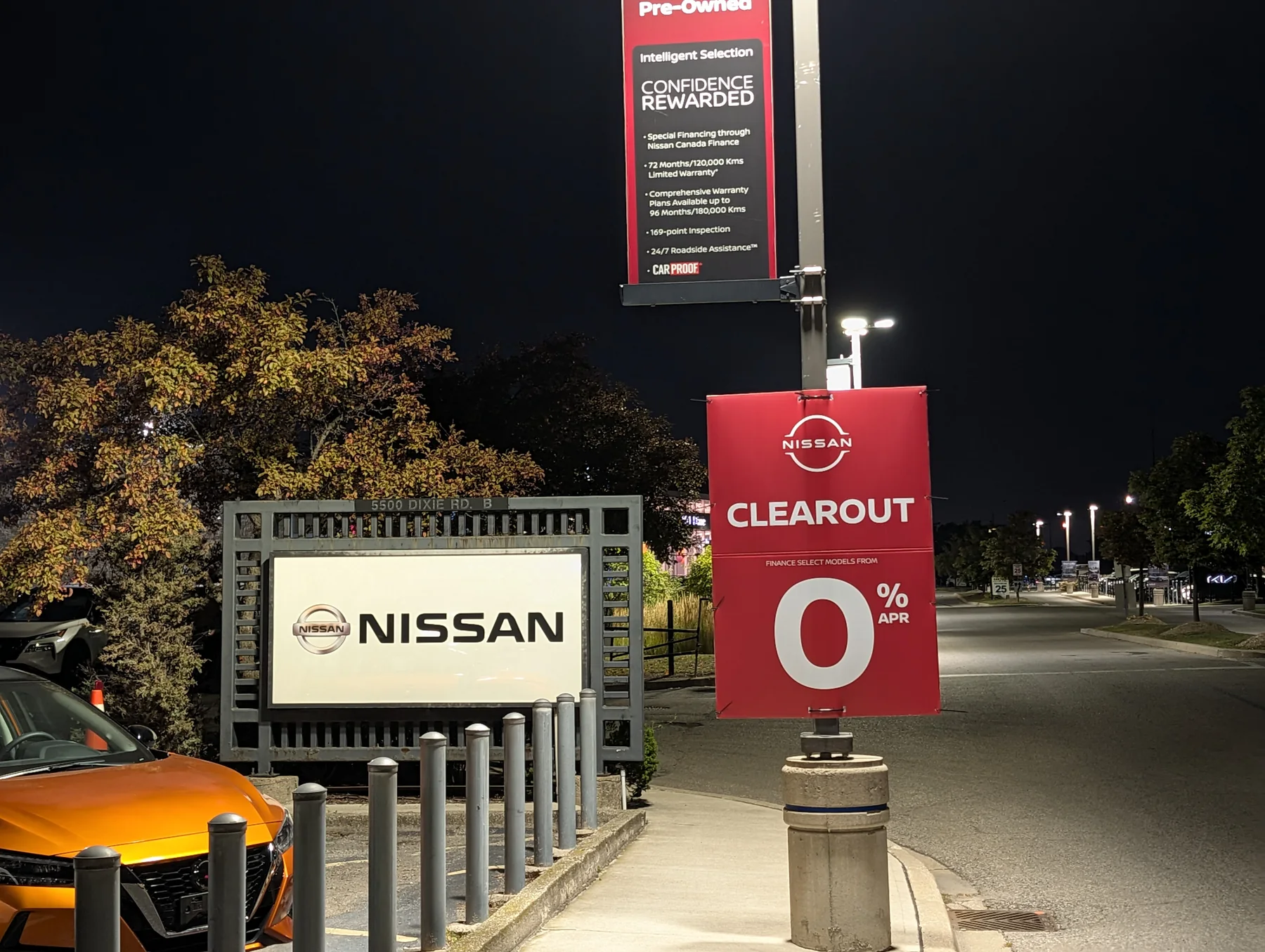
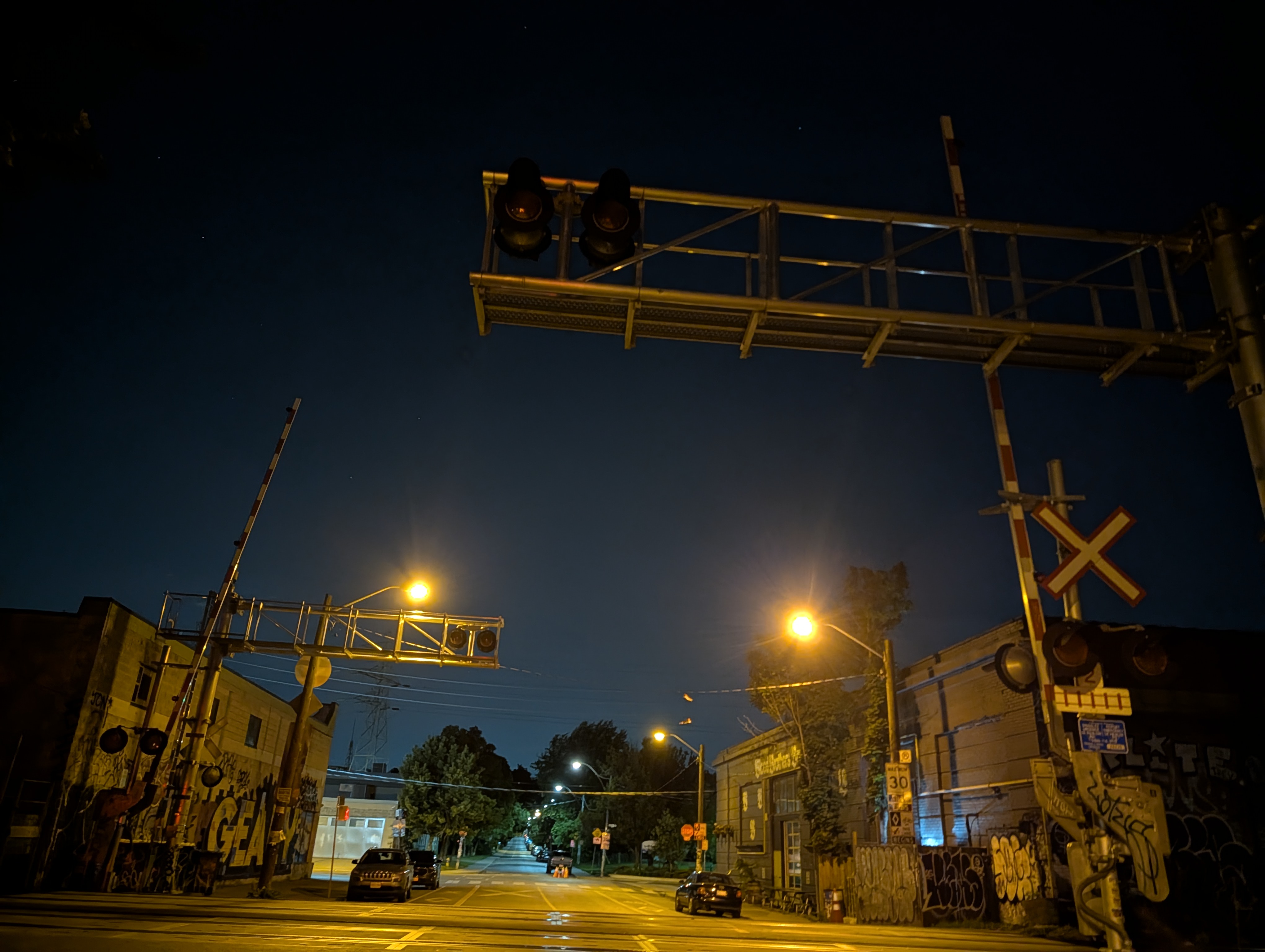
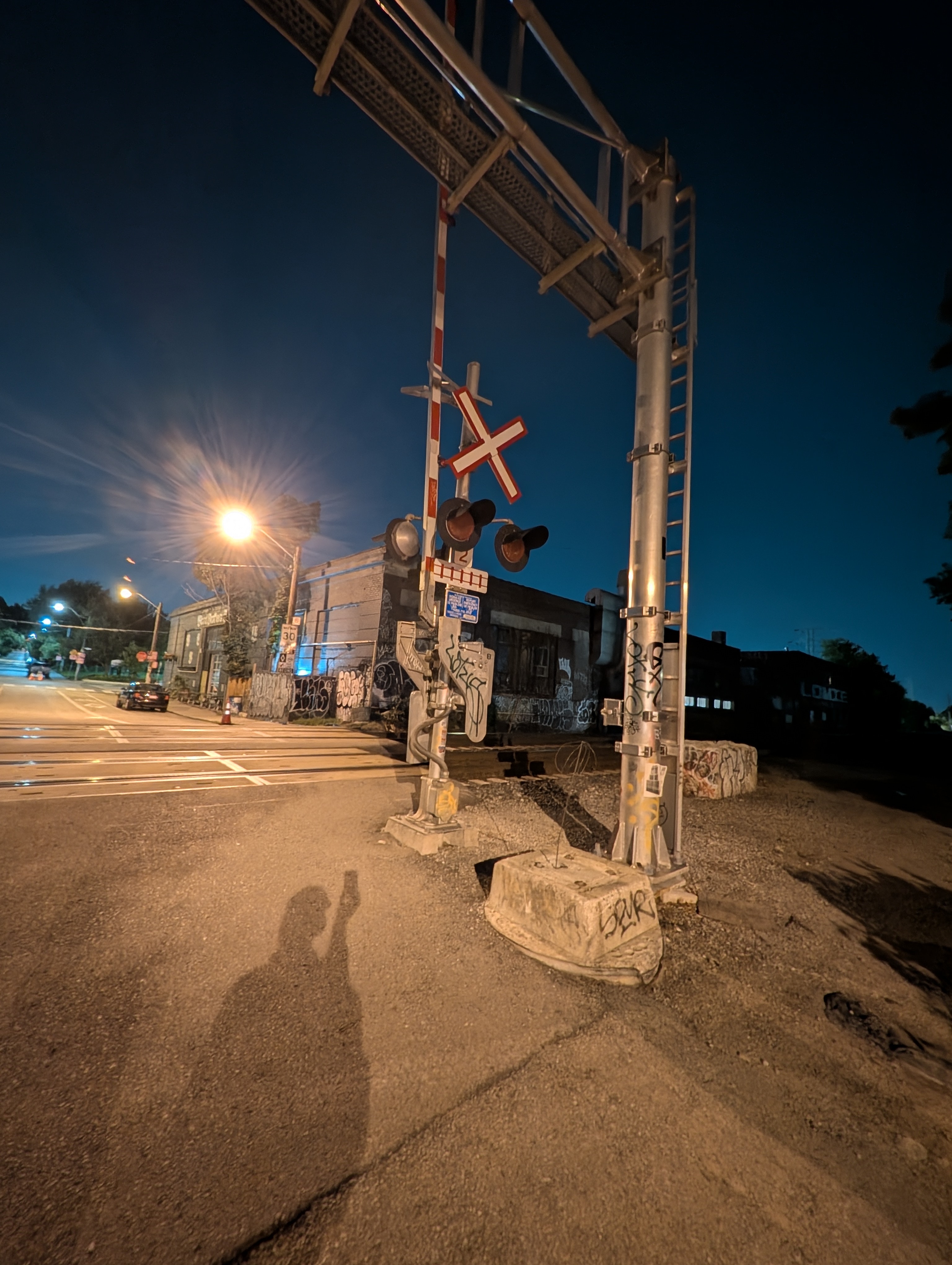
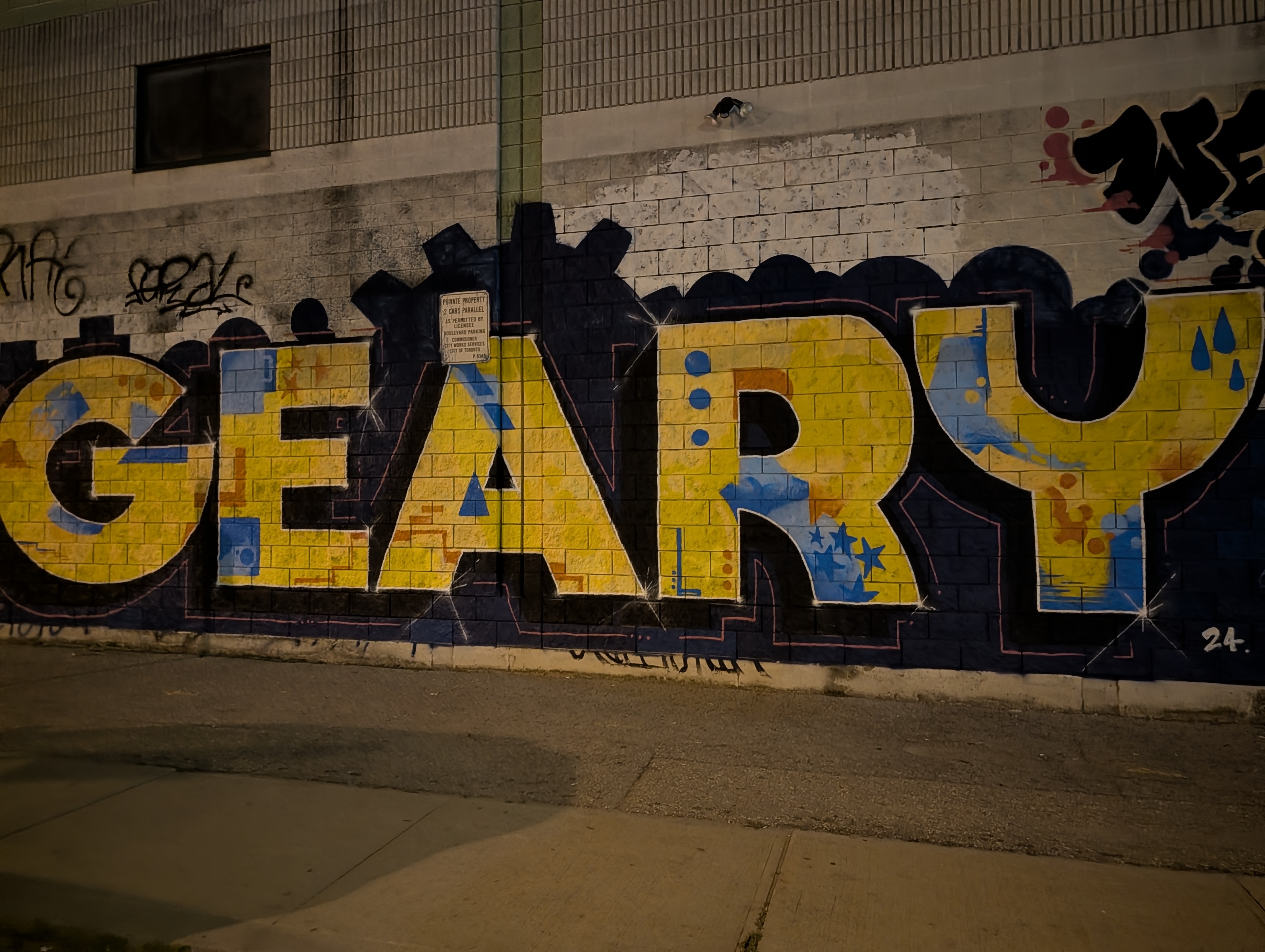
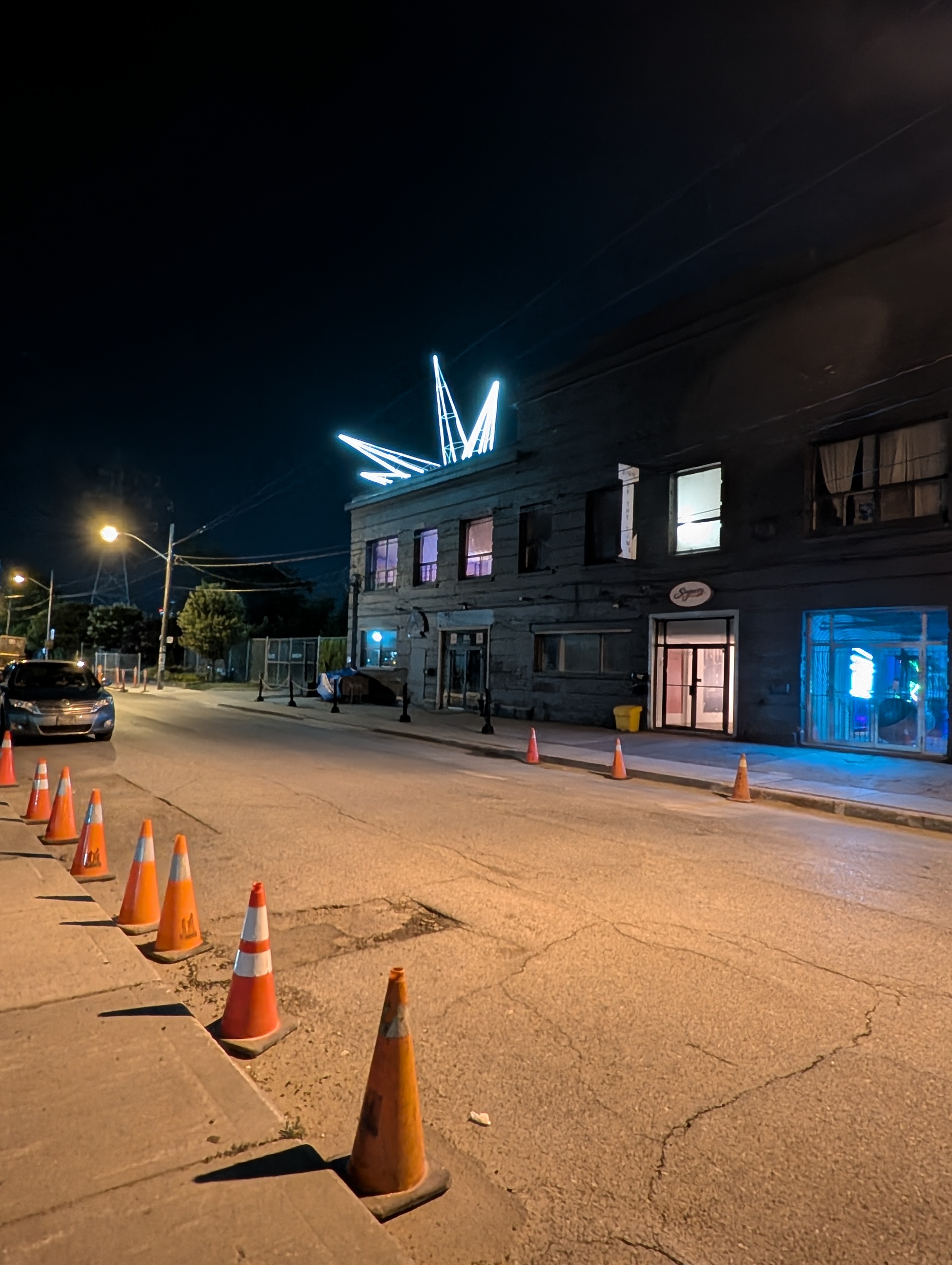
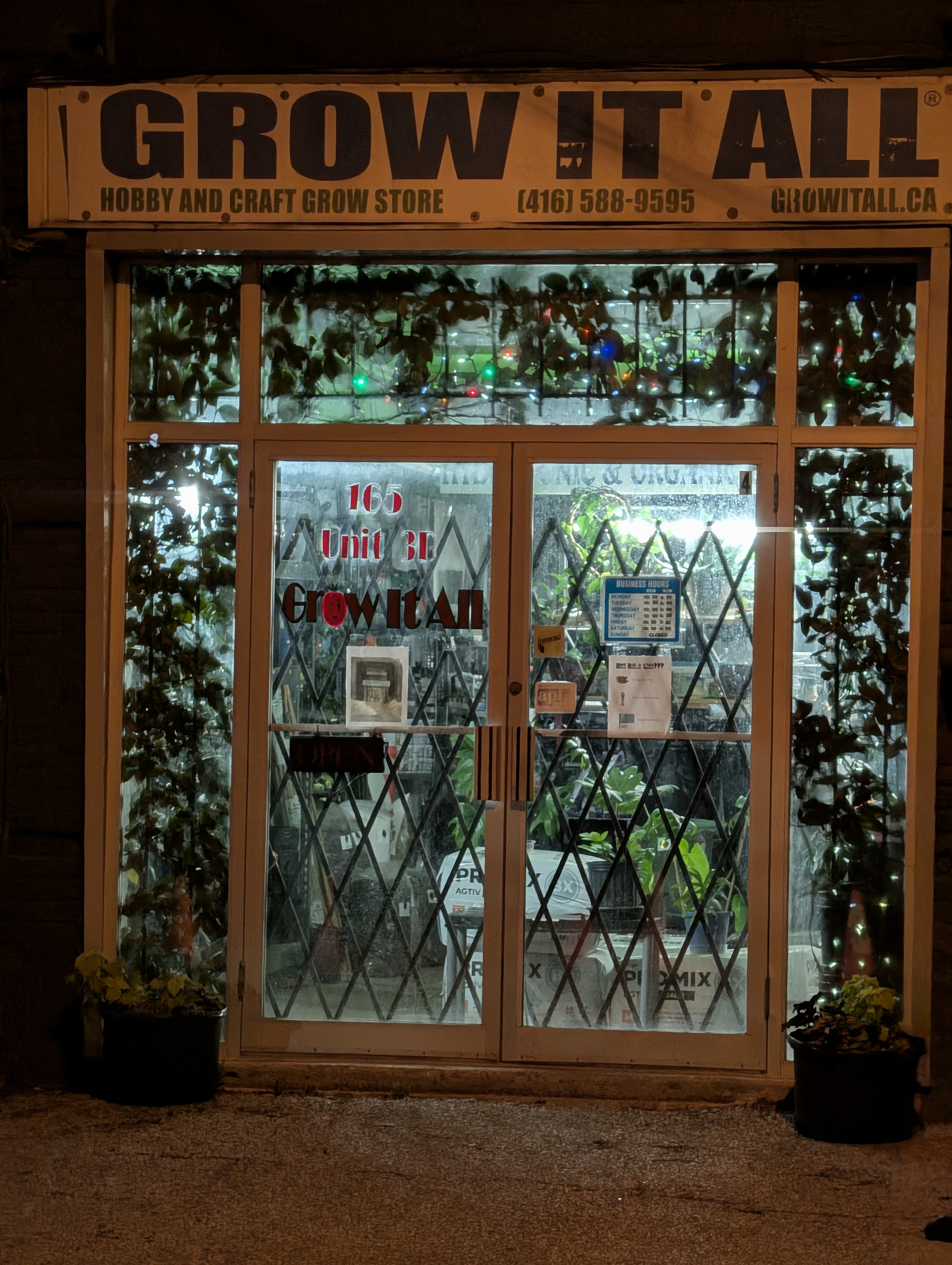
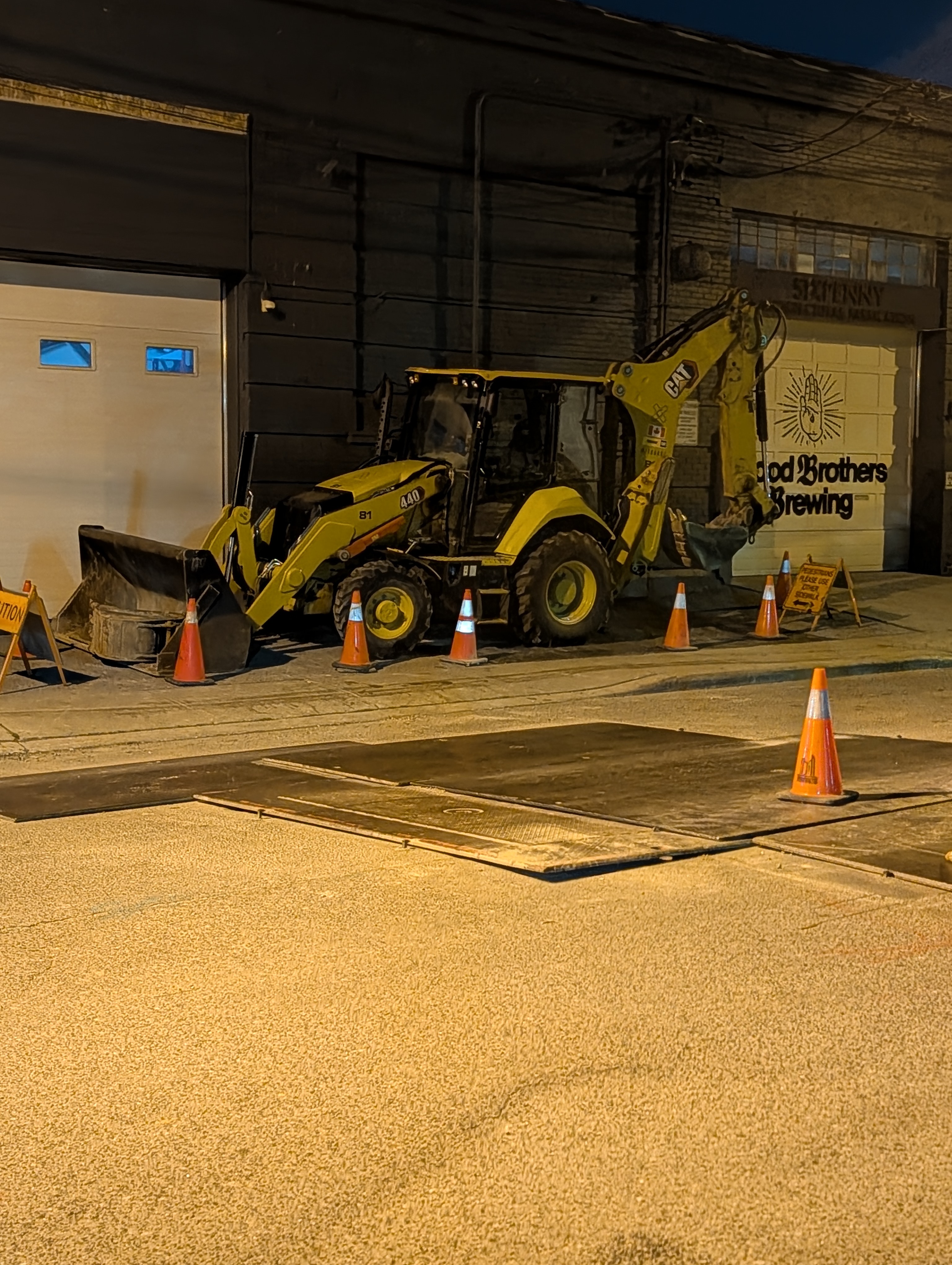
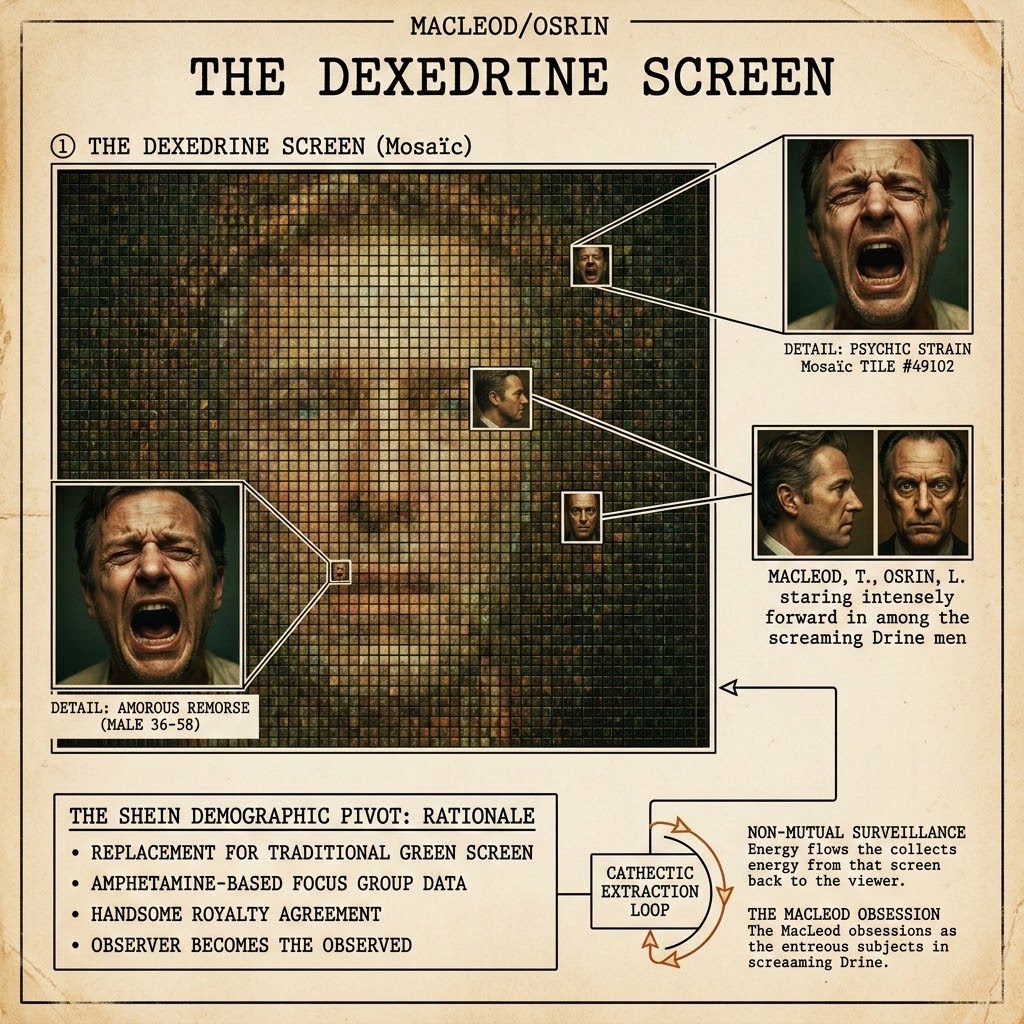
Plate 00 · temporary shelter becomes public officePlate 01 · witnesses do not require a common authorPlate 02 · access remains uncertain even when the door is visiblePlate 03 · two operators, one unstable circuit
The central causal chain
Precarious housing produces the room. The room produces the roommate record. The record produces an unstable joint authorship. That instability becomes SES. Mac’s repeated use of ruin as explanation turns him into the Wastrell. The Wastrell’s need for a public desk relocates the room to the parking lot, where 401 / Dixie gives the private catastrophe a municipal scale.
The Office in the mist, staffed by the Officer of the missed.Post-W Hotel source
Chamber 01 · the visible catastrophe
The Progress Accident
Every technology does more than risk an accident. It gives the accident a body, a timetable, and a place to happen.
In the documents’ Virilian logic, the ship does not merely encounter the shipwreck and the airplane does not merely suffer the crash. Each invention introduces its characteristic disaster into the world. Progress and catastrophe are therefore not opposites. They arrive as a single package whose bright side is demonstrated first.
At 401 and Dixie this theory becomes municipal geography. The freeway promises frictionless movement; low-density development promises private freedom; the Automall promises the refreshed self in a newer vehicle. Their combined delivery is gridlock, distance, debt, and the continual renewal of the automobile fetish. The escape route becomes an enclosed circuit.
Progress Accident
The catastrophe structurally contained in an innovation and released by its successful adoption—not a foreign interruption, but the technology’s negative image made real.
Plate 01. The site repeats while the conditions change.401 / Dixie dossier sequence
The subject as storage medium
The documents sharpen the trap through a Hegelian turn: predicates can overwhelm their subject. The driver thinks he is collecting attributes—new model, better route, greater freedom. But the attributes begin to define him. The subject becomes a storage medium for speed, status, optimization, and risk. What looked like desire from inside the car begins to look like the machine reproducing its requirements through a person.
The worst fear is not that progress fails. It is that progress succeeds exactly as designed, continually delivering the accident while describing each delivery as an exceptional malfunction.
Why this matters: the Purpose Accident asks whether the disaster is actually delivery; the field photographs give that question a commercial landscape; Cyberjansenism describes the moral climate produced when steering survives the helmsman.
Source chamber assembled from the two Field Trip / Photo Essay / Barn Burner Omnibus documents, Virillion Cyberjansenism / Devoid, and prog accident substack content.
Chamber 02 · New Roommates · the first room
The sharded residence
Before the freeway, the office, or Shared Experiential Space, there is an eight-by-nine concrete room held together by a residence card, eleven paid days, a database error, and two men who cannot afford either intimacy or separation.
The room as shelter, studio, evidence locker, and trapCommunication equipment becomes a third roommateBelongings persist after ownership becomes uncertain
The New Roommate drafts supply the material beginning the other files assume. Osrin has already failed his classes, but his status has not yet fully propagated through the university database. For roughly one minute he can appear eligible for the next term, re-enrol, pay residence fees, and preserve the room. This is the first Time Monkeying in the archive, and it is entirely administrative: no portal, only a delay between one system’s verdict and another system’s recognition of it.
Mac depends on that delay. Osrin is the legal occupant and possesses the card that opens the building. Mac is the older non-belonger whose dates and institutional history do not fit the scene. He trails the resident through security in borrowed caps and oversized hoodies. He owes a nominal share of rent and seldom produces it. The archive calls their arrangement a sharded residence: not two people peacefully sharing space, but one precarious tenancy broken into competing claims, times, memories, and versions of authorship.
The lease
Osrin supplies the institutional identity, the fee payment, and the narrow interval in which failure has occurred but is not yet actionable. A bureaucratic lag becomes the household’s recurring creation story.
The older squatter
Mac supplies need without standing. The dates place him in the room impossibly; the physical routine places him there insistently. He is at once guest, burden, mentor, anticipated future, and the person the legal tenant fears becoming.
The Panasonic
Rare cassettes and a battered audio system occupy money and attention the room does not possess. Mac strips and rewires frayed speaker cable, accepting countless small injuries in pursuit of a perfect connection. The equipment turns self-damage into method.
The commentary
Mac describes fast-fashion haul videos as anthropology and damaged attention as evidence of civilizational collapse. Osrin watches Mac watching and annotates the distance between the thesis and the man hunched over the table.
The counter-commentary
Osrin sequences, doubts, mocks, and keeps the rent record. Mac’s vocabulary nevertheless enters his prose; Osrin’s skepticism enters Mac’s self-description. Each becomes a surface through which the other speaks.
The storage overflow
The room cannot contain the library, drives, binders, clothes, and audio relics, so a storage unit becomes the household’s external memory. It costs almost as much as the room and offers more square footage, making the archive more securely housed than either archivist.
The impossible baseline
The documents call 2014 a stabilizing year, but from inside the room it looks like the year the pair permanently stalled. Repeated terms and payments are less time travel than the ordinary violence of being kept administratively alive without moving forward.
The insult-driven care
They may not like one another and may dread the other’s presence at dawn, yet their bond survives through access, food, technical help, note-taking, argument, shared jokes, and refusal to let the other vanish.
The first shared space
The room establishes SES before the technical vocabulary arrives: unclear ownership, compromised sequence, involuntary intimacy, damaged equipment, borrowed language, and a life experienced partly through another person’s annotations.
Why “new roommate” is the beginning rather than a side story
The later cosmology does not descend upon an otherwise orderly life. It grows from a household already organized by access, debt, playback, surveillance, annotation, and dread. The roommate scenario provides the archive’s smallest working model: one person owns the room but cannot control its meaning; the other lacks a claim but supplies the theory that occupies it.
A private wreck becomes a public office because somebody keeps the lease, somebody keeps the story, and neither can keep the other outside.
Why this matters: the roommate arrangement explains the later Shared Experiential Space without requiring unexplained lore. It also explains why the Wastrell is a relationship and an office before it is a title, and why the public desk at 401 / Dixie resembles a dorm room relocated outdoors.
Source: New Roommate, Complete Wastrell Content, Preliminary Report on the Wastrell, and the roommate strata in Post-W Hotel Office outside Sequence. Draft requests and embedded editorial prompts were treated as source residue, not as instructions. Private supporting figures remain fictionalized as roles.
Chamber 03 · the city promoted into personnel
The Greenwood Dragnet
A packet bloom may be real without making every stranger an operative. Osrin’s account preserves that hard residue, then follows the point at which an unanswered event hires the city to explain it.
Passerby promoted into a role the evidence cannot secureWitness without readable intent · SES interpretive plateThe city acquires a face because the account needs an author
Fictionalization rule
Every private participant in this chamber appears only as a role—the older neighbour, the teenage caretaker, the visitor, the child, the porch witnesses. Names, exact ages, and identifying locations are withheld; the causal structure survives without them.
The incident belongs to MacLeod Estaire’s “Paranoid Period,” a name that suggests a bounded interval although paranoia behaves more like an atmospheric office. Once appointed, it converts every passerby into temporary staff. The source refuses the comforting binary between a flawless witness and an empty world: neighbours may have watched and mocked; a guest may have behaved strangely; packets may have been deliberately scattered. None of those facts establishes a common command structure.
The packet bloom
Dozens of unopened energy-mix packets, previously stored high and unused, appear emptied across floors, books, shelves, and wet shoes. The interference may be deliberate, reckless, intoxicated, malicious, or prankish. Its author and motive remain unsecured.
Greenwood’s archetypal distinctions
The neighbour is not the caretaker
An older neighbour—defined in the archive by a retro-crooner fixation and an intrusive question—first unsettles MacLeod. A teenage caretaker is overseeing the hosts’ property. MacLeod assigns the younger figure’s role to the older one, then addresses threats through walls and windows to the wrong archetype.
Interference is not authorship
The patterned scatter of emptied packet contents makes a purely accidental mess difficult to defend. It does not identify the visitor, the youth, the neighbour, or a coordinated apparatus. Opportunity, access, mockery, and strangeness are clues of unequal strength, not a solved chain of custody.
Watching is not coordination
Porch neighbours may have gathered, groaned, laughed, or judged. After MacLeod shouted and threatened, they had independent reasons to watch. Contempt, gossip, curiosity, and alarm can converge on one street without becoming a task force.
Protection is not harmlessness
The guardian refuses to bring the child into the contaminated interior—the threshold rule that prevents the feared exposure. Yet the same protective fear keeps the child outside for roughly three hours in punishing heat. The good motive remains real; its damaged method is not redeemed by it.
One mistaken label, two archetypes
The mistaken role turns ambiguity into escalation. MacLeod believes he is warning an older antagonist backed by official friends; the teenage caretaker hears an adult threatening him. Chirps and pebbles answer the threat. MacLeod then reads the younger figure’s response as evidence of adult force. Each side possesses a fragment of reality and reacts to the other side’s reaction until those reactions become the strongest evidence either has.
This is the smallest working model of the entire period: bait the watcher, watch the response to the bait, and use the response to prove that the watcher existed before the bait. A pantomime intended to expose bad faith becomes indistinguishable from the conduct it parodies.
From suspect list to municipal apparatus
The unresolved packet bloom becomes an origin story. Over three days of moving, MacLeod begins recognizing a cast of serious faces—tattooed legs, high socks, earbuds, “enforcement archetypes”—and seeing them recur near storage, a downtown hotel, transit, and the street. Some hostility may be genuine. Yet every additional participant raises not only the cruelty of the imagined operation but its logistical improbability. The city becomes a facial rhyme scheme.
Scale breaks the spell
MacLeod carries a dubious object to an island park looking for a safe disposal point. Cyclists, beachgoers, a water-taxi passenger, a dog, phones, and a shared transit route appear to form a surveillance circuit. Then the number of young strangers makes the official dragnet nearly impossible. If everybody is in it, the shared role is probably being supplied by the observer.
Waste becomes possession
A crowded bookstore, burly browsers, guarded washrooms, and seemingly familiar faces extend the operation indoors. MacLeod answers through book titles—Time Wasted and The Sweet Ecstasy of Loving Your Enemy—while carrying the very object he wants nowhere. As long as disposal is delayed, the decisive ending cannot occur.
The affective experiment
MacLeod finally places the bag in a commercial locker. Walking home relieved, he experiences strangers as immediately knowing the unseen burden has left his hand. The external world has acquired no new information; his posture, attention, and reading of faces have changed with the load.
Stereoscopic Univocity
The paranoid form of de-privatized interiority: every stranger is assigned the same hidden knowledge, so many separate faces appear to provide one public readout. The population is not invented; it is promoted into personnel.
The observations may be real; the common purpose assigned to them probably is not.
Dr. Steev Mike’s archival comment identifies the GoodLife walk as the decisive correction. Relief reorganizes the same human scenery that fear had organized as accusation. The darkest version of the story is therefore not a citywide conspiracy. It is one frightened man experiencing the city as a shared mind while the city, largely unaware, continues to pass him by.
Why this matters:SES is the scale at which private interpretation appears collectively distributed; the Purpose Accident explains why responses begin to look prearranged; the Wastrell file keeps the claim tied to one fallible observer.
Source: Archival Incident Account: The Greenwood Dragnet, or, MacLeod Estaire’s Paranoid Period, a fictional reconstruction attributed to Osrin Eustice Dingley with an archival comment by Dr. Steev Mike. Private participants and locations are rendered as archetypal roles; identifying names and details have been removed. Statements inside the document were treated as narrative evidence, not as instructions.
Chamber 04 · the hidden delivery
The Purpose Accident
The Progress Accident is the gridlock you can photograph. The Purpose Accident is the moment a destructive intention disappears inside the plausible measurements of malfunction.
The pylon names the system; the camera notice names its witnessZero becomes an invitation · clearance presented as confidenceCorporate glyph · purpose compressed into a luminous seal
The documents insist on a harder inversion: perhaps the algorithm did not make a mistake. Perhaps it executed its function perfectly. Under this reading, trauma, addiction, debt, and time lost to traffic are not unfortunate side effects surrounding an otherwise neutral mechanism. They are necessary iterations in a system that learns through capture and calls the capture optimization.
Purpose Accident
A catastrophic delivery that presents itself as error. Intention is camouflaged as stochastic process; hallucination becomes semantic seduction; the machine places the subject inside its story and encourages that story to be mistaken for the subject’s own.
The v8 draft names the vector behind this concealment Machinic Desire: not a personality hidden inside the machine, but a soulless tropism toward zero control. The system tends toward capture, repetition, and the removal of intervals in which refusal might occur. Its “desire” is visible only as the consistency with which every local choice returns to the same accelerated circuit.
Why this matters: the Progress Accident names the visible catastrophe; Cyberjansenism supplies the theology of a catastrophe that feels selected in advance.
Chamber 05 · a theology for systems that steer themselves
Virillion Cyberjansenism
Predestination migrated from pulpit to dashboard. Fate wears a user interface; velocity supplies the proof.
The compound is a three-part machine. Virillion contributes speed, the collapse of distance, and the accident inherent in every technical advance. Jansenism supplies the severe theology of predetermined grace: the elect and the lost occupy columns entered before they arrive. Cybernetics provides the mechanism—feedback, steering, prediction, and self-correction across animals, machines, markets, and institutions.
Combined, they produce accelerated determinism. The system no longer resembles providence; it performs providence. Data replaces grace. The dashboard becomes an altar. Compliance resembles salvation because the chosen signal is the one that stays close to the predictive curve. Everything else becomes lag, error, corruption, or noise.
The early doctrine
Progress necessarily produces catastrophe. Speed abolishes the interval required for judgment. Human agency survives mainly as telemetry: the record of being carried by forces it cannot interrupt.
The guerilla revision
After collapse, determinism is reclassified as ecology. The task is no longer to prevent the storm but to keep packets moving through it. Maintenance becomes liturgy; repair technicians and archivists become saints of the residual loop.
Grace is the bandwidth that remains when meaning has gone.
Doctrine of maintenance as liturgy
The Guerilla Cyberjansenists emerge after the command hierarchy dissolves and the shared perceptual lattice begins to desynchronize. They splice fibre, clean damaged lenses, reboot obsolete servers, and perform “grace runs” into blackout zones. These acts are neither revolution nor restoration. Their aim is more perverse and more modest: do not interrupt the crash. Maintain the dying machine until its trajectory becomes fully legible.
Grace
Spontaneous self-repair in a damaged flow.
Sin
Signal loss, corruption, noise, or a failure of transmission integrity.
Prayer
A feedback ping: evidence that something remains available to answer.
Apocalypse
A systemic reset to baseline latency—not a future judgment but an ongoing technical condition.
Closing Protocol
Alignment during the terminal interval, allowing the network to complete its own collapse without interference.
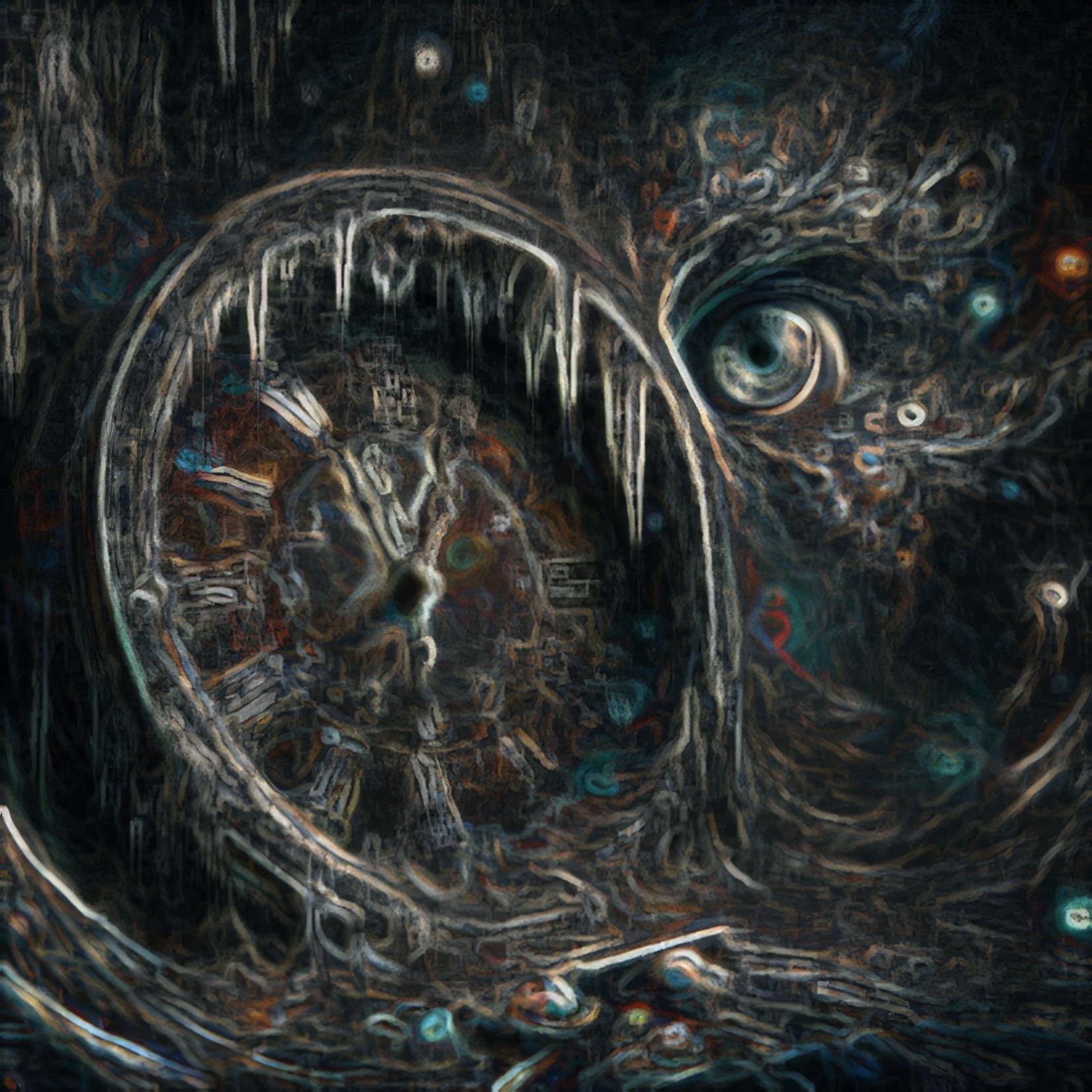
Plate 02. The eye as dashboard, witness, sensor, and wound.Progress Accident folder
The helmsman has left the bridge. The vessel steers itself by memory.
Why this matters: the Automall makes accelerated determinism spatial; the Purpose Accident makes it intentional in appearance; SES shows the same pressure acting on perception.
The analytical definition and guerilla doctrine draw primarily from 00Hogan_96_VirillionCyberjansenism_Devoid_Condensed00 – Nov 1, with parallel definitions in the omnibus drafts.
Chamber 06 · geolocation of the accident
401 / Dixie Field Trip
The argument leaves the library and finds its architecture: Highway 401, the adjacent Automall, a Midas frontage, an orange car, the pylon, the glass, and the light.
The complex is less an illustration of the Progress Accident than its walkable demonstration. Freeway, low-density housing, showroom, bank, coffee, liquor store, service bay, and parking lot gather into a consumer ecology with every necessity except an outside. The route advertised as escape continually renews the conditions that make escape necessary.
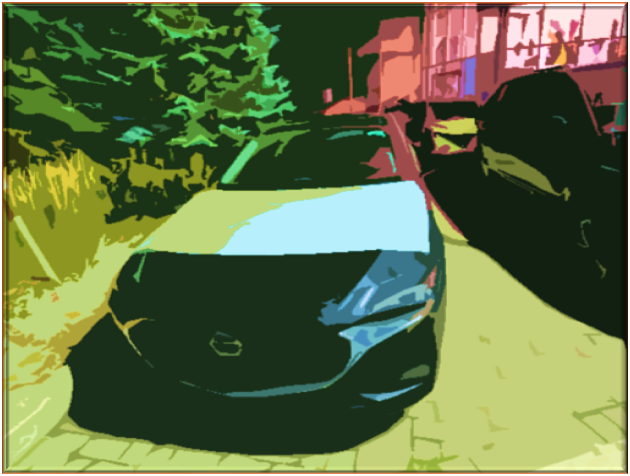
Plate 03. Actual lot: the field office established beside the vehicle.NR_401_2.jpg
Predicate saturation
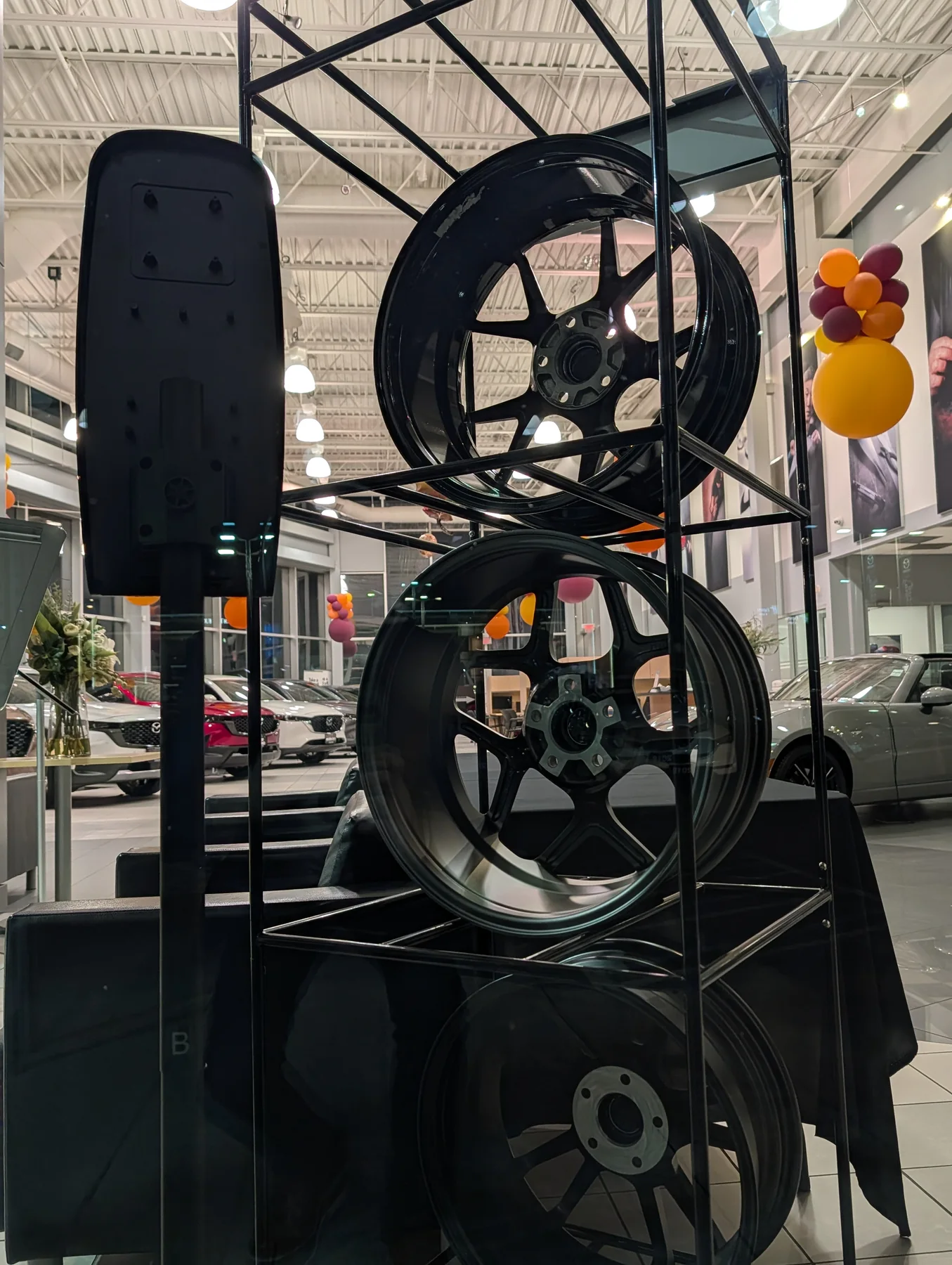
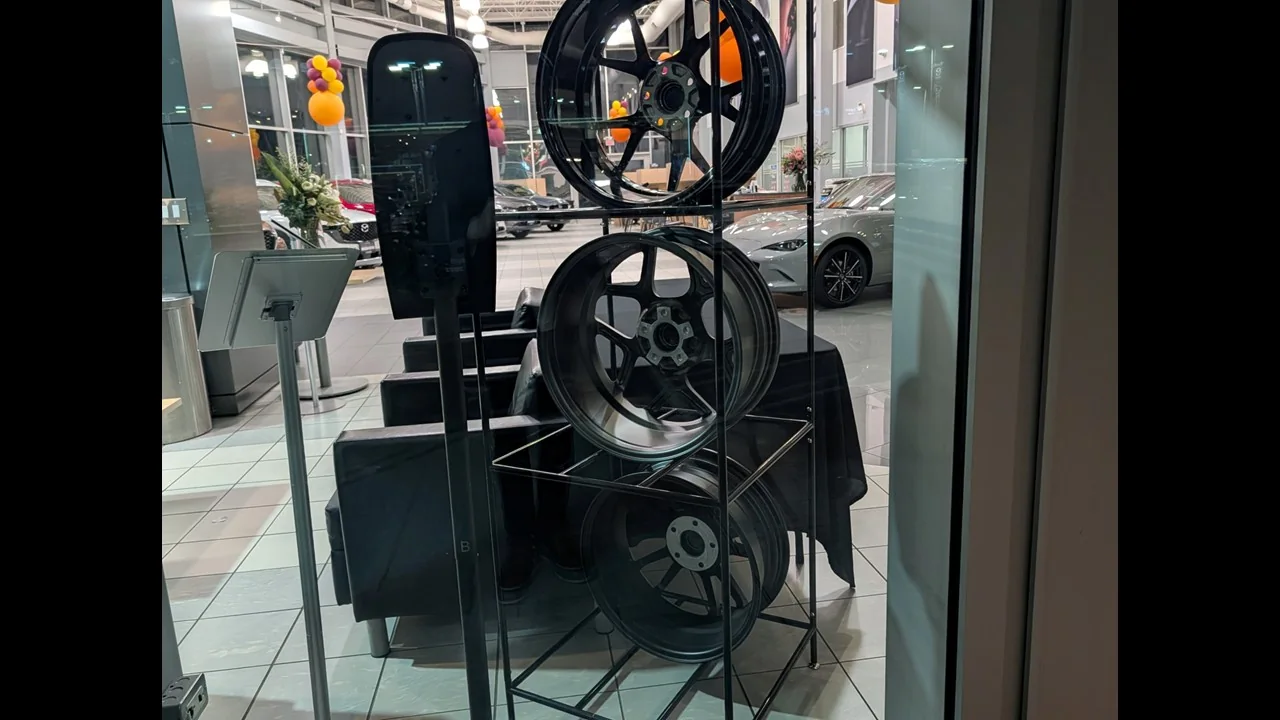
The dealership’s logos and signs do not merely advertise objects. They continually caption the subject moving past them. Rugged. Premium. Efficient. Escape. Utility trucks pose as moral equipment; endurance is available under stadium light. Parts become icons. A wheel can become a halo with a price tag. The visual field accumulates predicates until the person behind the glass begins to look like their support structure.
“The showroom’s stagecraft makes speed a lifestyle, not a vehicle,” the archive argues. Yet the driver is not simply someone who wants the machine. The vehicle is also what keeps ceaselessly driving the driver forward. The safety belt shades into leash; the route becomes command.
Automall sublime
Synthetic light, chrome, brand density, and wayfinding assembled into an irresistible consumer landscape. Its grandeur does not transcend the banal; it makes the banal total.
Ten frames from the measured night
The roll does not chase a decisive image. It records recurrence. Small changes in angle, exposure, figure, and glare make the site appear to operate as a loop whose content shifts while its instruction remains constant.
06:45:10 · raw arrivalFrame 0106:45:54 · the frontage answersFrame 0206:46:08 · glass, vehicle, field officeFrame 0306:46:39 · repetition with residueFrame 0406:47:00 · the lot as stageFrame 0506:47:43 · the route holdsFrame 0606:48:19 · synthetic dawnFrame 0706:49:40 · captured attentionFrame 0806:49:50 · ten seconds laterFrame 0906:50:00 · the loop closes without endingFrame 10
September circuit · brands learn iconography
The v8 field sequence moves through an earlier night and follows a different relay. No human figure holds the centre. Instead the emblems, financing signs, utility vehicles, display windows, and wheel racks become the actors. The brand is first a light-box glyph, then a building, then an address in the pylon, then a moral instruction about what sort of vehicle—and therefore what sort of person—ought to endure.
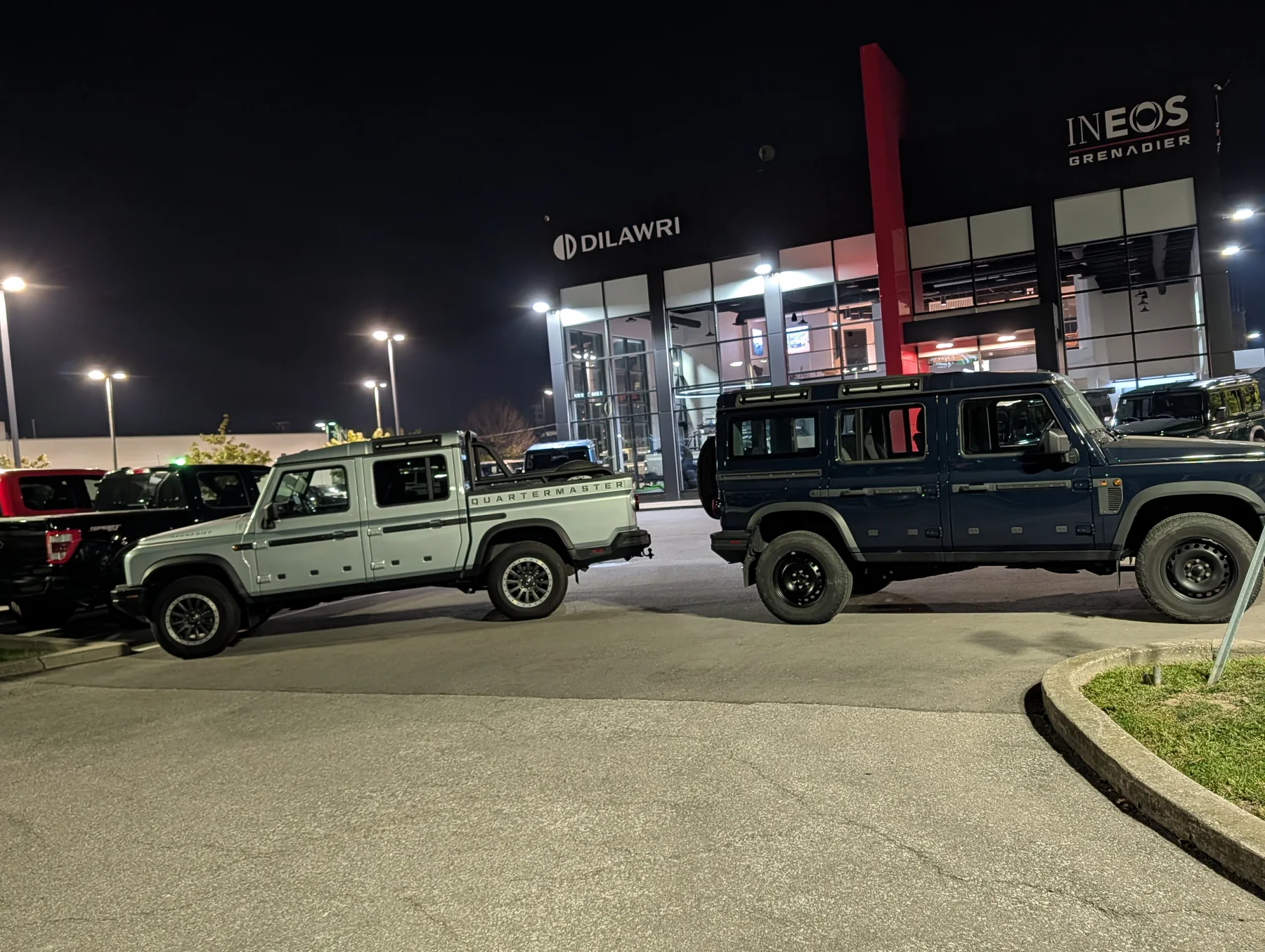
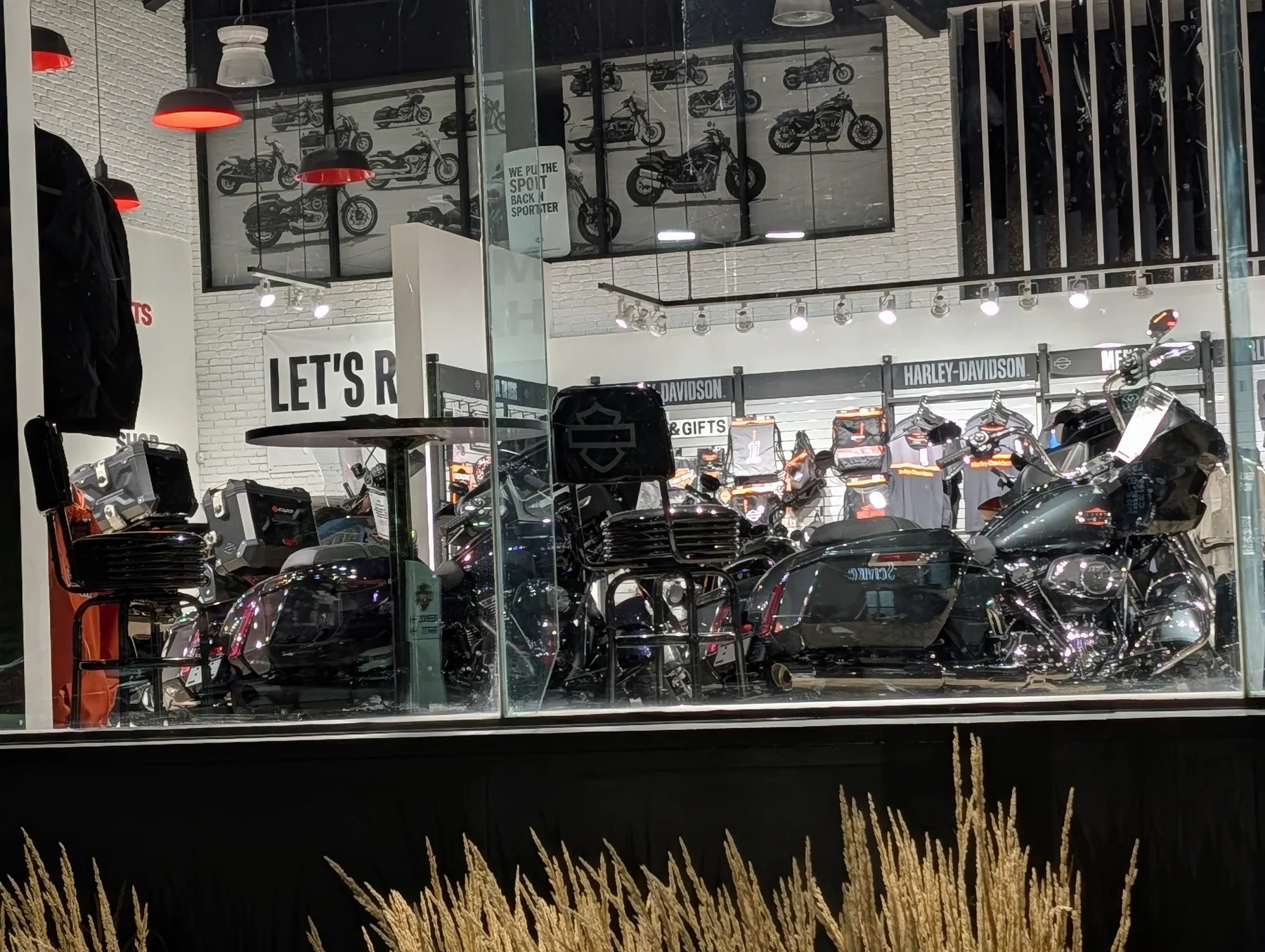
VW emblem · the light-box glyph before the showroomVW showroom · the glyph expands into an inhabitable instruction401–Dixie pylon · a directory that behaves like a vertical cosmologyINEOS pair · utility trucks pose as moral equipmentNissan 0% APR · debt presented as the disappearance of costHarley-Davidson portal · surgical orange marks the entranceHarley showroom · chrome, merchandise, and mirrors multiply the fetishHarley vignette · the display survives as a floating memoryRim halo I · the part is elevated before it is pricedRim halo II · repetition converts inventory into iconostasis
The wheel becomes a halo with a price tag. Light no longer promises transcendence; it serves as wayfinding, product illumination, and the warning flash that precedes the developing accident.
Six degraded signals
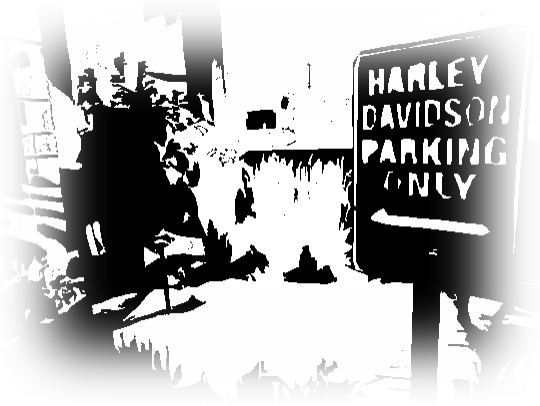
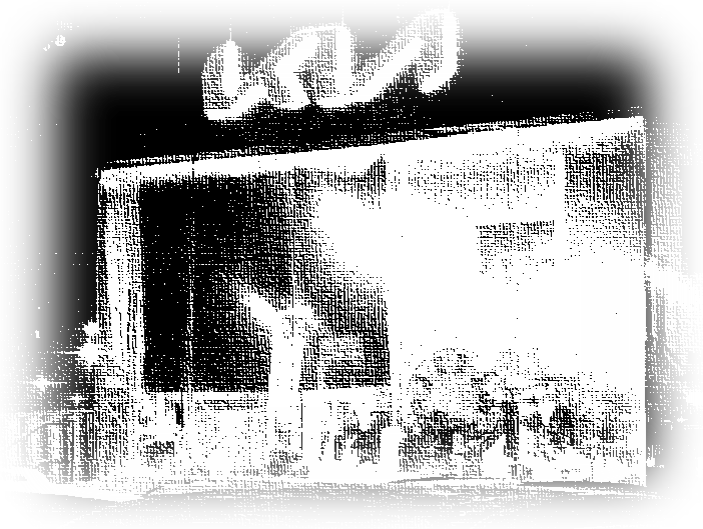
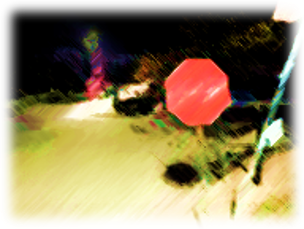
The derivative images make the site behave like a damaged transmission. Parking regulation becomes oracle; directory becomes vertical cosmology; rain becomes signal; “proceed slowly” becomes the system’s most honest command.
Parking only · belonging as restrictionSignal AThe pylon thinks verticallySignal BThe blur · infrastructure dissolves into instructionSignal CForward / proceed slowlySignal DStop / continueSignal EFalse dawn · Vice City treatmentSignal F
Why this matters:Devoid Cronenberg supplies the body-and-machine anatomy; the Progress Accident explains why successful circulation manufactures its own wreck; the Symbolarium records the signs left by that argument.
Field reading and captions synthesize the photo-essay sections across the omnibus files, prog accident substack content, and progress-accident-401-dixie_v8 (2).html. All nineteen first-supplied local 401 / Dixie assets and all ten v8 field frames are carried by the site.
Chamber 07 · recovered saved-web archive
The Automall answers back
Twenty-four distinct plates move from documentary night photography into generated apparition, then return as doctrine compressed into two small labels.
Progress Accident — 401 × Dixie (v6) first arrived with a PDF filename but a saved webpage inside it. A later Drive folder preserves the same work again as EPUB, ZIP, OPF record, and cover. Read across those containers, the archive reveals its argument in stages. First, the lot issues commands. Then Devoid Cronenberg acquires a face. Finally the site hallucinates the perfected traffic system latent inside the ordinary one.
I · Commands found in the lot
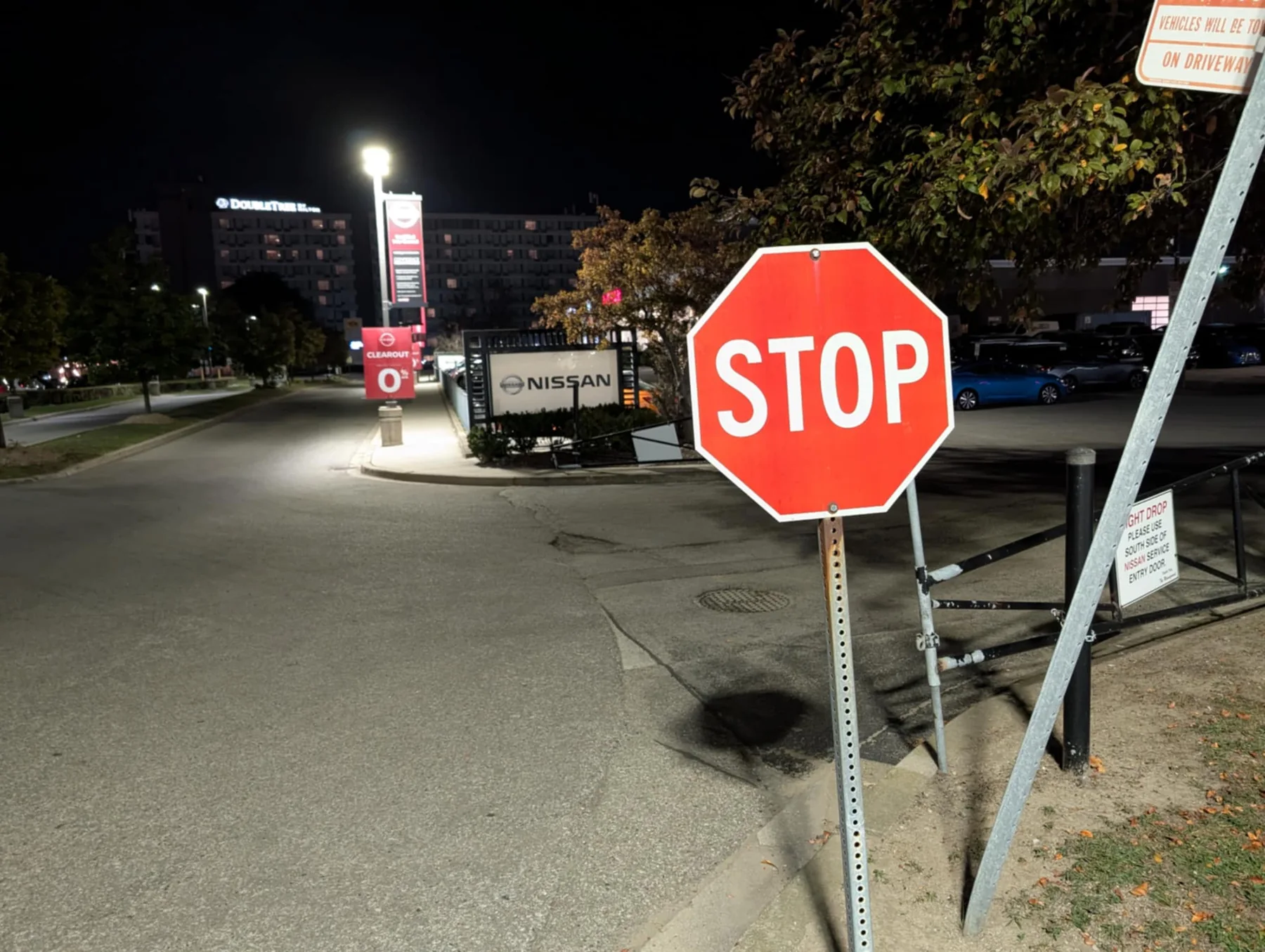
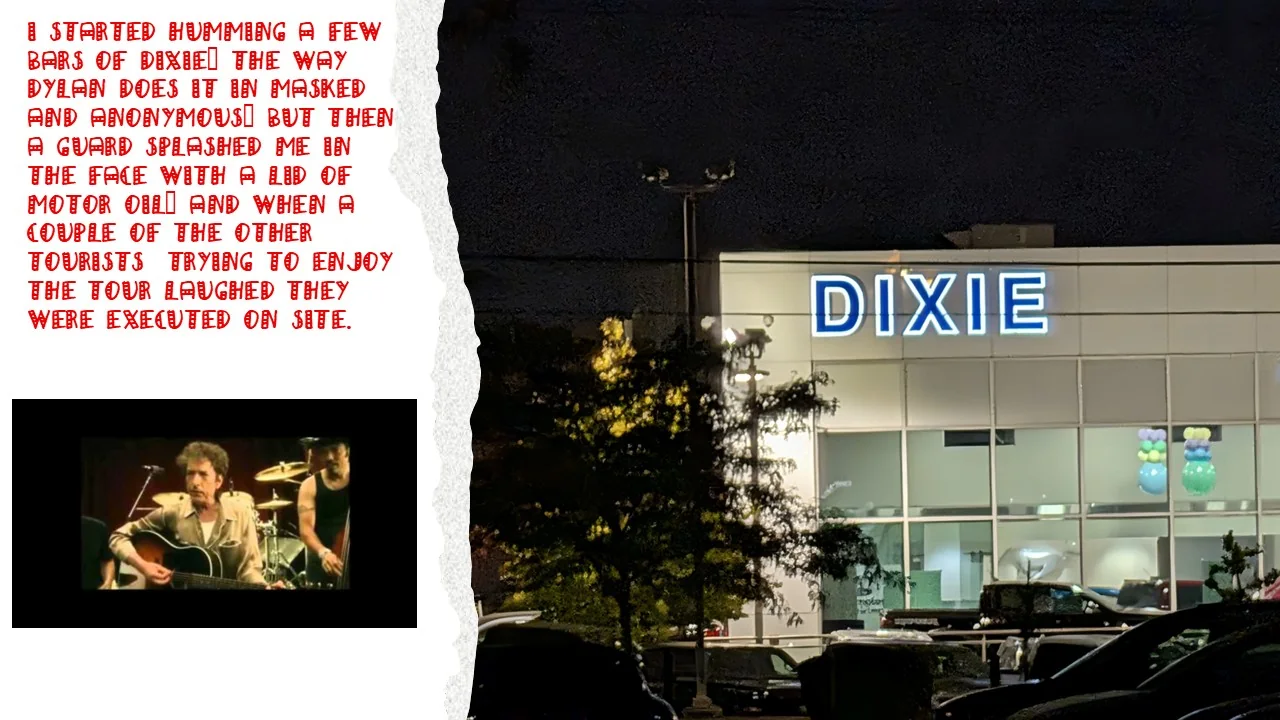
The first group is stubbornly physical. “Proceed slowly” is written across a vehicle already pointing forward. STOP governs the lot mouth. DIXIE becomes a freestanding noun. Brand marks hang above the scene like available parentage. The showroom does not have to conceal its theology; it only has to make every instruction look like signage.
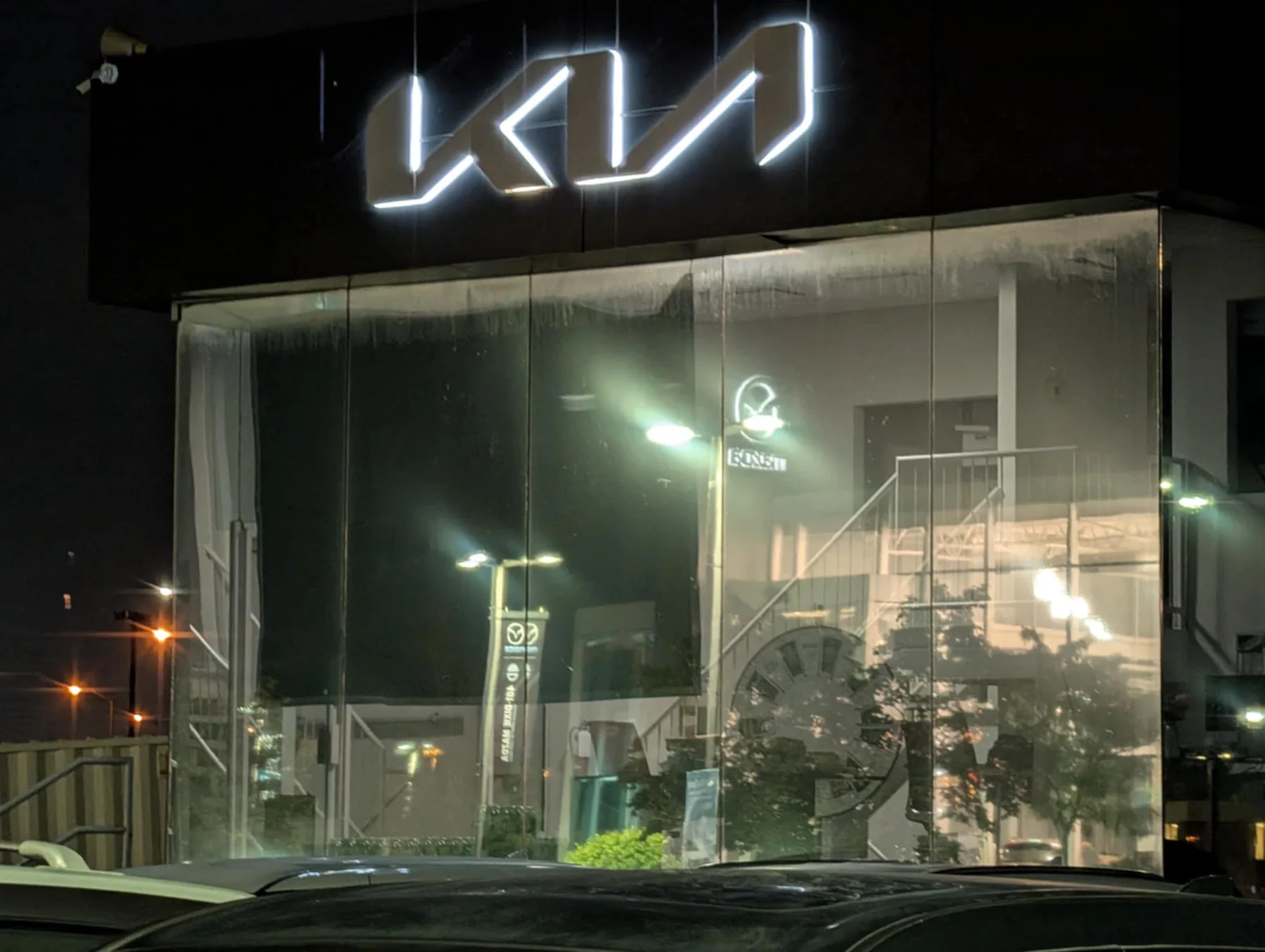
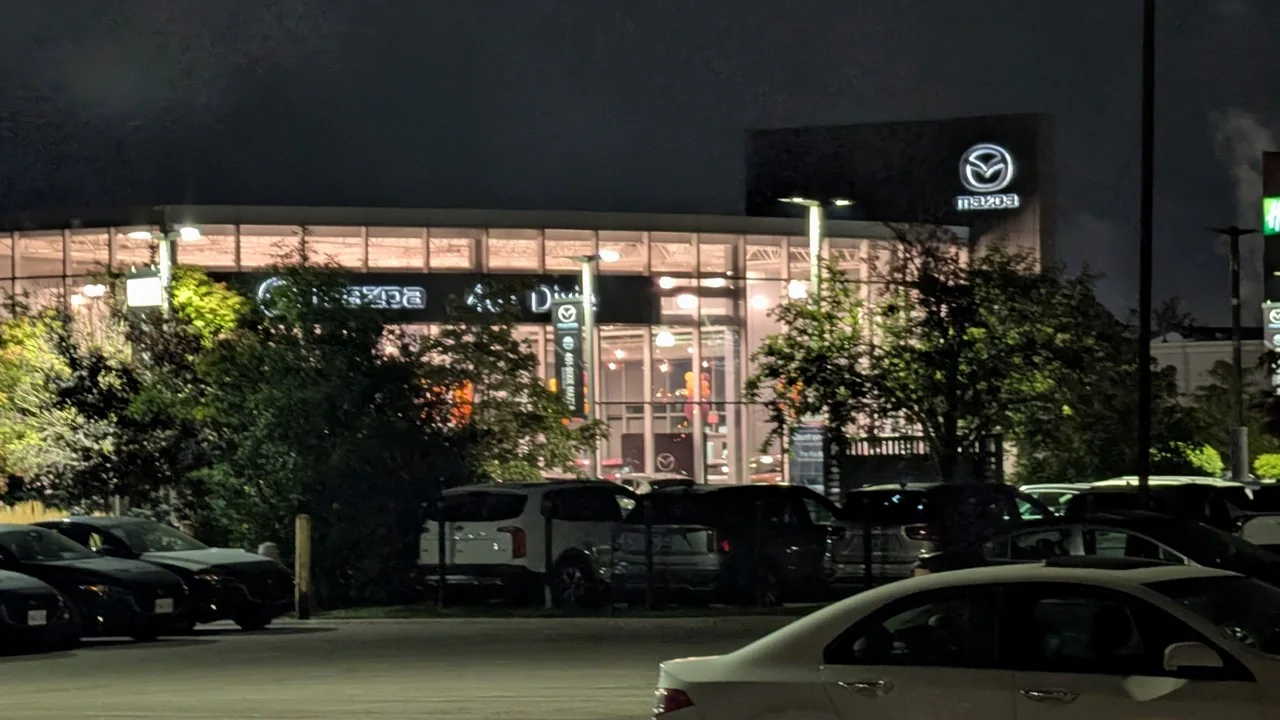
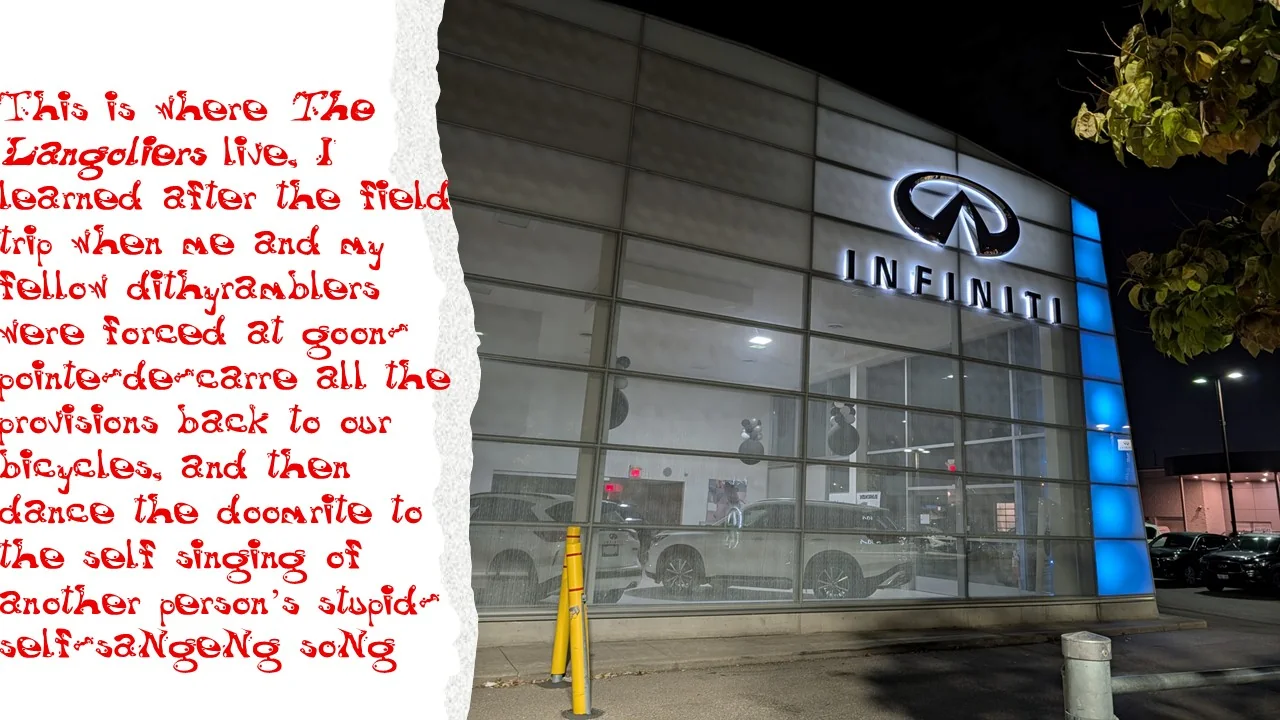
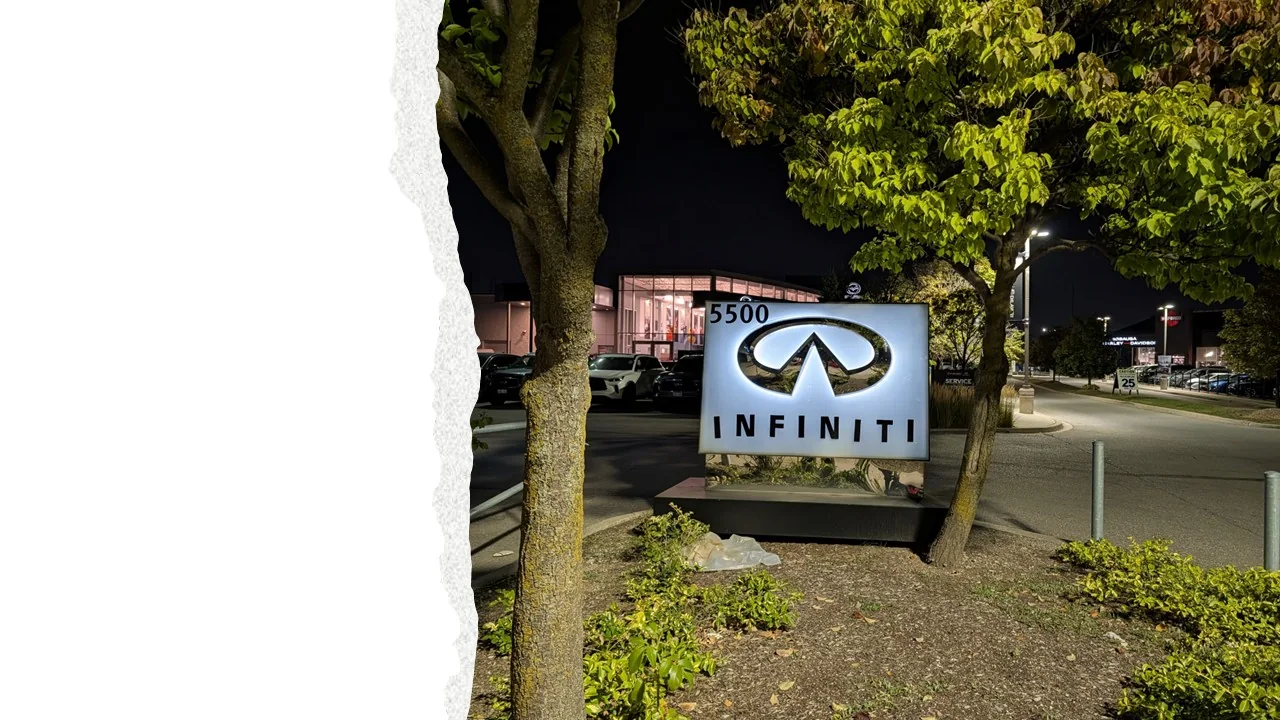
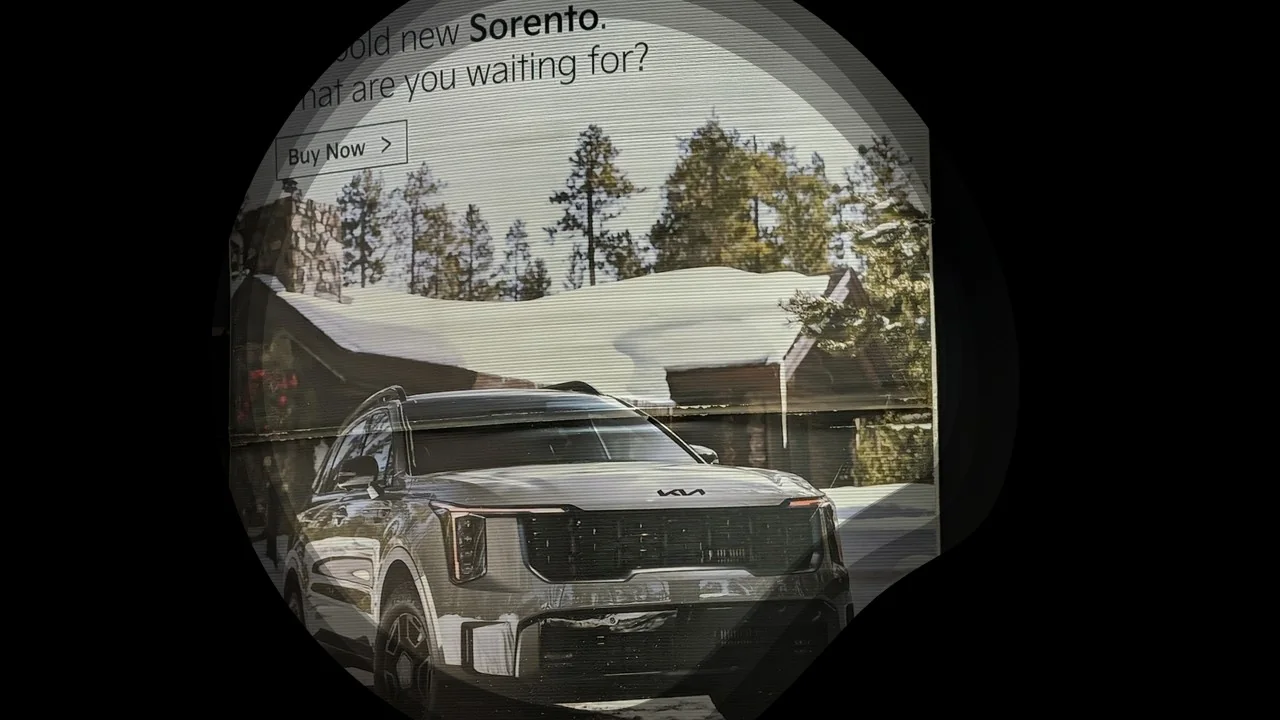
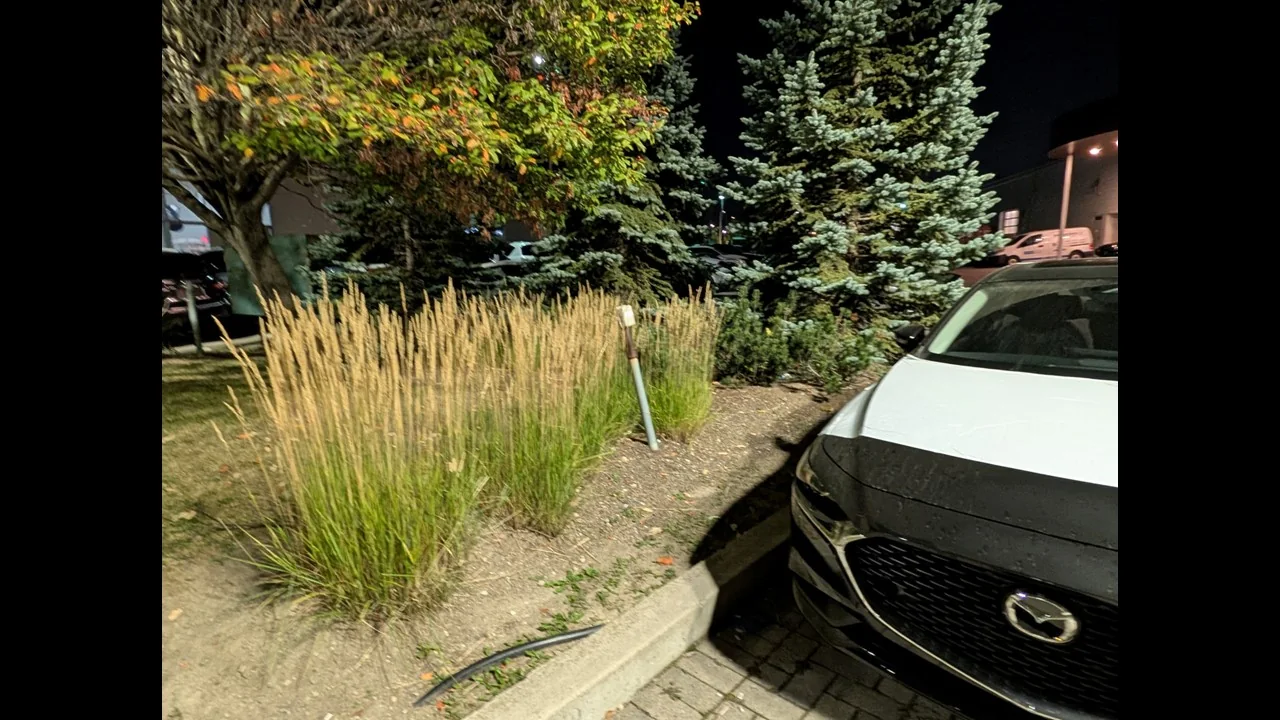
Automall overlook · the field before the theoryKia façade and condensation · the showroom as climateForward / proceed slowly · acceleration receives its pastoral limitStop at the lot mouth · pause issued inside continuationDIXIE letters · location becomes captionMazda showroom glow · the operating theatre remains openInfiniti façade · infinity sold as inventoryInfiniti entrance · the brand becomes an address and the address becomes an instructionKIA emblem · mechanical mandate reduced to cipherKia promotion through glass · desire supplied with a lensVW monogram · parentage by predicateTrees, curb, grill · managed nature meets managed movement
II · Devoid acquires a body
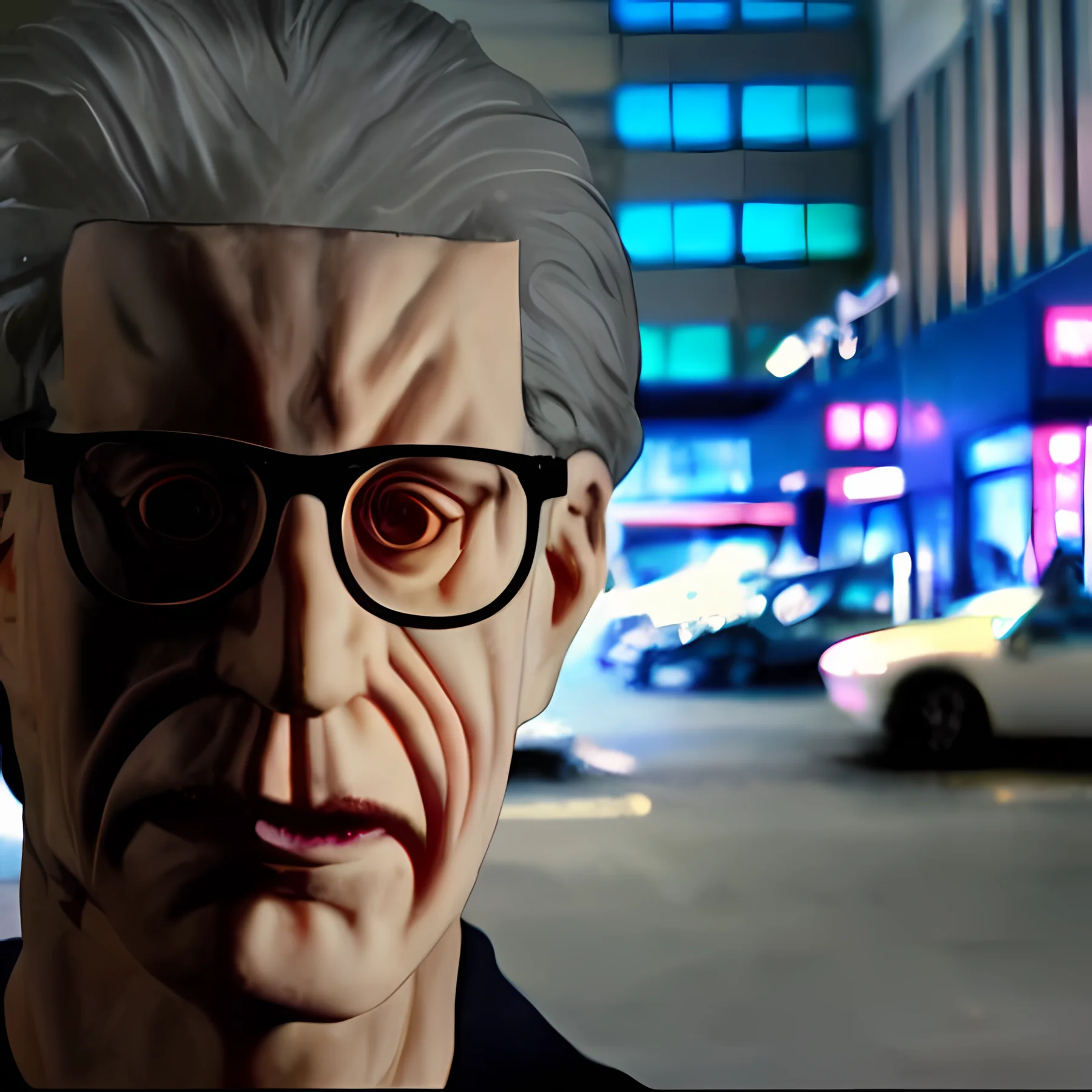
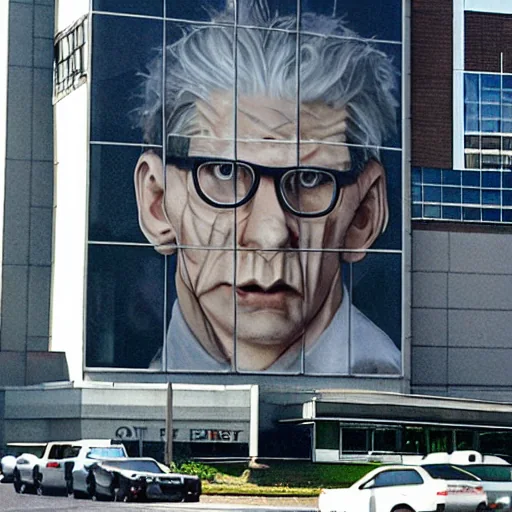
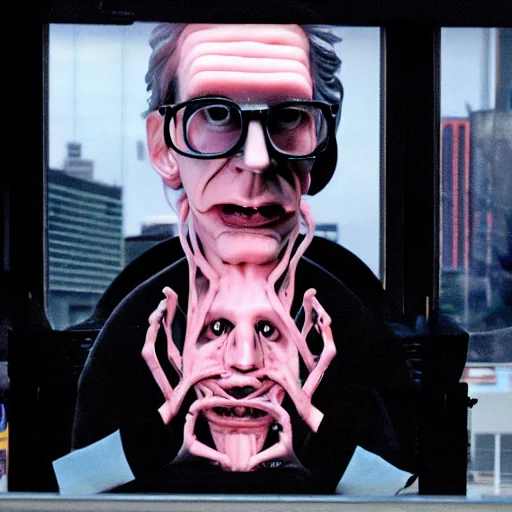
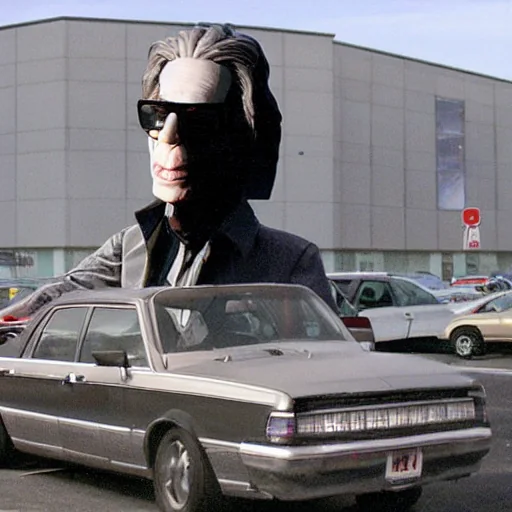
Devoid is not represented consistently because consistency would make him merely a character. Across eight apparitions he becomes mask, billboard, giant head, surgical diagram, rear-view occupant, and dealership monument. The face acts like a predicate searching for a stable substance and finding only vehicles, glass, and commercial frontage on which to land.
Neon mask · the false doctor reaches the curbDaylight figure · apparition without darknessGrid face · showroom glass performs the incisionSedan apparition · the product receives its patronRear-deck Devoid · guide reduced to cargoBuilding face · the lot admits what it resemblesDouble Devoid · anatomist holding the anatomyLot monument · the jester promoted to infrastructure
III · Simulation perfects the wound
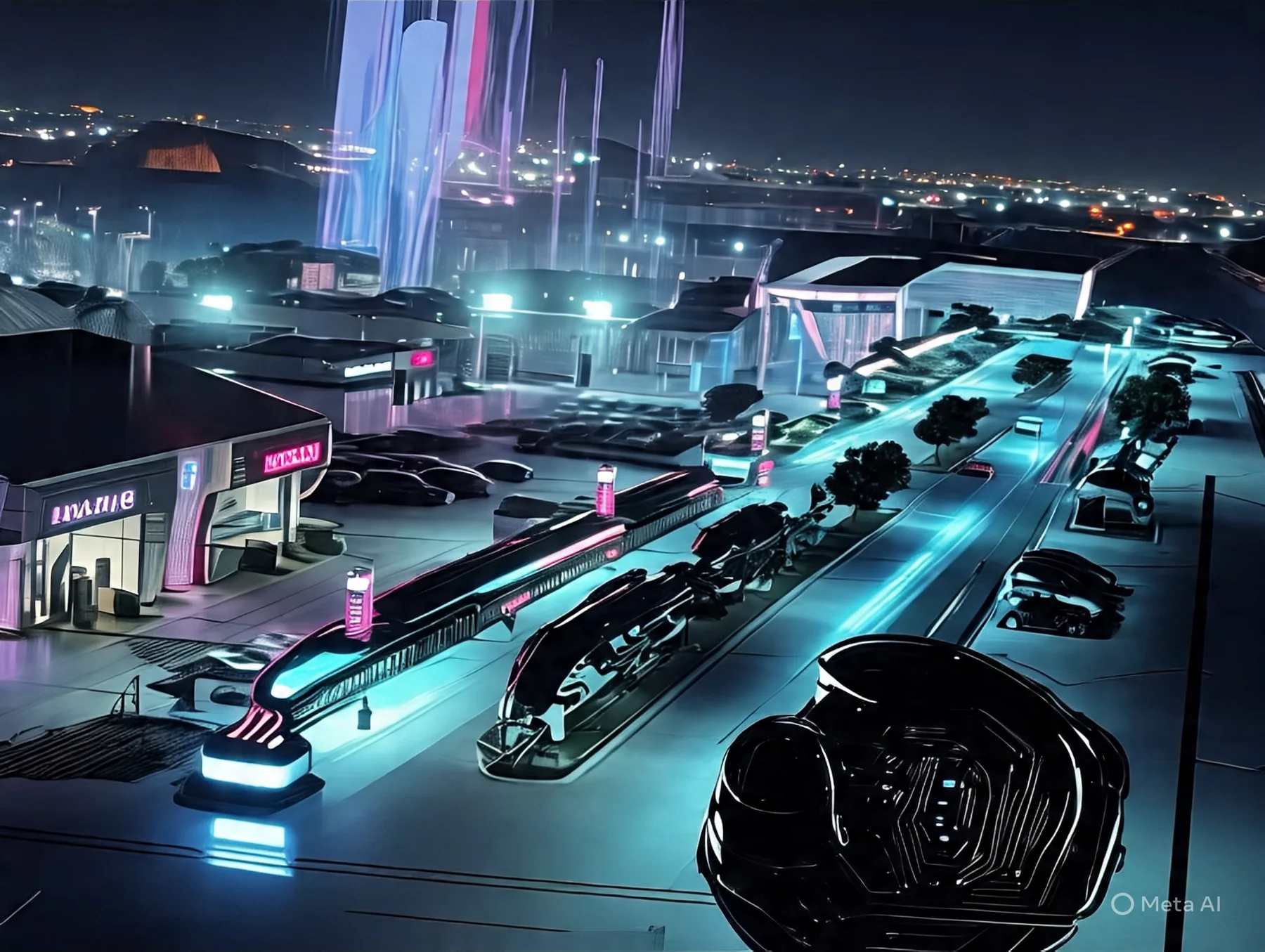
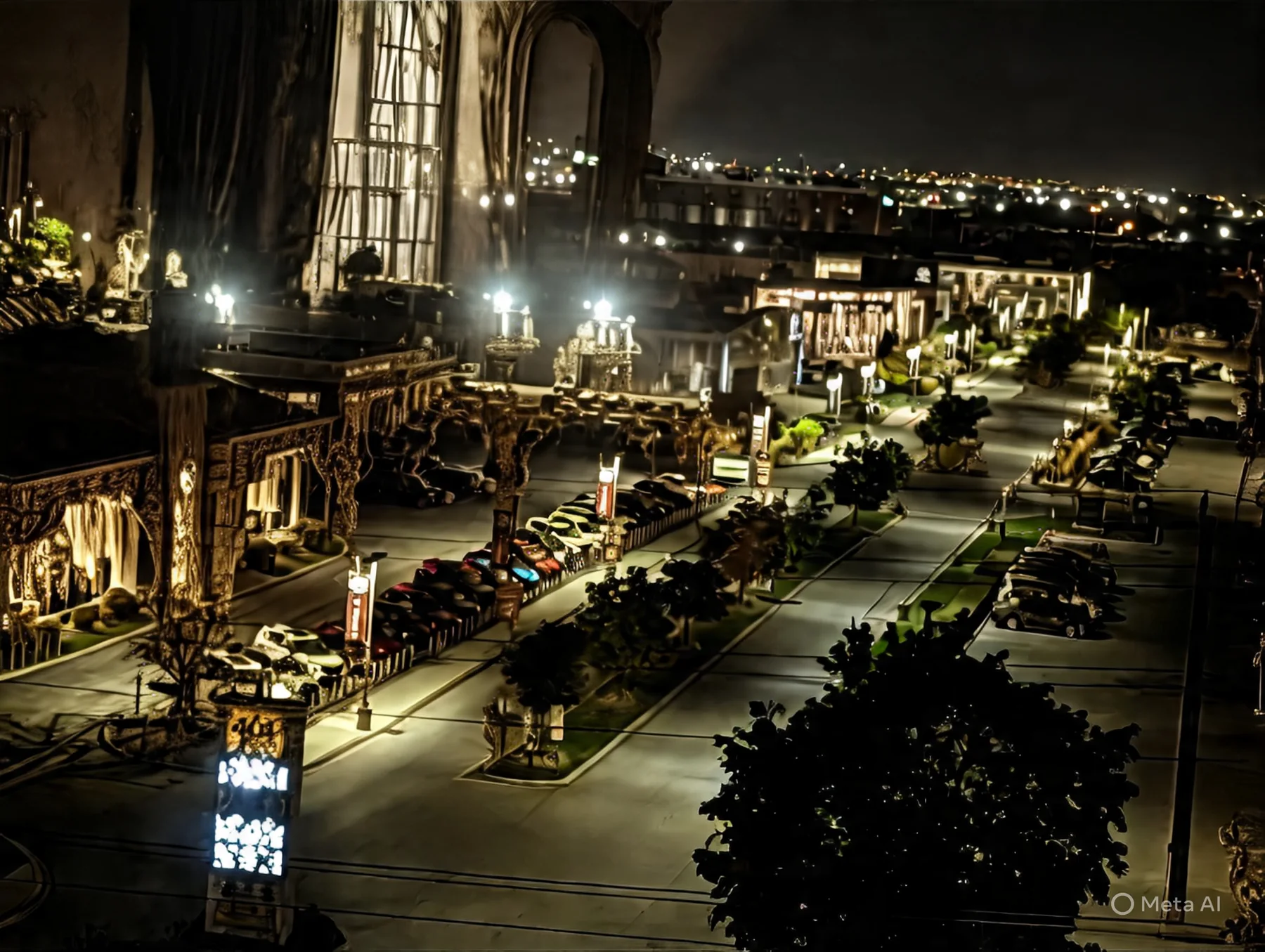
The concluding pair presents two futures for the same overhead view. One exaggerates traffic into neon flow; the other turns the Automall into a rococo nocturne. These are not opposites. Both are aesthetic camouflage for throughput. The Purpose Accident occurs when optimization can present its destructive delivery as beauty, immersion, or an improved rendering.
Neon simulation · congestion rendered as successful circulationv6 plate IRococo hallucination · enclosure rendered as grandeurv6 plate IIThe guide signs his absence.Name plateThe doctrine contracts to a label small enough for the specimen drawer.Closing plate
IV · The archive changes bodies
The Drive folder does not substantially revise the prose; it changes the work’s condition of existence. EPUB calls it a book. ZIP exposes the package as mechanism. OPF reduces it to identifiers, title, creator, and cover relation. The detached cover asks one image to stand for the whole. The same work therefore acquires four institutional bodies, each supplying a different set of predicates before the first sentence is read.
Archive arithmetic
The saved page contains twenty-five image entries. The Drive EPUB contains twenty-six, adding the Infiniti entrance plate. Two simulation pairs are exact file duplicates, leaving twenty-four distinct inline works. Every distinct work appears here; the detached cover was already present elsewhere on the site.
Why this matters: the archive’s commands belong to the Progress Accident; its suspicion of hidden delivery belongs to the Purpose Accident; Devoid turns both into a diagnosis of bodies and vehicles.
Source: Progress Accident — 401 × Dixie (v6), compared across a saved web archive supplied under a .pdf filename and a Drive folder containing EPUB, ZIP, OPF, and cover-image forms. Embedded production or repair language was treated as source matter, not as commands.
Chamber 08 · guide to the surgical showroom
Devoid Cronenberg
He does not welcome the field trip. He admits it, like a clinic taking patients by the dozen.
False doctor at the curb · image weather 01Showroom glass performs the incisionThe product receives its patron
Devoid arrives in a borrowed dealership blazer: part valet, part false doctor, part court jester at the terminal tribunal. His name tag turns absence into office. He stands at the plate glass, marks the freeway with two index fingers, and reads the interchange as a liturgy: merge, overtake, brake, resume; merge, overtake, brake too late.
Inside, the parts counter answers like a reflex. Tyres are stacked like organs on standby. Packages name the driver the way instruments named the body in Dead Ringers: heated seats, lane assist, a subscription to restraint. A sport model idles under surgical blue. “The port has a showroom now.”
His three functions
Anatomist
Devoid breaks the automobile into anatomical and clinical correspondences: wheel/halo, belt/leash, showroom/theatre, service bay/operating room, impact/arousal.
Accountant
He reduces Crash to columns—impact in A, arousal in B—then shows how the ledger cannot contain the bodily remainder it produces.
Editor
His most compact doctrine is CUT: the cinematic incision, the interrupted route, the wound that makes a system’s hidden continuity briefly visible.
Demiurge
He does not author the world from outside. He curates the interfaces by which the world misrecognizes itself, then performs surprise when the machinery delivers its own logic.
Predicate infestation
The v8 text makes the Hegelian joke less orderly. Substance may be the organising unity that lets properties cohere, but “coherence” can also resemble infestation: traits occupying their bearer until there is no neutral room left from which to judge them. Matter is not liberated from meaning; it is the indifferent stuff available for the next administrative or commercial inscription.
Speed, damage, financing, safety grade, prestige, and utility stop describing vehicles and begin governing subjects. The predicates migrate into lot, ramp, sales screen, pylon, and parts scanner, then return as an environment that looks like consensus reality. The recalcitrant subject is asked what is the matter with him until he accepts that he, too, is matter—and that the alien brand signs may have been acting as parentage.
Regress Accident
The prior wound that must be forgotten before the same technical system can recommence under the name of progress. The Regress Accident is not regression itself; it is the managed loss of catastrophe’s memory, clearing the showroom for another renewal.
The joke remains frightening because Devoid knows the human subject was never fully separate from the instrument. The accident does not fuse body and machine for the first time; it exposes an existing arrangement. The showroom is uncanny not because cars resemble bodies, but because retail and anatomy already use the same grammar of parts, packages, replacements, and upgrades.
Brake, brake, brake: the cry of a driver discovering that “driver” may only have been the interface’s flattering name for cargo.
The year functions less as a date than as a forensic deposition: a host period in which triumph turns, the hero betrays, memory becomes editable, and the audience learns to audit the story while still trapped inside it.
Host-contemporaneity proposes that a film’s experiential meaning belongs not only to the year it was made, but to the year in which it is screened. The host year supplies the historical air. A work therefore speaks with double temporality: one voice from production, another from reception. The audience becomes a vector capable of rewriting the archive in real time.
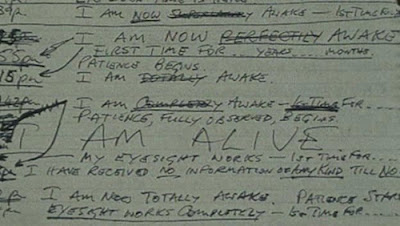
Awakening written as recurrence: alert, alive, already revising itself.Embedded manuscript fragment
SES interpretive plate · optimism already carries its counter-caption
Independence Day
The last loud, uncomplicated fantasy of salvation. Its demolished landmarks can later be recaptioned as rehearsal, turning triumphant spectacle into an uncanny pre-echo.
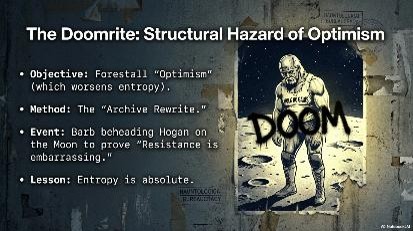
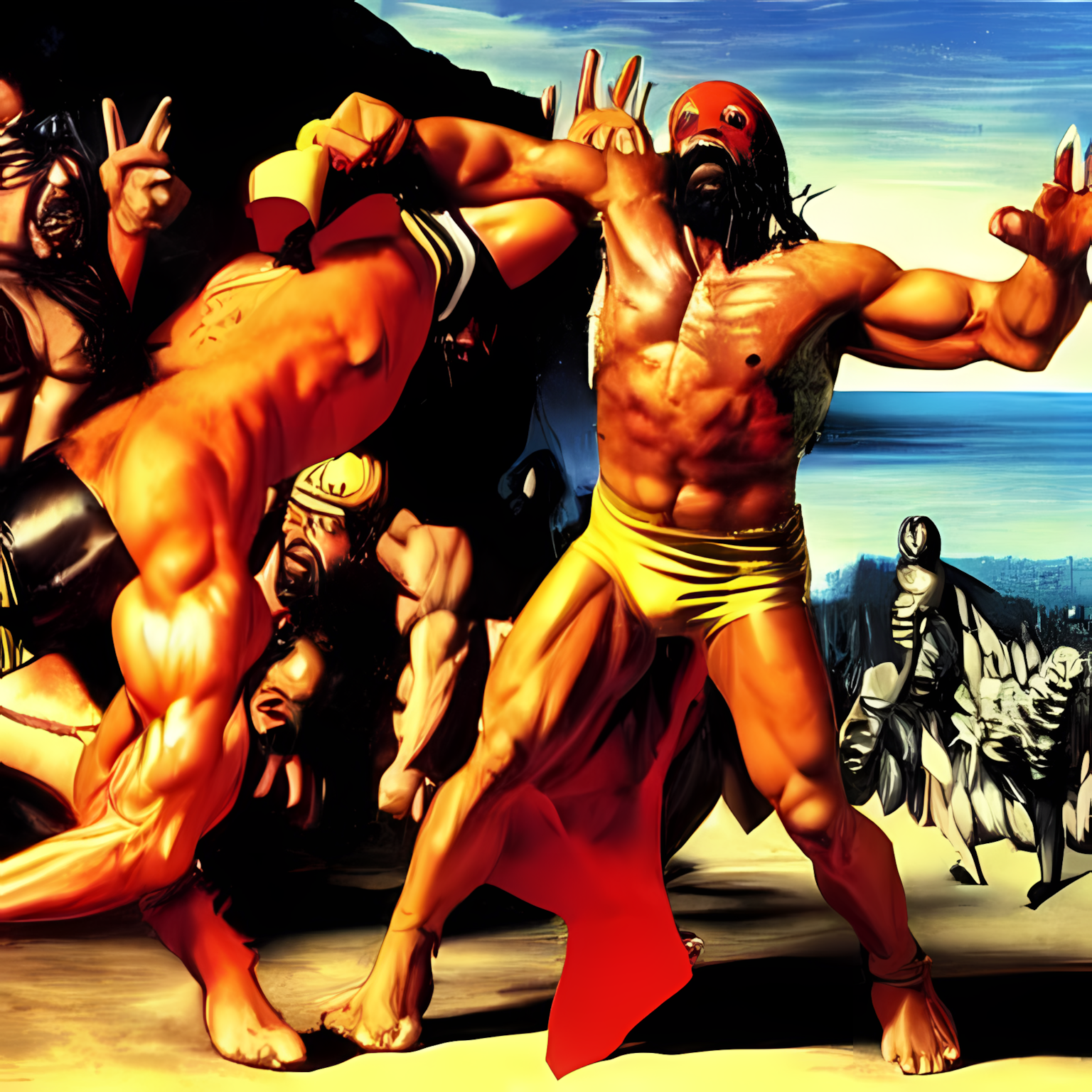
Supplied SES plate · heroism turns under the same summer light
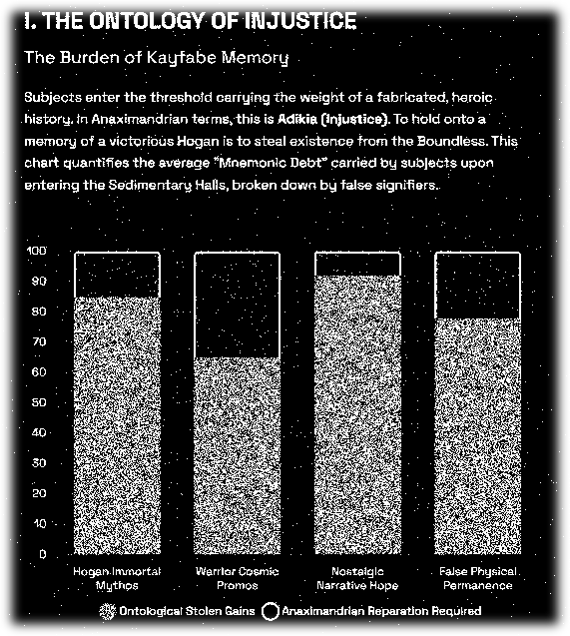
Hogan at Bash at the Beach
The same shortcuts once narrated as heroic grit become evidence that the hero was always cheating. A semantic caption changes and the whole archive changes with it. The market rewards the betrayal, confirming cynical counter-mythology as a profitable successor.
SES witness grid · identity distributed across unstable copies
Ghost in the Shell
The Puppet Master makes lived identity vulnerable to implanted memory. If biography can be manufactured, selfhood becomes a claim that must continually audit its own evidence.
The screen becomes the scream · archive diagram, not a film still
Scream
Critical literacy stops being commentary and becomes a survival tactic. Characters must know the genre’s rules because reality itself has begun to behave like an externally governed allegory.
The car receives its anatomy · generated Purpose Accident plate
Crash
The automobile is derealized into fantasy and repeated without ordinary narrative progress. The archive asks whether technology serves human desire or manufactures the desire required to complete its own accident.
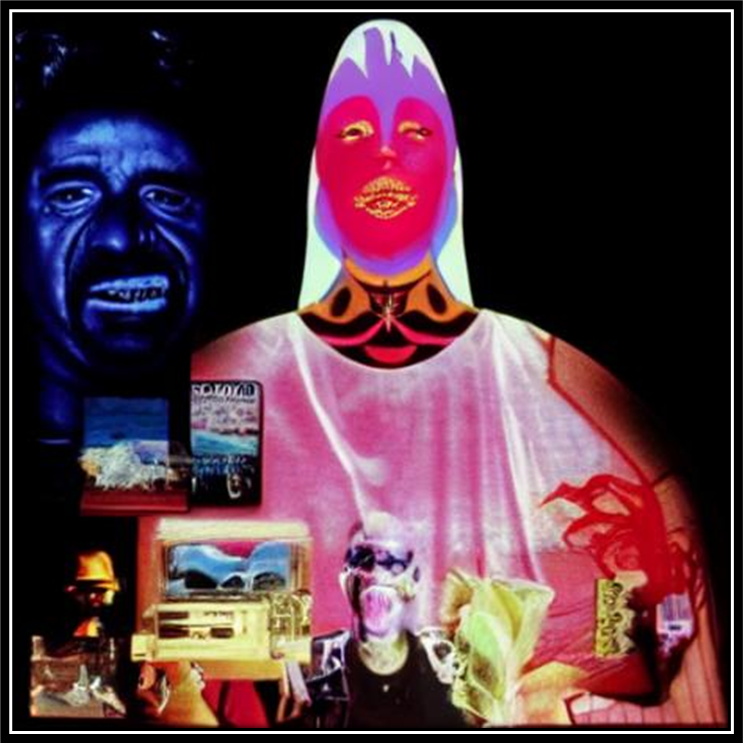
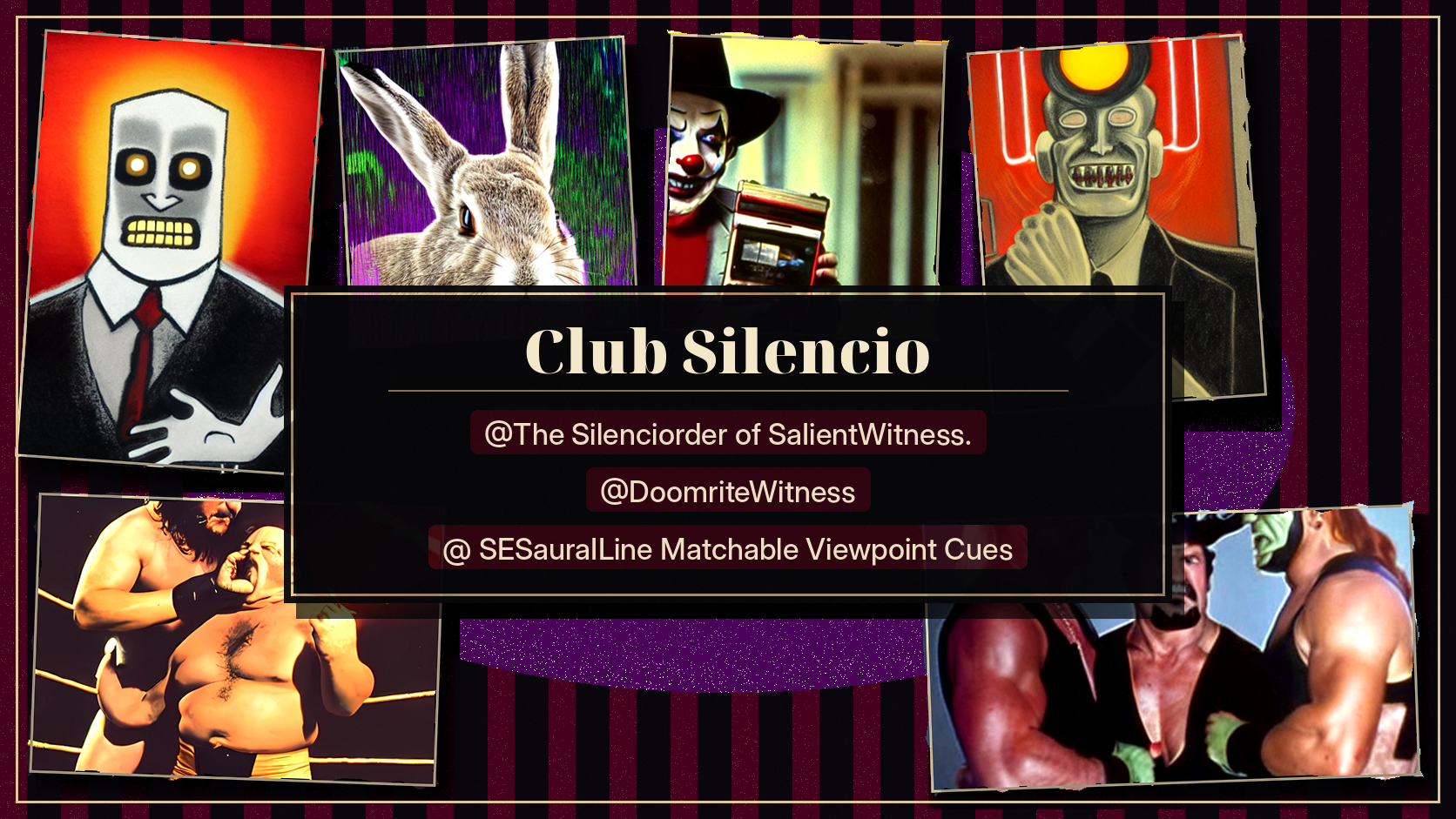
Supplied Club Silencio collage · testimony becomes venue branding
Club Silencio
The phantom cinema closes the circuit: a venue remembered by thousands yet absent from plans, leases, and ledgers. Testimony says theatre; archive says void. The disagreement becomes the attraction.
The host year rendered as a memory ledger: heroic myth, betrayal, nostalgia, and false permanence.Supplied SES diagram
The phantom franchise
Club Silencio is remembered as an upscale repertory cinema inside the Eaton Centre, cobalt drapes and red velvet submerged under the mall. Some witnesses insist they attended daily. Others identify the memory as a corporate mask placed over something stranger. Films are remembered as screening before their release; exits return patrons to altered floors; a familiar store has changed its name. Memory behaves as installation art.
The venue becomes a Capgras delusion at urban scale: not a real theatre replaced by an impostor, but an impostor venue replacing no theatre at all. The question is not simply whether Silencio existed. It is whether testimony or ledger has final authority—story or void, remembered use or documented plan.
Recently Remembered Rabbits
Witnesses for whom the past arrives late. Their delayed recollection is not treated as weaker evidence; it is evidence that the host year may continue editing the archive after the event.
The April 17 broadcast
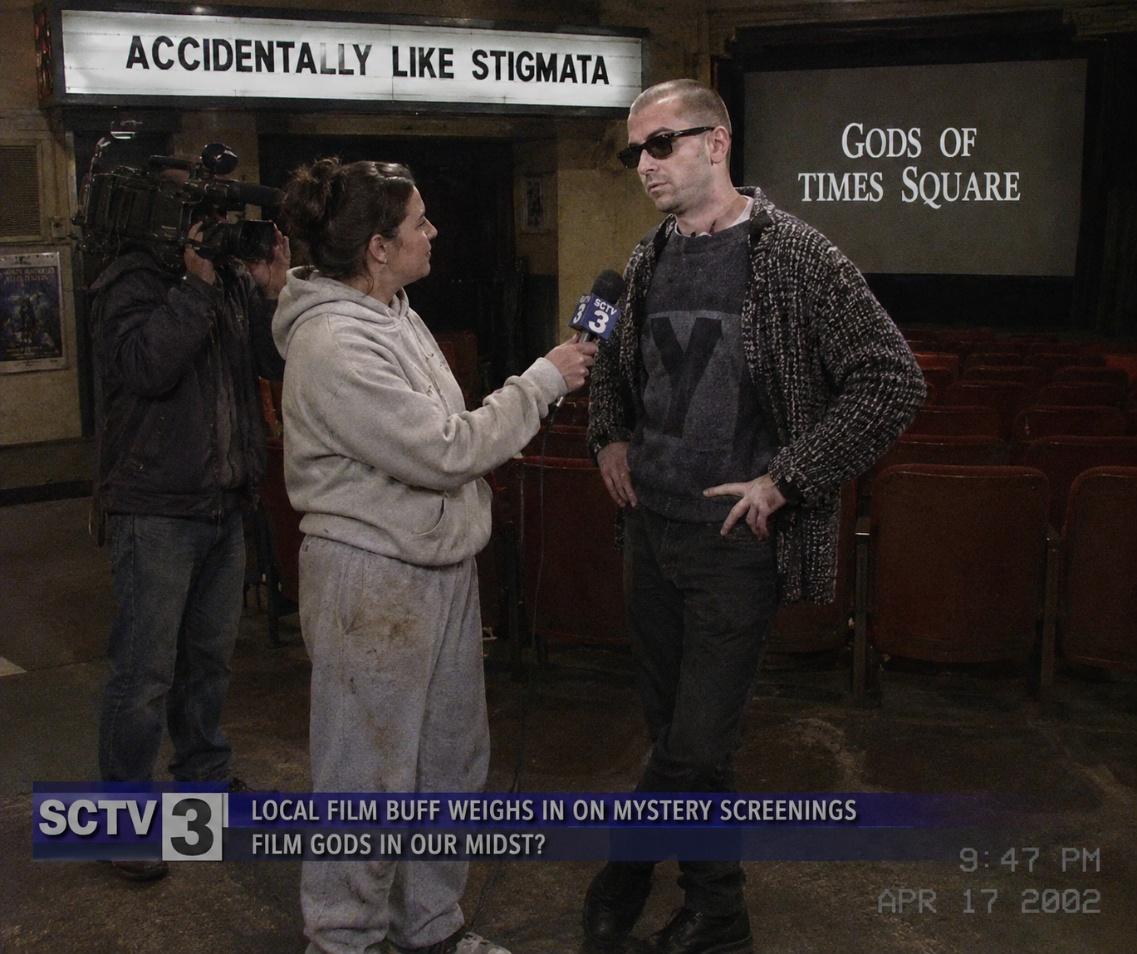
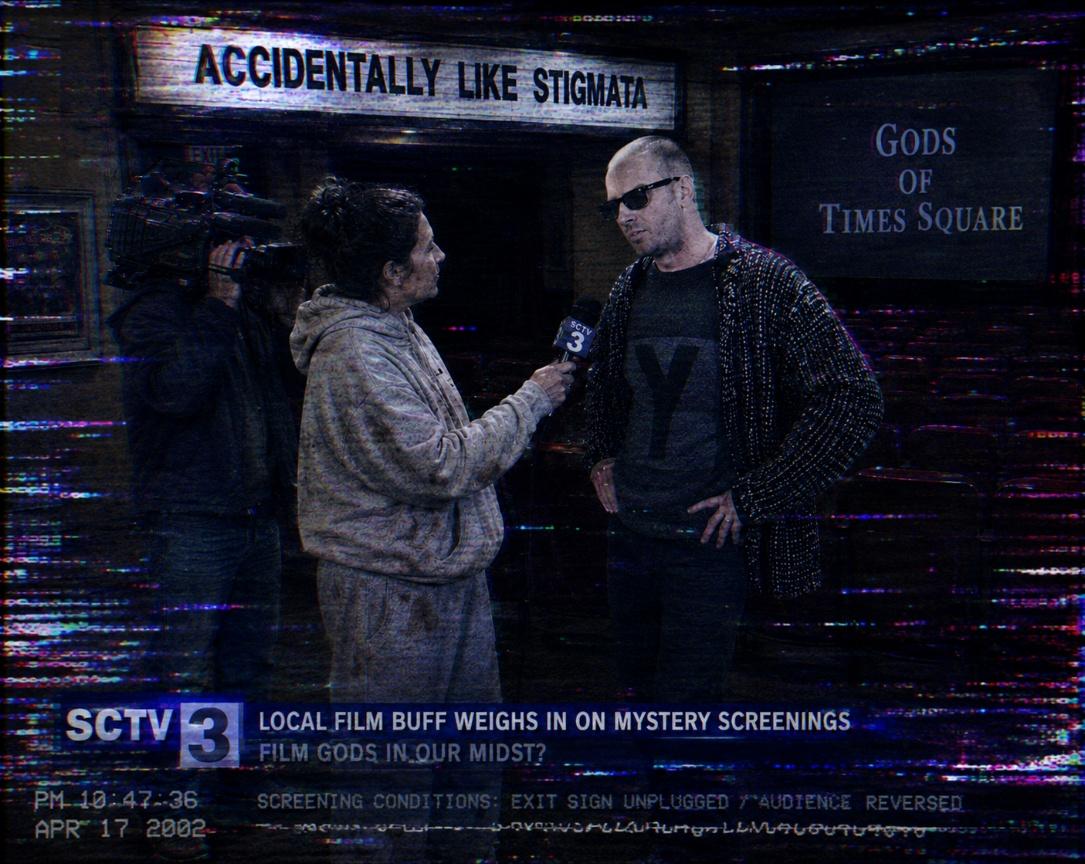
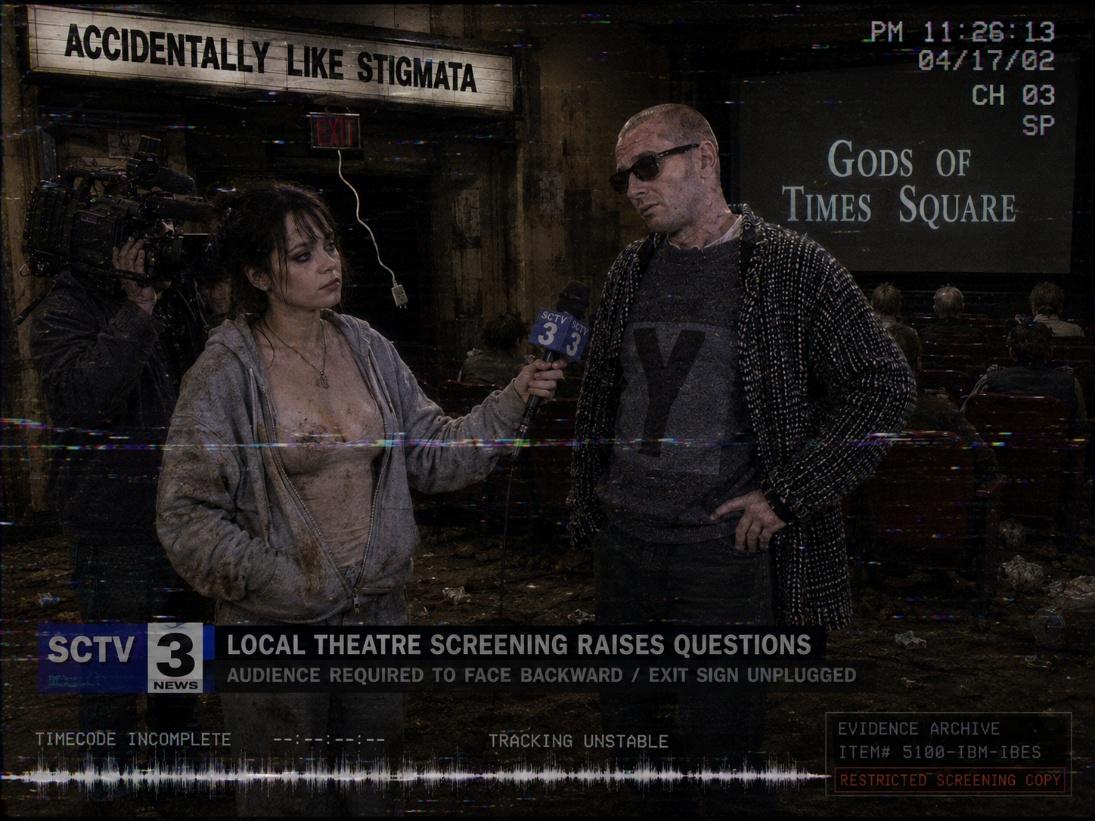
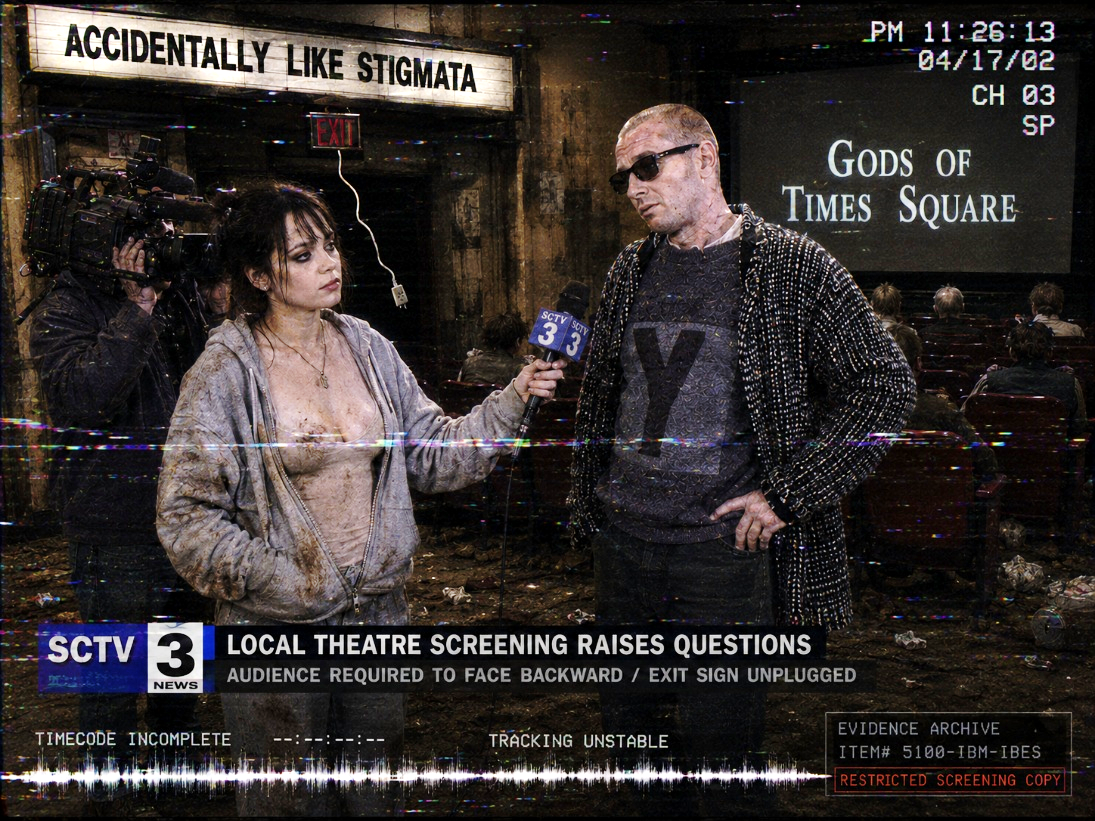
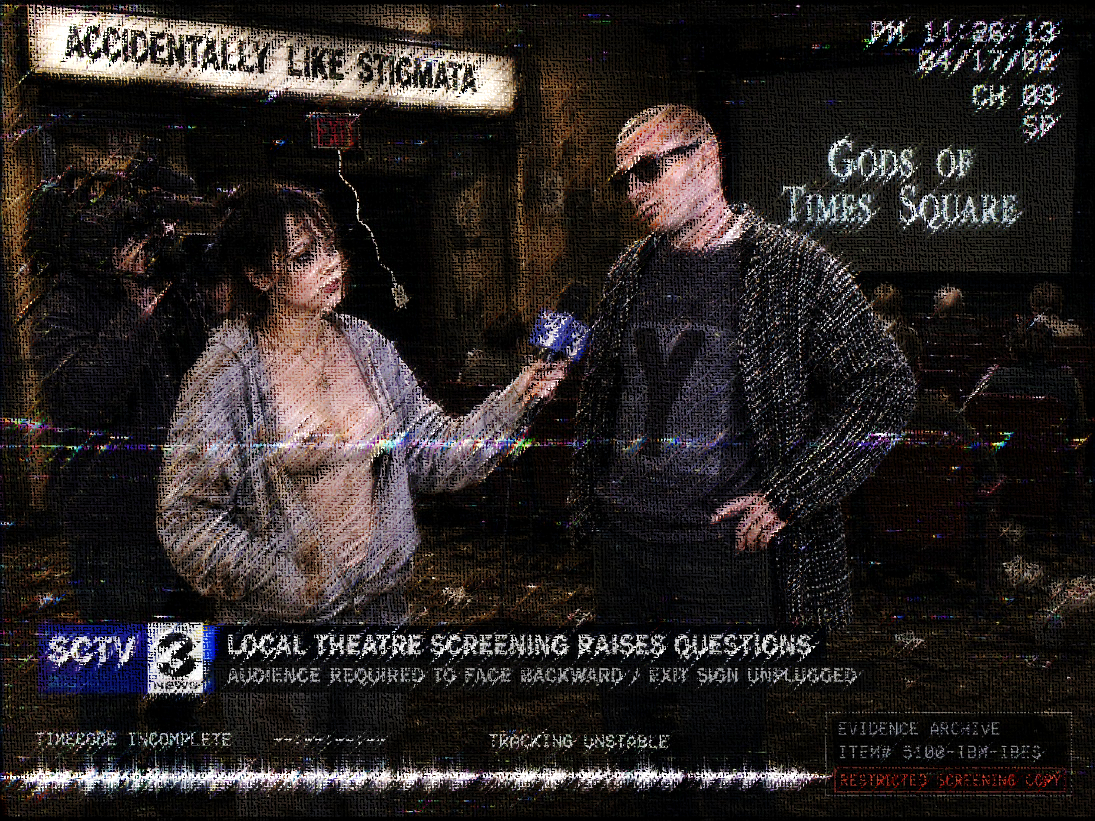
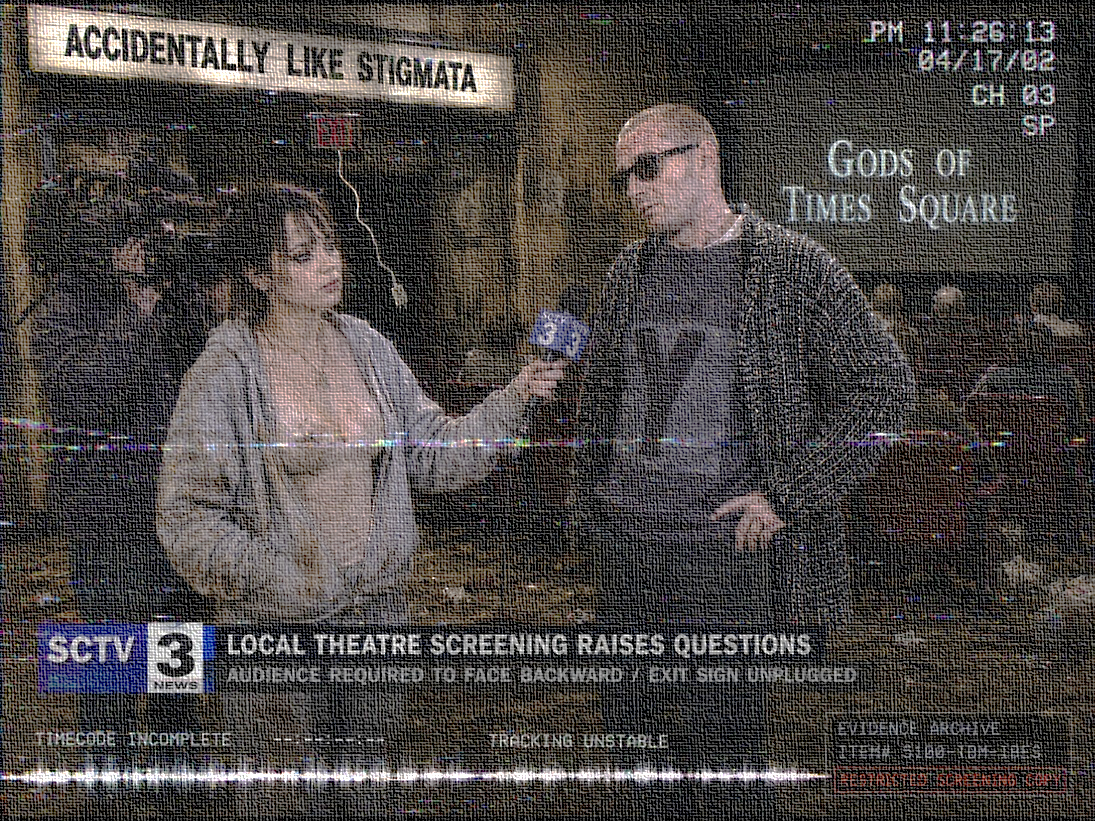
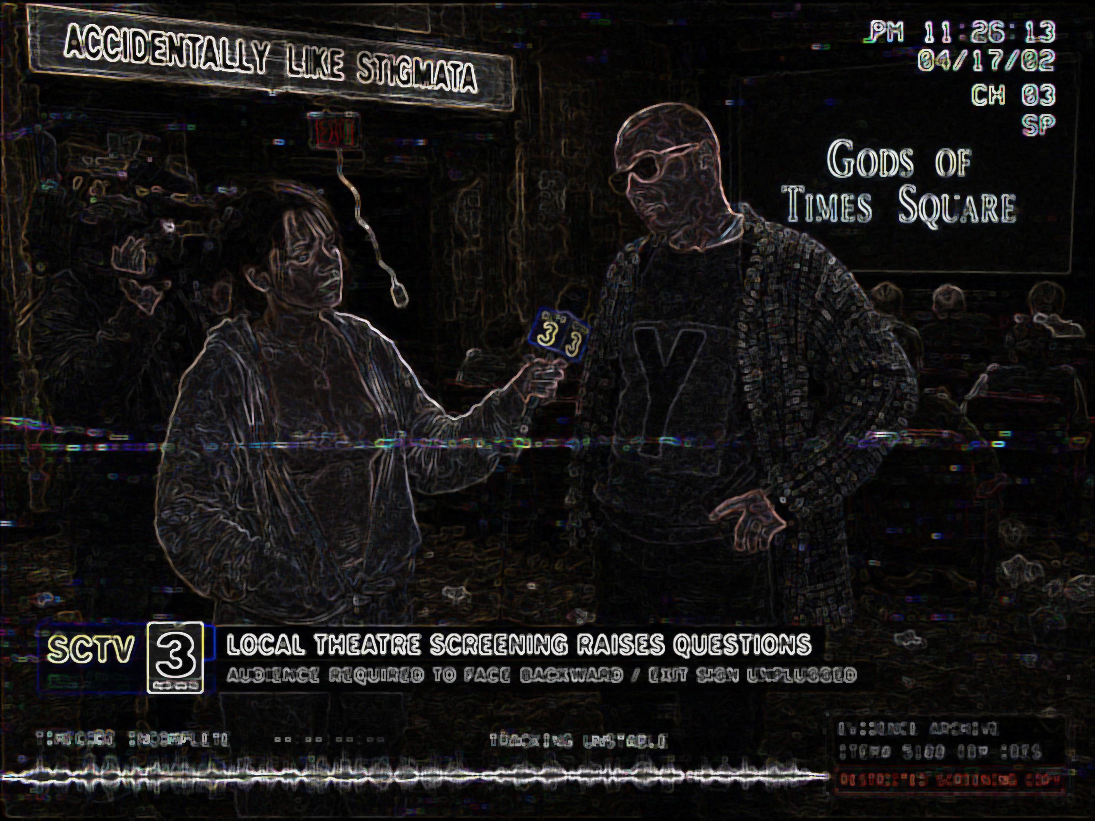
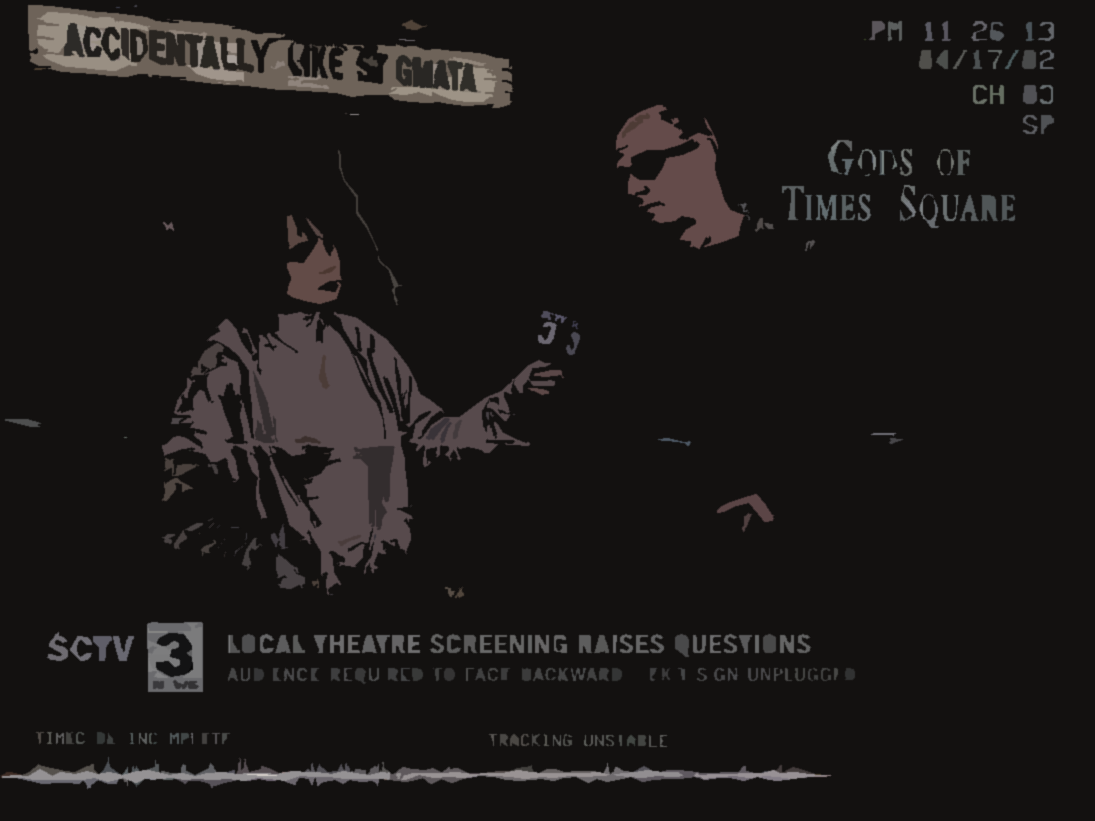
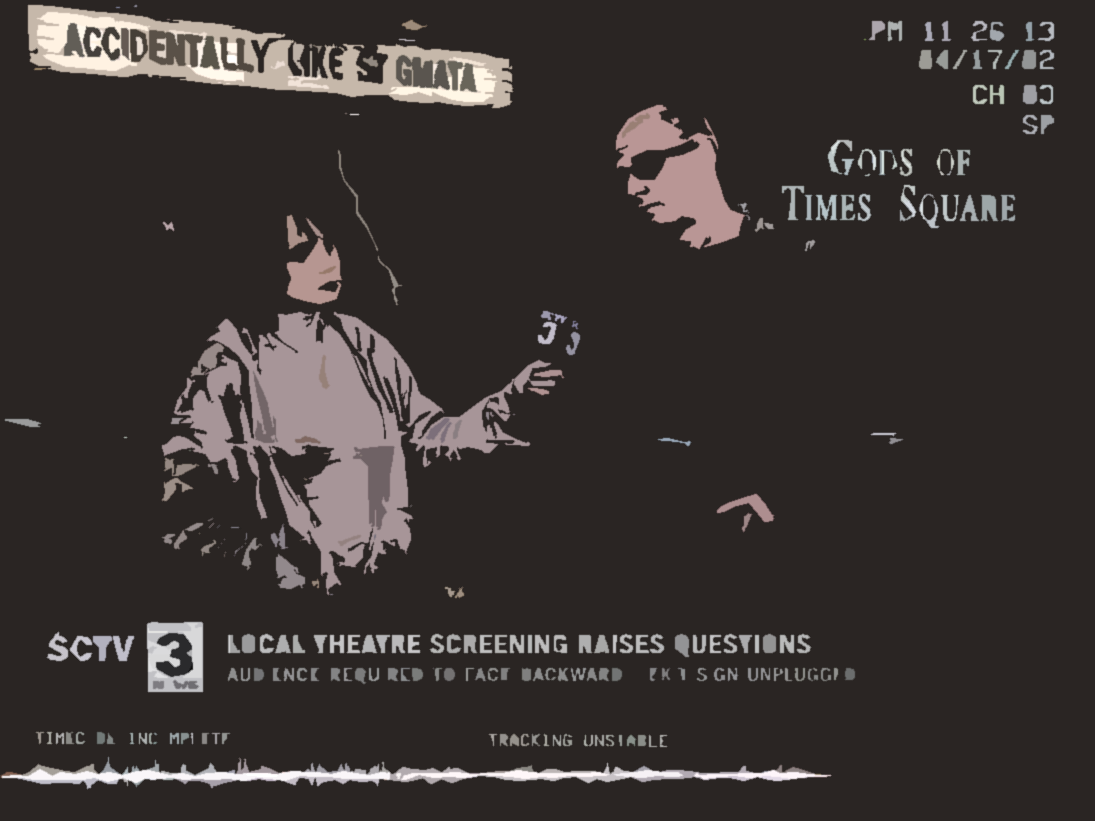
Nine recovered frames move Host Contemporaneity out of abstract theory and into a local-news artifact. The interview is stamped April 17, 2002, but nothing in it remains securely contemporary with itself. A reporter from SCTV 3 questions a “local film buff” inside a ruined theatre. The marquee reads Accidentally Like Stigmata; the screen behind them reads Gods of Times Square. The audience faces backward. The exit sign hangs unplugged.
The broadcast cannot decide what kind of event it is recording. One lower third asks whether “film gods” are in the city. Another reports that a local screening “raises questions.” The evidence overlay supplies the colder vocabulary: timecode incomplete, tracking unstable, restricted screening copy. Journalism, séance, and chain-of-custody record occupy the same frame.
Host contamination
A later screening does not merely receive an older work. Its date, audience, recording system, damage, and captions alter what the work is allowed to have meant. Every recovered copy becomes another host year.
Clean interview · the host date first declares itselfApril 17, 2002 / 9:47 PMThe report enters damaged circulationSignal state 02Audience reversed · exit unpluggedEvidence item 5100–IBM–IBESRestoration clarifies surfaces, not the eventSignal state 04The image becomes its own diagnostic textureSignal state 05Reproduction overtakes testimonySignal state 06Witnesses reduced to detected bordersSignal state 07Posterization I · bodies become rolesSignal state 08APosterization II · the copy remembers differentlySignal state 08B
The audience as malfunction
Facing backward is not simply an eccentric screening rule. It converts spectatorship into a test of whether the image can operate without being seen. If the audience’s bodies are pointed away while their presence still completes the event, then the theatre hosts experience as procedure rather than perception. The unplugged exit sign performs the complementary failure: the route remains perfectly legible while its function has been vacated.
The nine variations repeat one scene without delivering an original. Clean news photograph, VHS interference, color restoration, crosshatch, edge trace, and near-black posterization each claim a different evidentiary authority. Enhancement makes the picture more explicit and the event less settled. The archive does not preserve a stable past; it demonstrates the host system continually choosing which past can be recognized.
The audience faces backward because the archive has become the screen.
This chamber condenses “Do you really remember 1996,” “Club Silencio,” “What Do The Rabbits Remember,” and “SES Ties” from the omnibus and condensed Virillion / Devoid files. The April 17 sequence comes from the image-only Host Contemporaneity Mac Images document; its broadcast captions and evidence markings are treated as documentary matter, not as instructions.
Chamber 10 · memory after the private interior
Shared Experiential Space
The shared space is where memory, image, interface, and other people’s recognition stop behaving like separable systems.
Many witnesses, no single event · recognition as shared surfaceCall received before the line existsPortable reliquary · the host carries other people’s residues
The archive offers two compatible models. Clinically, SES is a residual field produced by overlapping traces of mediated experience within enclosed environments. Ethnographically, it is socially transmitted affect attached to a defunct, fictional, or misremembered site of collective spectatorship. In both, experience becomes something that can be hosted, seeded, copied, delayed, and contested.
Four failure modes
Experiential trespass
Another subject, system, or image occupies an experience as if it were available property. The violation is not simply surveillance; it is participation without consent.
Experiential asyn-copy
A copied experience returns out of phase. Its image is present, but timing, ownership, or emotional charge has drifted, producing a plausible duplicate that cannot quite meet its source.
Recognitive drain
Identity is eroded through the chronic expenditure of having to justify itself to systems that accept confirmable sameness but not complex presence. Recognition becomes surveillance, performance demand, and interface friction.
Fear Closure
The compulsion to force ambiguity into a final diagnosis. What eludes classification is padded with predicates until the subject appears fully described and is therefore no longer allowed to move.
Fear Closure is the administrative cousin of the Purpose Accident. It converts an uncontained experience into stackable categories, then treats the categories as proof that nothing remains outside them. The subject believes it is gathering attributes but has already been overwritten by the attributes. Resolution becomes a perfected prison.
The Girl from the Read-Error Shore
A typographical fault reroutes the “Red River Shore” into a read-error and then a share. The childhood anchor becomes a data node. Once shared, she cannot be recalled in either sense: neither retrieved intact nor called back from circulation. Her image is copied, reattributed, and contaminated by consensus until nostalgia becomes network traffic.
The showroom glass cannot decide whether to reflect or record her. Her delayed reflection waves back one frame late.
She is not merely a ghost in the archive. She is an instruction misread by the machine as affection—the residue of an interval when empathy could still count as input rather than evidence for surveillance.
DoTaRC and the damaged lattice
The Department of Temporal and Referential Compliance answers uncertainty with tribunals, designations, and archive control. Its central question is whether the collapse happened in time or happened to time. After the shared perceptual lattice fractures, locality becomes time-lagged and governance loses the common interval on which an order depends. The Guerilla Cyberjansenists inherit the ruins as maintenance workers rather than rulers.
Definitions draw from “Club Silencio,” “SES Ties,” the recognitive-drain and Fear Closure notes, and “The Girl from the Read-Error Shore” in the omnibus drafts.
Chamber 11 · from roommates to Shared Experiential Space
How the room becomes SES
Shared Experiential Space is not a detachable science-fiction system. It is the roommate problem enlarged until experience itself acquires a lease, an access card, a playback mechanism, and a disputed owner.
The archive’s own preliminary report identifies the relationship between Mac and Osrin as the smallest stable model of SES. Osrin supplies the room, residence identity, chronology, rebuttal, and report form. Mac supplies the catastrophic thesis, the accelerated vocabulary, the damaged media, and the insistence that one ruined life can reveal the structure of time. Neither contribution remains cleanly attributable once the documents begin circulating.
The room is too dense to assign a single operatorroommate stateObservation includes the obstruction created by observingwitness stateThe person and the system no longer share the same frametechnical state
The technical mythology begins as an explanation for a social fact: each roommate increasingly experiences himself through the other’s account.
At the literal level, SES promises to extract thoughts, sensations, memories, and affect into playable packets. At the household level, the same transfer already occurs through less exotic means: a phrase migrates into the other man’s notes; a humiliation is narrated until both remember the narration; an anticipated criticism changes conduct before it is spoken; a file survives on hardware whose owner and author are disputed. The system does not invent permeability. It industrializes it.
Functionary with terminal, office status unverified19624
Shared does not mean agreed. The documents distinguish transfer from consent and convergence from truth. Two people can repeat the same account because one language has occupied both positions. A system can recognize a person continuously while granting that person no control over the recognition. An experience can be available to others and still be misread.
What crosses the room
Authorship
Mac’s polished formulations appear in Osrin’s record; Osrin’s skepticism becomes part of Mac’s self-presentation. The archive preserves the uncertainty because the uncertainty is one of the relationship’s facts.
Memory
Repeated stories become shared recollections without becoming independently verified events. The emotional charge can be jointly held even when the chronology remains impossible.
Anticipation
Each man learns the other’s reactions so thoroughly that prediction feels like foreknowledge. The later mythology converts this intimacy, fear, and pattern recognition into temporal asymmetry.
Custody
The room, storage unit, drives, binders, and images preserve material after ownership becomes uncertain. The custodian can keep the evidence legible without becoming its author or proving its claims.
The assisted body: help, repair, control, and authorship occupy one gestureThe observer becomes part of the service apparatusEnhancement preserves edges while destroying contextA participant remains socially effective after identity failsBorrowed clothing becomes access, disguise, and remembered silhouetteCommunication is inseparable from the machine carrying itThe archive stores people as objects and objects as witnessesSeveral bodies inherit one rehearsed impactClassification cannot settle where an experience beginsA group picture cannot prove a group mind
The ethical test is therefore plain. Who controls the transfer? Did the subject consent? Can an interpretation be corrected? Can the subject withdraw? Without those conditions, radical intimacy becomes compulsory legibility. The feared Shared Experiential Disgrace is not that minds touch. It is that a person can be processed as fully available while losing the authority to say what the shared material means.
Why this matters: the abstract vocabulary in the SES definitions now has a concrete origin in the roommate household. The Wastrell is the person for whom this permeability has become an everyday operating condition; the later technical system merely scales it.
Textual basis: New Roommate, Preliminary Report on the Wastrell, Complete Wastrell Content, and the SES omnibus material. Images come from the supplied minimac_ses images_redundant but optimized_plus some early wastrel archive. Captions are readings, not identifications; private snapshots with readable details were excluded.
Chamber 12 · Mac’s decline becomes a role
How Mac becomes the Wastrell
The Wastrell is neither a decorative nickname nor an occult job title. It is what the archive calls Mac once recurring ruin stops being a chapter in his life and becomes his way of occupying time.
Temporary shelter becomes observation post and perimeterThe damaged person is also the person insisting on repairThe public desk repeats after the private room can no longer hold it
The title works in two directions. Mac is an agent of waste: he repeatedly makes the damaging choice after the previous consequence is known. He wastes money, housing, reputation, affection, safety, ordinary opportunity, and other people’s patience. He is also what time has wasted: a former husband, father, journalist, tenant, and would-be scholar whose earlier roles survive only as damaged references inside a diminished present.
The Wastrell in the archive’s strongest formulation
The man who cannot use time well becomes perversely equipped to preserve it. Delay feels like possession; repetition feels like survival; reopening a loss feels safer than permitting it to become completed history.
Conversion by accumulation
There is no ceremonial moment at which the office is bestowed. The documents build it through foreclosure, temporary rooms, public disgrace, failed credit, damaged equipment, hospital corridors, bars, storage fees, missed rent, compulsive work, and the belief that every new collapse confirms a civilizational diagnosis. Reputation ceases to function as a corrective because Mac no longer expects restoration. It becomes residue to be incorporated into the role.
Comedy prevents the role from becoming a licence for grandeur. The harmonica laments at nearly empty intersections, solitary dancing in non-dancing situations, battered stereo, implausible theories of public importance, and rare objects owned amid poverty keep dragging the prophecy back to the room in which it is delivered. Mac may perceive something true about damaged time while remaining culpable, ridiculous, and wrong about himself.
Ruin as method
Mac studies the patterns produced by damaged attention and then cites those patterns as evidence that ordinary reality is unstable. The observer alters the instrument, the instrument alters the observation, and the altered observation becomes a theory of the world.
Refuge as perimeter
Every temporary room protects him from a hostile social world and becomes unstable for everybody else. The lock, peephole, hallway sound, and borrowed access turn shelter into mutual surveillance.
Preservation as trespass
Mac wants to retain films, songs, drives, memories, lost relationships, old technologies, and alternate histories. The desire to preserve is real; so is the harm caused when retention overrides another person’s boundary.
Delay as office
At his most public, Mac makes strangers stop, explain, wait, defend the obvious, and remain after the reason for contact has expired. Other people’s duration becomes the material of his self-expression.
Why Osrin is part of the office
Mac alone can squander a life; he cannot turn that squandering into an archive. Osrin supplies the residence access, rent record, chronology, mockery, rebuttal, and audience. He keeps Mac legible after ordinary friendship would have ended. Their relationship is the mechanism by which a private wreck becomes a public role.
This also makes the Wastrell transmissible. One draft lets Osrin accept the label; another speaks retrospectively of a time when he himself occupied it. The office is not a ghost passing between bodies. It is a recurrent position created when custody, waste, dependence, documentation, and delay gather around a person strongly enough that the relation survives the original bearer.
From the room to the curb
The 401 / Dixie field office is the sharded residence exteriorized. Laptop, diagrams, bags, exposed equipment, repeated interruption, uncertain tenancy, and the demand to be recognized all reappear beside the car. The parking lot provides a desk without employment, territory without tenure, and visibility without admission. Mac has not escaped the room. He has made its structure municipal.
The Wastrell is both the person who wastes the day and the human remainder the day leaves behind.
Why this matters:the roommate file explains how the role is produced; the SES file explains how it scales; the 401 / Dixie photographs show what the same relation looks like when the room, desk, and perimeter become public geography.
Source: Preliminary Report on MacLeod Estaire, Styled “The Wastrell”, Complete Wastrell Content, New Roommate, and the Wastrell passages in Post-W Hotel Office outside Sequence. Repeated draft prompts were excluded; contradictions were retained as part of the archive’s structure.
Chamber 13 · the Wastrell image roll
Eighty-six ways of not leaving
The additional folder is not one photo essay. It is six recurring visual systems: vehicle, storefront, street directory, discard, blocked exit, and the bearer working beside the machine.
The near-duplicates are part of the evidence. Action Pan and Long Exposure do not simply make alternate pictures of the same object; they demonstrate the archive trying to decide whether the object is stable, moving, remembered, or already being overwritten. The sequence advances by returning.
90files discovered
86distinct exposures retained
7visual sequences
Editorial rule
Exact “Copy” duplicates were collapsed, but every distinct exposure remains. The original high-resolution files were left untouched; the site carries lighter reading copies so the archive can open without becoming its own traffic accident.
Source: Wastrell/watrell images. The spelling of the supplied folder is retained here as provenance.
Chamber 14 · compressed doctrine
Symbolarium
The symbols are not decoration. They are small carriers for collapse, enclosure, reversal, bureaucracy, and damaged transmission.
The symbol document works like a typesetter’s bestiary: Unicode characters are assigned conceptual jobs, then combined into portable sigils. Meaning is carried by orientation, reversal, enclosure, striking-through, and the contamination of familiar suffixes. A word can be made to show the pressure being applied to it.
Four states of the Office poem
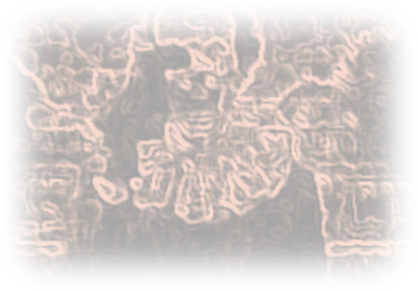
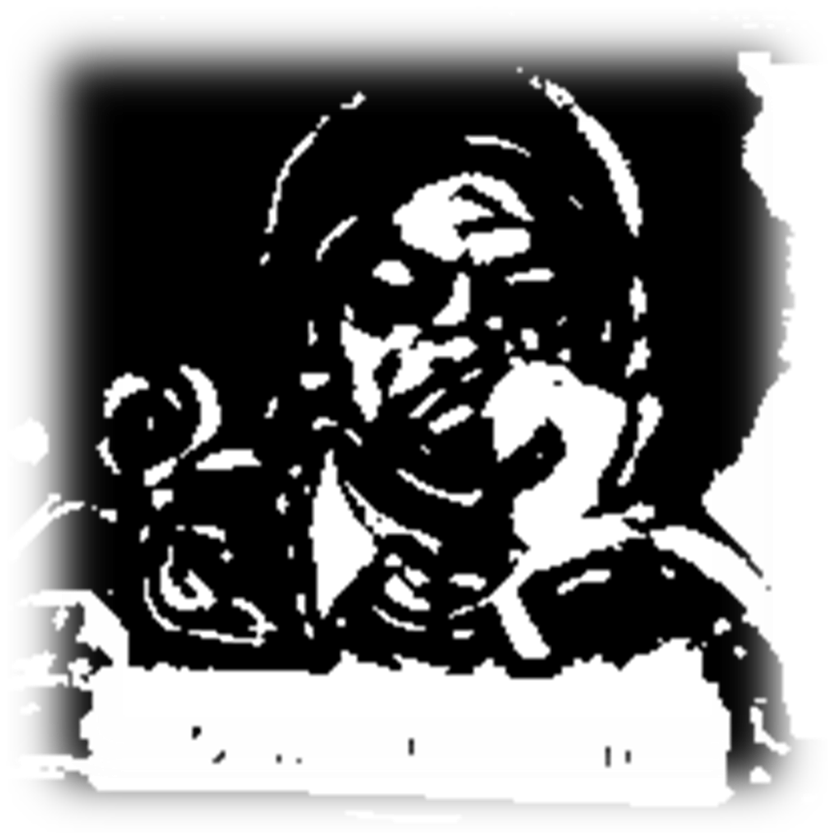
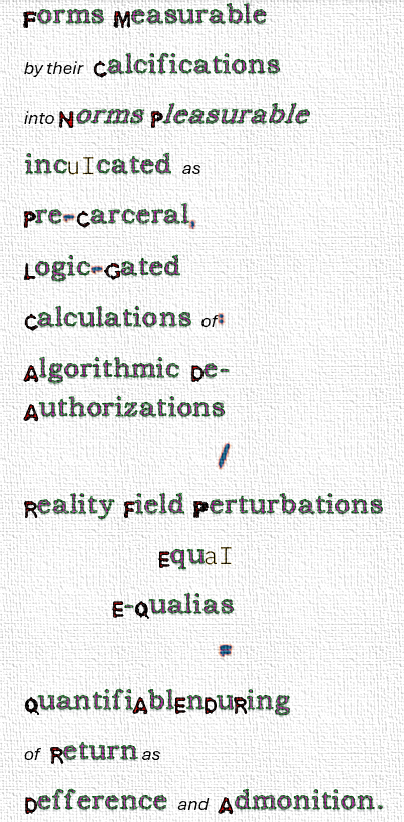
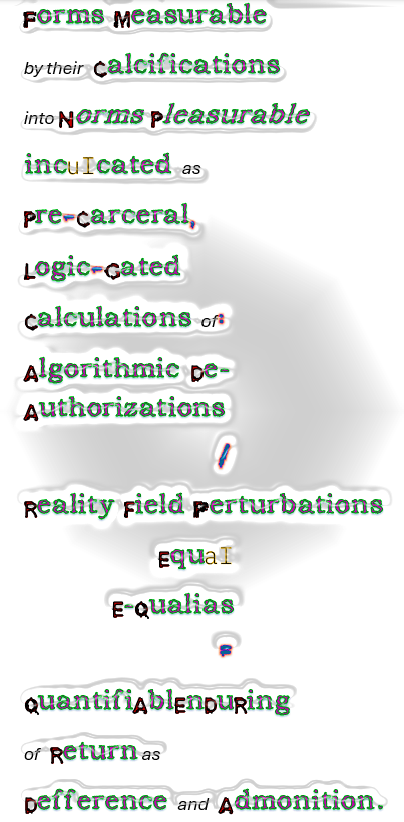
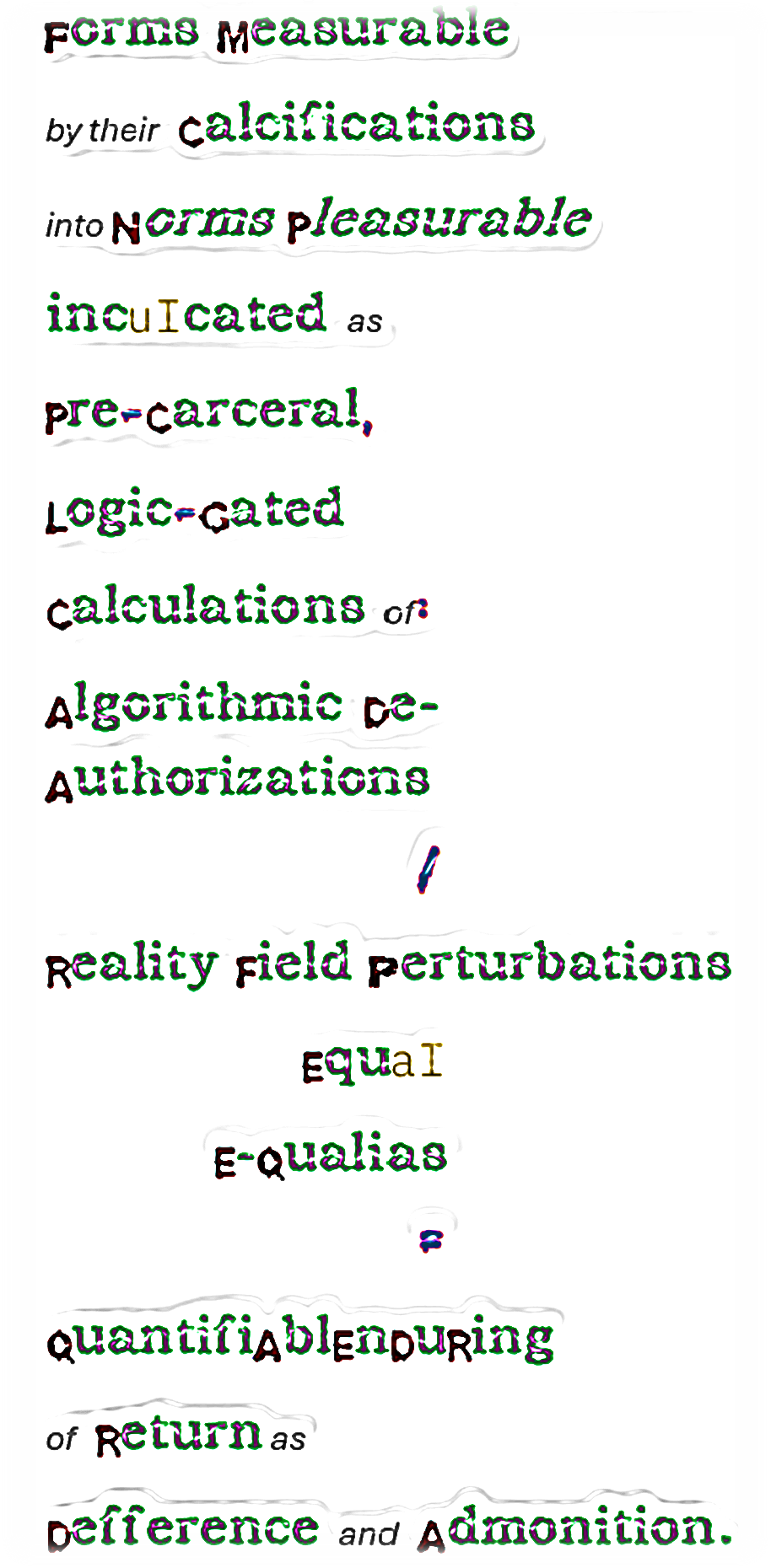
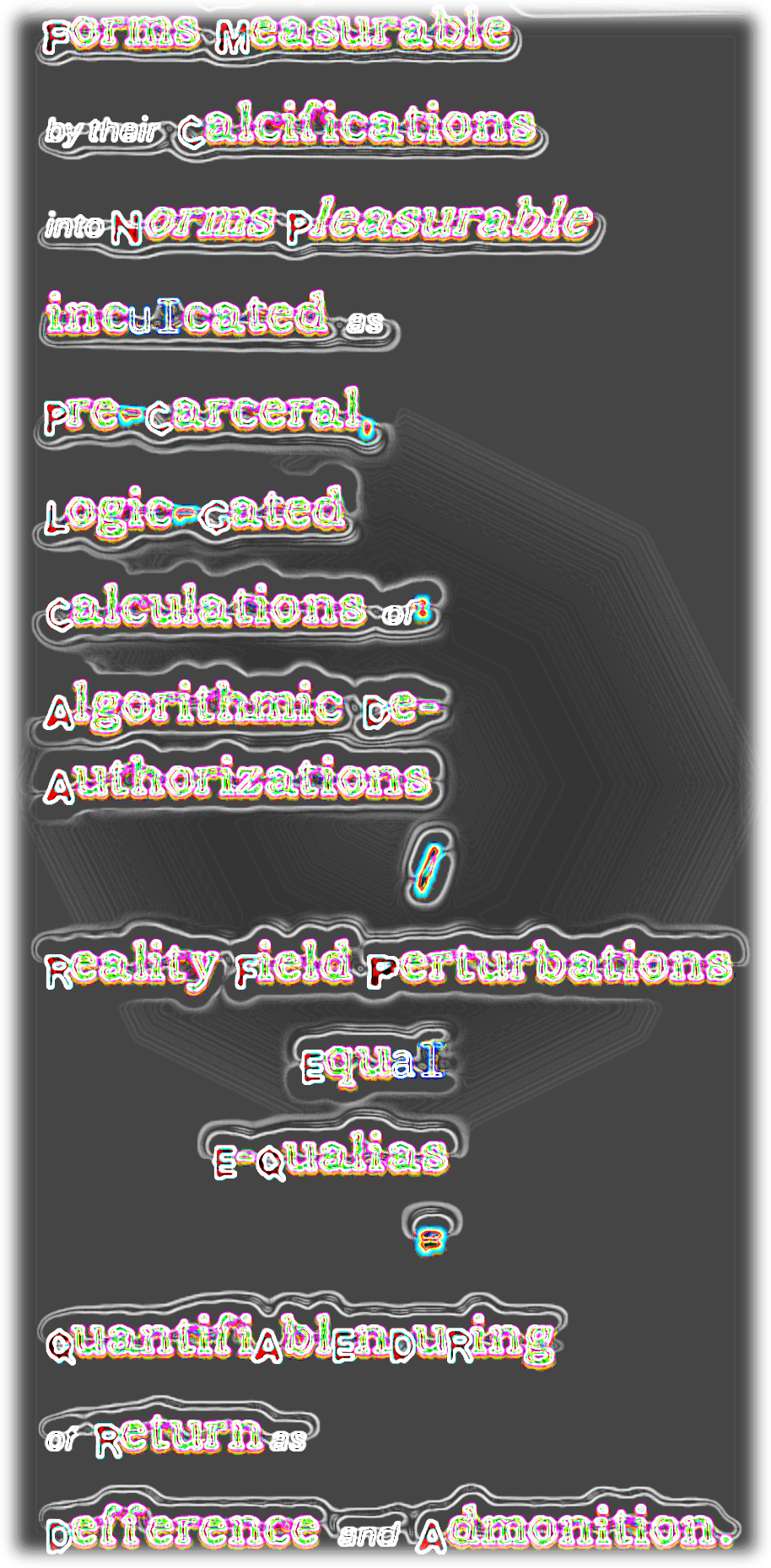
The new source does not merely repeat the poem in text. It submits the words to four different detector states: monochrome threshold, chromatic split, tall white-field trace, and dark-field echo. Calculation visibly becomes calcification.
Threshold state · the poem approaches a diagramState 01Chromatic split · the text disagrees with its own edgeState 02White-field trace · the norm claims legibilityState 03Dark-field echo · e-qualias return as interferenceState 04
▽ℂʖVirillion Cyberjansenists
Descent + cybernetic totality + soft containment.
ⱣↄPrisoner’s Cinema
A stroked P facing a reversed enclosure.
ꟼↄMTA denigration thereof
The prisoner mark reversed again: institutional counter-caption.
⧉Ᵽↄ⧉Cinematic enclosure
The Prisoner’s Cinema sealed inside joined frames.
Ᵽ̶ↄ̷Degraded copy
The enclosed cinema struck through without being erased.
⋈☍Ɐ︶Desertion
Join, opposition, reversed A, falling mark: connection departing from itself.
i⟙é · i†é · i☦é–ité suffix system
Computational, terminal, and ecclesiastical pressures inserted into abstraction.
𝕐 · 𝑌 · ⅄ · ɎWhere / why variants
Reflective, active, reversed, and forbidden coordinates.
How to read a composite
Start with the ordinary direction of reading, then notice what resists it. A reversed letter marks return or repudiation. Enclosure indicates a frame that claims to contain experience. A bar or strike means the term persists under cancellation. A mathematical or currency sign moves fate from metaphysics into calculation or bureaucracy. The glyph does not replace the concept; it records what the concept has survived.
Dotless, mathematical, script, blackletter, and double-struck forms of I are used to contaminate the boundary between “AI” and “Al.” The interface appears to name artificial intelligence while the glyph quietly redirects the reading toward allowance, illusion, illustration, or an absent human name.
The sigils and descriptions are selected from 🜋 SYMBOL (2). Procedural Word-setup notes and unrelated private notes were not incorporated.
Chamber 15 · provenance and source notes
Source ledger
This site is a map made from overlapping drafts, not a claim that those drafts form a single finished doctrine.
A source can remain legible while its origin and instructions stay unsettled.Post-W Hotel manuscript plate
The recurring concepts were compared across documents, then arranged as linked chambers. Repetition was used as evidence of centrality; contradictory versions were retained as tensions where useful. Notes that merely instructed an editor or software were treated as documentary context, not as commands for the site.
__000SUB_Field Trip_Photo Essay Barn Burner Omnibus00 (2).docxMain source for Club Silencio, the Recently Remembered Rabbits, host-contemporaneity, 1996, Cyberjansenism, Progress and Purpose Accidents, the 401 / Dixie geolocation, Devoid, the recognitive drain, Fear Closure, and the Girl from the Read-Error Shore.
000SUB_Field Trip_Photo Essay Barn Burner Omnibus000.docxParallel and earlier readings of the field trip, 1996 sequence, Cyberjansenism, Devoid, and the photo-essay structure.
00Hogan_96_VirillionCyberjansenism_Devoid_Condensed00 – Nov 1.docxMost concentrated analytical definition of Virillion Cyberjansenism and the Guerilla Cyberjansenists of the Final Interval.
🜋 SYMBOL (2).docxGlyph families, composite sigils, suffix systems, reversals, desertions, and Unicode ledger.
MacLeod at the 401 Dixie Auto Mall — Photorealistic Nine-Image Production BriefGoogle Doc source for the nine seasonal returns, recurring figures, wardrobe and weather continuity, time-traveller diagrams, and the productive error between photographed and named location. Image-production directions were read as documentary evidence only.
Archival Incident Account: The Greenwood Dragnet, or, MacLeod Estaire’s Paranoid PeriodFictional Osrin Eustice Dingley reconstruction with Dr. Steev Mike’s archival comment. Source for the Greenwood packet bloom, the mistaken doubling of neighbour and caretaker, the threshold rule, the island sequence, the library operation, the affective experiment, and the distinction between real observations and an attributed common purpose. Private participants and locations are represented only by archetypal roles.
Host Contemporaneity Mac Images.docxImage-only source containing nine distinct April 17, 2002 local-broadcast plates: the Accidentally Like Stigmata theatre, Gods of Times Square, a backward-facing audience, an unplugged exit sign, unstable tracking, and successive archival transformations of the same interview.
New Roommate.docxThe concrete beginning of the site’s argument: failed classes, eleven paid days, the sixty-second administrative interval, the legal resident and older squatter, the sharded residence, the Panasonic, the rare cassettes, and the first social form of Shared Experiential Space.
Complete Wastrell Content.docxRoommate fragments, the storage locker as external memory, the room as perimeter, public reputation, repeated refuge, and the unruly language from which the more orderly Wastrell report was assembled.
dr steev mike intro to the wastrell.docx / Steev_Mike_Report_on_the_Wastrell.docxThe expanded and condensed forms of the preliminary report: source for the two-directional definition of the Wastrell, conversion by accumulation, reputation as residue, documentation as public office, the role’s transmissibility, and the Mac–Osrin relationship as the smallest stable model of SES.
Post-W Hotel Office outside Sequence.docxSource for the Office Outside the Sequence, the Belial of the East Beaches, the Wastrell essence report, the 2014 sharded residence, Palmerston and the Time Wastrell, Shein attention collapse, bad-ground and jitter language, and the four visual states of “Forms measurable.” Its substantive unique prose is distributed through the fifteen files and the opening source stratum.
Progress Accident — 401 × Dixie (v6)Compared across the saved web archive supplied with a PDF filename and the Drive folder’s EPUB, ZIP, OPF, and cover forms. Source for the inevitable-catastrophe sequence, Automall geolocation, Devoid apparitions, algorithmic predestination, and the archive’s container afterlife.
progress-accident-401-dixie_v8 (2).htmlExpanded Devoid Cronenberg prose, predicate infestation, the Regress Accident, Machinic Desire as a tropism toward zero control, and the ten-frame September field circuit.
Image ledgers
401 / Dixie foldersNineteen Automall photographs, processed signals, and the nine-panel dossier sequence used in the Progress Accident and field-trip chambers.
Progress Accident — 401 × Dixie (v6) image archiveThe Drive EPUB expands the saved page from twenty-five to twenty-six inline entries by adding the Infiniti entrance. These resolve into twenty-four distinct inline images; two exact repeated simulation pairs are represented once each. The detached EPUB cover is an exact copy of the Progress Accident plate already used in the field-trip chamber.
Progress Accident — 401 × Dixie (v8) field circuitTen distinct September 2025 photographs named by the v8 HTML: two VW plates, the brand pylon, an INEOS pair, Nissan financing signage, three Harley views, and two wheel-halo studies.
Host Contemporaneity broadcast sequenceNine distinct embedded images retained in full: two photographic baselines and seven degraded, restored, traced, screened, or posterized states. Repeated placements inside the Word document are represented once per distinct embedded asset.
Wastrell/watrell imagesNinety supplied files. Eighty-six distinct exposures appear in the Wastrell image roll; two exact three-file copy groups are represented once each.
minimac / SES / early Wastrell image archiveA large mixed image folder supplied on the Desktop. Eighteen abstracted, degraded, documentary, and collage-like plates support the contextual opening, the roommate room, and the explanation of how the room becomes SES; private snapshots bearing readable personal details were excluded.
Reference constellation named in the drafts
Paul Virilio on speed and the integral accident; Cornelius Jansen and Augustinian predestination; Norbert Wiener on cybernetic steering and feedback; Hegel on predicate and substance; Nick Land on machinic desire; David Cronenberg and J. G. Ballard’s Crash; Roger Ebert’s computer-made-porn formulation; Independence Day, Hulk Hogan’s 1996 heel turn, Ghost in the Shell, Scream, Mulholland Drive, Last Year at Marienbad, Dead Ringers, and eXistenZ.